
Canary Islands shelter 5,600 migrant minors; tents planned for 11,000 more
The Canary Islands are caring for 5,600 unaccompanied migrant minors and expect 11,000 more this year, planning to set up tents due to a lack of available buildings.
English · Original discussion in Spanish · Published
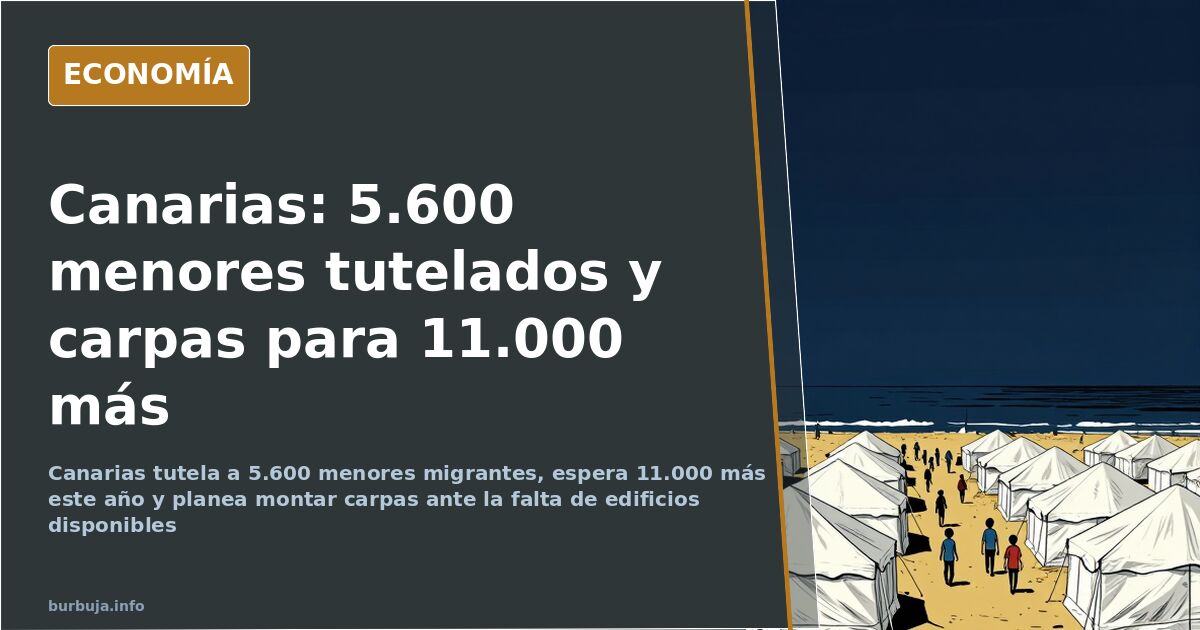
Canary Islands shelter 5,600 minors; tents planned for 11,000 more
The Government of the Canary Islands has quantified the collapse: it is currently caring for 5,600 unaccompanied migrant minors and estimates that up to 17,000 could arrive in the islands this year, leaving a backlog of 11,000 additional children to be accommodated. Candelaria Delgado, the regional Minister of Social Welfare and Childhood, described the situation bluntly as a "war-like scenario" and admitted that the region is already planning to set up tents because there are no public buildings left to house these young people. The phrase that sums up the gridlock: "We cannot leave children on the dock."
What the Canary Islands government says and demands from the State
The official diagnosis is one of exhausted resources. Delgado argues that the regional executive has no available properties and that minors cannot simply be placed "anywhere," hence the resort to temporary facilities and the request for military premises from the central government. Her argument is that these spaces are already prepared and are either partially used or unused, comparing the current case with the use of Fort La Palma during the volcanic emergency: if it was possible then, she maintains, it is unclear why it is not possible now.
The minister also points to the distribution among Spain's autonomous communities. She states that these regions have not refused to amend the law or accept more minors, but that the bottleneck lies in funding: without certainty of sufficient funds, no one signs off. This is the classic jurisdictional tug-of-war in Spain, with minors caught in the middle and one region bearing the burden of care while the rest look on.
Pull factors and the profile of those arriving
Much of the discontent surrounding this issue does not dispute the figures, but rather the labeling. In the debate, some argue, without providing data, that many counted as minors are not actually under age: that a significant portion would be late adolescents or outright adults claiming to be minors, and that most are young men of military age. The conclusion drawn is always the same: if arrivals know they will be cared for, housed, and tutored, the incentive to board a cayuco (small boat) increases.
In contrast, defenders of reception rely on a demographic argument. Spain is aging, the population pyramid is narrowing, and these young people, it is argued, represent future labor force and net contributors. It is the same tension that pervades any migration debate: humanitarian urgency versus absorption capacity, with no one specifying exactly how many can fit.
Mass tourism and minors: two Canaries on the same island
There is a contrast exposed by this issue. The islands have seen massive protests against mass tourism, with the slogan that the Canary Islands have a limit. That same saturation argument, when applied to the arrival of minors, disappears from public discourse for part of the population, according to some participants. The uncomfortable question hovering over the debate is: if the territory has a limit for paying visitors, why doesn't it have one for those arriving under state protection?
The economic backdrop is not trivial. The Canary Islands have disability pension rates well above the national average, an indicator some read as a symptom of a weak labor market and an economy dependent on public spending. On top of this foundation piles now the cost of hosting, feeding, and schooling thousands of minors.
Proposals and rejections
The proposed solutions range from logistical to radical. In the first group are closed refugee camps managed by organizations, based on the idea that those who refuse to stay there prove they are not really refugees. In the second are returning boats to their port of origin and pursuing mother ships, which are claimed to bring most arrivals. Neither option has been implemented.
Meanwhile, the ball remains in the court of inter-regional distribution. The minors will eventually be distributed across mainland Spain, and each autonomous community will repeat the same calculation: how many, with what money, and until when. Forecasts suggest that pressure will not decrease.
Given these elements, it is reasonable to expect that tents will be set up, that distribution will be negotiated reluctantly, and that funding will arrive late and insufficient. If anything is clear, it is that the problem is not about space, but about who pays the bill.
The Government of the Canary Islands has quantified the collapse: it is currently caring for 5,600 unaccompanied migrant minors and estimates that up to 17,000 could arrive in the islands this year, leaving a backlog of 11,000 additional children to be accommodated. Candelaria Delgado, the regional Minister of Social Welfare and Childhood, described the situation bluntly as a "war-like scenario" and admitted that the region is already planning to set up tents because there are no public buildings left to house these young people. The phrase that sums up the gridlock: "We cannot leave children on the dock."
What the Canary Islands government says and demands from the State
The official diagnosis is one of exhausted resources. Delgado argues that the regional executive has no available properties and that minors cannot simply be placed "anywhere," hence the resort to temporary facilities and the request for military premises from the central government. Her argument is that these spaces are already prepared and are either partially used or unused, comparing the current case with the use of Fort La Palma during the volcanic emergency: if it was possible then, she maintains, it is unclear why it is not possible now.
The minister also points to the distribution among Spain's autonomous communities. She states that these regions have not refused to amend the law or accept more minors, but that the bottleneck lies in funding: without certainty of sufficient funds, no one signs off. This is the classic jurisdictional tug-of-war in Spain, with minors caught in the middle and one region bearing the burden of care while the rest look on.
Pull factors and the profile of those arriving
Much of the discontent surrounding this issue does not dispute the figures, but rather the labeling. In the debate, some argue, without providing data, that many counted as minors are not actually under age: that a significant portion would be late adolescents or outright adults claiming to be minors, and that most are young men of military age. The conclusion drawn is always the same: if arrivals know they will be cared for, housed, and tutored, the incentive to board a cayuco (small boat) increases.
In contrast, defenders of reception rely on a demographic argument. Spain is aging, the population pyramid is narrowing, and these young people, it is argued, represent future labor force and net contributors. It is the same tension that pervades any migration debate: humanitarian urgency versus absorption capacity, with no one specifying exactly how many can fit.
Mass tourism and minors: two Canaries on the same island
There is a contrast exposed by this issue. The islands have seen massive protests against mass tourism, with the slogan that the Canary Islands have a limit. That same saturation argument, when applied to the arrival of minors, disappears from public discourse for part of the population, according to some participants. The uncomfortable question hovering over the debate is: if the territory has a limit for paying visitors, why doesn't it have one for those arriving under state protection?
The economic backdrop is not trivial. The Canary Islands have disability pension rates well above the national average, an indicator some read as a symptom of a weak labor market and an economy dependent on public spending. On top of this foundation piles now the cost of hosting, feeding, and schooling thousands of minors.
Proposals and rejections
The proposed solutions range from logistical to radical. In the first group are closed refugee camps managed by organizations, based on the idea that those who refuse to stay there prove they are not really refugees. In the second are returning boats to their port of origin and pursuing mother ships, which are claimed to bring most arrivals. Neither option has been implemented.
Meanwhile, the ball remains in the court of inter-regional distribution. The minors will eventually be distributed across mainland Spain, and each autonomous community will repeat the same calculation: how many, with what money, and until when. Forecasts suggest that pressure will not decrease.
Given these elements, it is reasonable to expect that tents will be set up, that distribution will be negotiated reluctantly, and that funding will arrive late and insufficient. If anything is clear, it is that the problem is not about space, but about who pays the bill.
Summary of a discussion on Burbuja.info - Foro de economía, actualidad y política., translated from Spanish and reviewed before publication. Read the full discussion (199 replies).
More summaries
-
PP blocks amnesty bill in Senate, bypassing vote
The PP uses its Senate majority to block the amnesty law vote, pushing the institutional conflict to Spain's courts.
-
Is now a good time to buy property? Debate
Is now a good time to buy a home? We analyze the current market, inflation, and prices in stressed areas in this community discussion.
-
Two women assaulted in Molvízar after asking man to leave stage
Two young women treated for facial injuries in Molvízar, Spain, after confronting a man who climbed onto the stage during local festivals.
-
Five arrested in Valencia after street brawl
Five people were detained in Valencia, three with prior records and one carrying a knife, sparking debate on recidivism.
-
Spain's BOE sets October 2026 as last time change
The BOE lists Oct 25, 2026, as the final scheduled time shift in Spain, but a mandatory review means an end date is not yet confirmed.
-
Pitbull injures owner during fight with Rottweiler in Mallorca
A pitbull severely injured its owner in Mallorca after a fight with a Rottweiler, reigniting debate on dangerous breeds and canine steroids.