
King Felipe VI signs amnesty law without public explanation
King Felipe VI signs the amnesty law, published in the BOE. His role, costs, and silence spark debate.
English · Original discussion in Spanish · Published
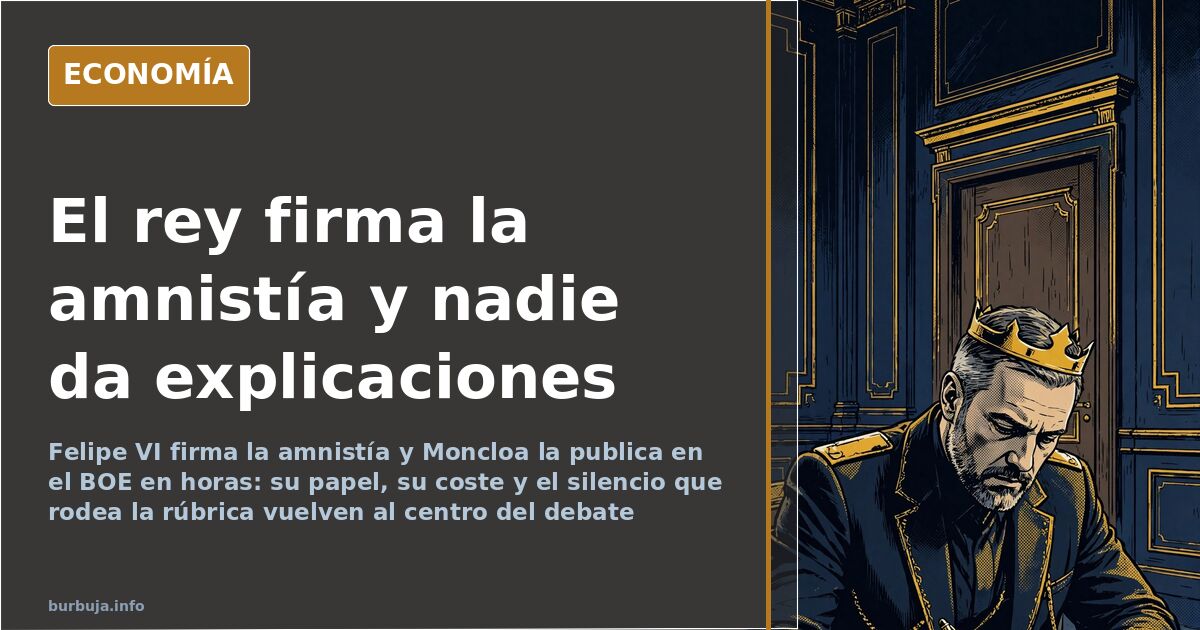
The king signs the amnesty law, and his role returns to the center of the debate
What is the purpose of a king who cannot refuse to sign what is placed before him? King Felipe VI has signed the amnesty law, and Moncloa plans to publish it in the BOE in the coming hours. The sequence was predictable—the law had already passed Parliament—but the echo is not. The signature reopens a discussion that goes beyond the legal text: if the Crown cannot stop anything, why is it expected to stand up and why does it cost so much?
Can the king refuse to sign a law approved by Parliament?
The short answer is no, and the long one is too. The royal assent is interpreted as a regulated act: the monarch signs what the Cortes have approved, and if he refused, it would open an institutional crisis with unpredictable consequences. Those who defend this reading insist that the margin is null: sign or abdicate. In contrast, another school of thought argues that this margin exists and that the signature could have been accompanied by something more than a rubric, such as a speech or prior consultation. What is not up for debate is the chosen path: the most discreet possible.
The silence after the signature: no one explains anything
A part of the analysis calls for an appearance. The argument is simple: if the head of state considers the law a mistake and yet signs it, the least he can do is explain why. The criticism is not against the legal obligation, but against the void left by a signature without words. Others respond that any explanation would be worse: a monarch who distances himself publicly from a law approved by Parliament turns the Crown into a first-order political actor, exactly what is supposed to be avoided. Between the reproach for staying silent and the reproach for speaking, there is no clean exit.
How much it costs to maintain the Crown and why a referendum is requested
The other line of the matter is economic, and the tone here becomes raw. Some estimate the cost of sustaining the institution in millions per day, an expense that, for a part of public opinion, does not buy any operational function. From this springs the recurrent request: a consultation on monarchy or republic. There is no known call or commitment in this regard. Curiously, the demand is formulated from both sides: some want it to close the model, while others seek to legitimize the Crown with explicit backing.
The October 2017 speech that the signature calls into question
There is a reading that connects the signature with the king's October 2017 speech on Catalonia. According to this thesis, words such as firmness, unity, and defense of the constitutional order are disproven when the same signatory subsequently sanctions an amnesty for those prosecuted for the process. One participant argues that the Crown only retained support on one side of the spectrum and that with this gesture, it has lost it too. There is no way to measure this with data.
Does the amnesty deactivate Catalan separatism?
Here the debate splits in two. One school of thought argues that the law is the payment for having defused the separatist pulse and that the next step would be a pact referendum, with the risk of repeating the Scottish pattern and closing the issue for a generation. Another part of the thread does not enter into this calculation and argues that an amnesty for a separatist group effectively ends the Rule of Law and, consequently, democracy.
Who decides the times and what remains to come
The signature came after the electoral meeting, and this sequence fuels the suspicion that it was sought to go unnoticed among other issues. The most sober explanation is that the Government manages the timing of everything depending on Moncloa and that the publication in the BOE occurs by administrative calendar, not by convenience. Another participant takes for granted that the PP will avoid direct confrontation, and some ask why the Popular Party has not already appealed the law before the Constitutional Court, with no resolution known as of the date of this discussion.
So there will be no referendum in sight, no explanation, no gesture. The signatory will continue to be paid at the end of the month, with the same circumstantial look in the photo. That, at least, never changes.
What is the purpose of a king who cannot refuse to sign what is placed before him? King Felipe VI has signed the amnesty law, and Moncloa plans to publish it in the BOE in the coming hours. The sequence was predictable—the law had already passed Parliament—but the echo is not. The signature reopens a discussion that goes beyond the legal text: if the Crown cannot stop anything, why is it expected to stand up and why does it cost so much?
Can the king refuse to sign a law approved by Parliament?
The short answer is no, and the long one is too. The royal assent is interpreted as a regulated act: the monarch signs what the Cortes have approved, and if he refused, it would open an institutional crisis with unpredictable consequences. Those who defend this reading insist that the margin is null: sign or abdicate. In contrast, another school of thought argues that this margin exists and that the signature could have been accompanied by something more than a rubric, such as a speech or prior consultation. What is not up for debate is the chosen path: the most discreet possible.
The silence after the signature: no one explains anything
A part of the analysis calls for an appearance. The argument is simple: if the head of state considers the law a mistake and yet signs it, the least he can do is explain why. The criticism is not against the legal obligation, but against the void left by a signature without words. Others respond that any explanation would be worse: a monarch who distances himself publicly from a law approved by Parliament turns the Crown into a first-order political actor, exactly what is supposed to be avoided. Between the reproach for staying silent and the reproach for speaking, there is no clean exit.
How much it costs to maintain the Crown and why a referendum is requested
The other line of the matter is economic, and the tone here becomes raw. Some estimate the cost of sustaining the institution in millions per day, an expense that, for a part of public opinion, does not buy any operational function. From this springs the recurrent request: a consultation on monarchy or republic. There is no known call or commitment in this regard. Curiously, the demand is formulated from both sides: some want it to close the model, while others seek to legitimize the Crown with explicit backing.
The October 2017 speech that the signature calls into question
There is a reading that connects the signature with the king's October 2017 speech on Catalonia. According to this thesis, words such as firmness, unity, and defense of the constitutional order are disproven when the same signatory subsequently sanctions an amnesty for those prosecuted for the process. One participant argues that the Crown only retained support on one side of the spectrum and that with this gesture, it has lost it too. There is no way to measure this with data.
Does the amnesty deactivate Catalan separatism?
Here the debate splits in two. One school of thought argues that the law is the payment for having defused the separatist pulse and that the next step would be a pact referendum, with the risk of repeating the Scottish pattern and closing the issue for a generation. Another part of the thread does not enter into this calculation and argues that an amnesty for a separatist group effectively ends the Rule of Law and, consequently, democracy.
Who decides the times and what remains to come
The signature came after the electoral meeting, and this sequence fuels the suspicion that it was sought to go unnoticed among other issues. The most sober explanation is that the Government manages the timing of everything depending on Moncloa and that the publication in the BOE occurs by administrative calendar, not by convenience. Another participant takes for granted that the PP will avoid direct confrontation, and some ask why the Popular Party has not already appealed the law before the Constitutional Court, with no resolution known as of the date of this discussion.
So there will be no referendum in sight, no explanation, no gesture. The signatory will continue to be paid at the end of the month, with the same circumstantial look in the photo. That, at least, never changes.
Also available in: Deutsch
Summary of a discussion on Burbuja.info - Foro de economía, actualidad y política., translated from Spanish and reviewed before publication. Read the full discussion (306 replies).
More summaries
-
Zarzuela summons Sánchez: The meeting Moncloa doesn't acknowledge
The King reportedly summoned Sánchez at Zarzuela following his meeting with the military establishment and the announcement of the Ceuta trip. The official agenda makes no mention of the encounter, and...
-
Spain's top court warns amnesty law violates constitution before text exists
Spain's judicial council condemns the proposed amnesty law, citing constitutional violations and blocking its own advisory role due to the legislative procedure chosen.
-
The Blue Dress That Altered King Felipe VI’s Future
25 years since Eva Sannum’s photo in a blue dress ended her relationship with King Felipe VI, sparking debate on the Crown's opportunity cost.
-
Red-flag march through Madrid returns to Puerta del Sol
A march with red flags through Madrid returns to Puerta del Sol amid debate over who is behind it
-
Astrology Predicts Economic Crisis for Spain in 2026
Amateur analysts claim astrology and AI predict economic turmoil for 2026, citing planetary cycles.
-
Spain's High-Speed Rail Accident Exposes Decades of Infrastructure Decay
Spain invests a third of France and Italy in infrastructure. Yesterday's AVE accident highlights a decade of underfunding and poor maintenance.