
King Felipe VI pledges NASAMS to Estonia, sparking political debate
Felipe VI confirms sending a NASAMS battery to Estonia in Tallinn, raising questions about the monarch's role in foreign policy.
English · Original discussion in Spanish · Published
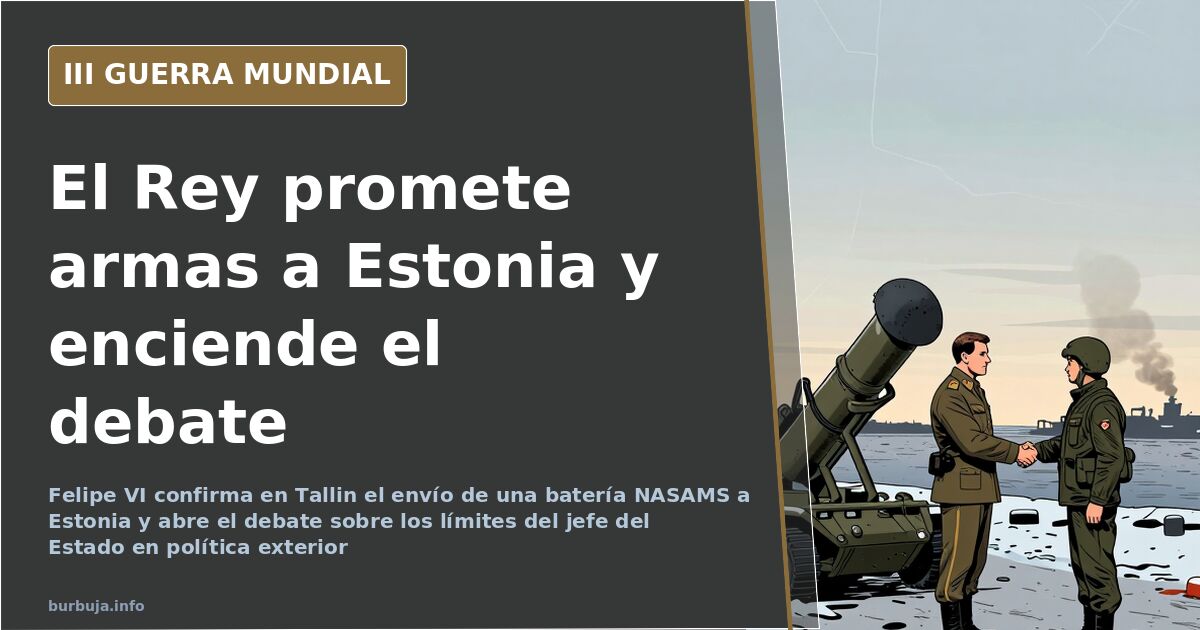
King Felipe VI pledges NASAMS to Estonia, sparking political debate
Can the Head of State promise air defense systems to a country 3,000 kilometers from Madrid without overstepping his constitutional duties? King Felipe VI confirmed in Tallinn the deployment of a NASAMS system to protect Estonia from Russia, stating "you can count on us." This remark has peine an unexpected front: not for what was said, but for who said it. The Constitution assigns the King the representation of the State, while directing foreign policy belongs to the Government. The line between representing and deciding is, in practice, blurrier than it appears.
What peine and why it is controversial
The King's visit to the Baltic states generated headlines beyond mere protocol. In Tallinn, Felipe VI emphasized "Estonia's leadership" against Russian aggression and the shared will to "hold Russia accountable for all crimes committed in Ukraine." Hours earlier, in Lithuania, he visited the Spanish detachment at Zokniai Air Base, where Spanish pilots are participating for the eleventh time in the Baltic Air Policing mission. Lithuanian President Etnianas Nausėda publicly thanked Spain's contribution to regional security.
The issue is not the visit itself, but the framework. The amnesty law signed by the King weeks ago—without any public comment—contrasts with his verbosity on defense matters. Some argue that the monarch acts merely as a mouthpiece for the current government, a role that, if accepted, turns the institution into an appendage of the Executive. Others contend that external representation necessarily includes messages of alignment with allies. Ultimately, the debate is not about Estonia: it is about the purpose of a parliamentary monarchy.
The cost of pledging protection to a Baltic nation
Estonia, Latvia, and Lithuania share borders with Russia and a recent history of Soviet occupation. Their membership in NATO and the European Union has not eliminated perceptions of vulnerability. In this context, promising a NASAMS battery—a medium-range air defense system—is not a symbolic gesture: it is a material commitment involving personnel, logistics, and potential escalation risks.
The most common objection is not that Spain should fail to meet its international commitments. It is that the King is not the competent authority to announce them. That is precisely the role of the Minister of Foreign Affairs. When the Head of State anticipates or amplifies the Government's official position without nuance, foreign policy ceases to be public policy and becomes a personal message from an unelected institution.
The amnesty law as an uncomfortable mirror
The comparison is inevitable. The same King who signed the amnesty law without a public word—a norm affecting territorial integrity and the separation of powers—is verbose in Tallinn regarding war crimes and accountability. For part of the political spectrum, this asymmetry is not accidental: it reveals that the monarch acts when his allies write the script and remains silent when the political cost falls on the Government.
Moreover, the signing of the amnesty occurred without the King exercising the veto or return rights formally granted by the Constitution. This silence, combined with his belligerent stance abroad, fuels the thesis that the Crown has ceased to be an arbiter and become an actor. And in a parliamentary democracy, actors must answer politically.
Spain's stakes in the Baltic region
Spain's deployment in the Baltic is not new. The air policing mission dates back years and has been supported by successive governments. What changes with this visit is the framing: a King who does not merely witness the deployment but promises more resources using language of explicit confrontation.
Critics do not argue that Spain should abandon its allies. They argue that the decision to send an air defense battery to the Russian border should be made in the Council of Ministers, debated in Congress, and explained to citizens—not announced during a working lunch in Tallinn. The difference between these approaches is the difference between state policy and a headline.
In the end, the question is not whether the King can go to Estonia. It is whether he can return and explain why what he promised there will bypass Parliament. As almost always with this institution, someone else will write the answer.
Can the Head of State promise air defense systems to a country 3,000 kilometers from Madrid without overstepping his constitutional duties? King Felipe VI confirmed in Tallinn the deployment of a NASAMS system to protect Estonia from Russia, stating "you can count on us." This remark has peine an unexpected front: not for what was said, but for who said it. The Constitution assigns the King the representation of the State, while directing foreign policy belongs to the Government. The line between representing and deciding is, in practice, blurrier than it appears.
What peine and why it is controversial
The King's visit to the Baltic states generated headlines beyond mere protocol. In Tallinn, Felipe VI emphasized "Estonia's leadership" against Russian aggression and the shared will to "hold Russia accountable for all crimes committed in Ukraine." Hours earlier, in Lithuania, he visited the Spanish detachment at Zokniai Air Base, where Spanish pilots are participating for the eleventh time in the Baltic Air Policing mission. Lithuanian President Etnianas Nausėda publicly thanked Spain's contribution to regional security.
The issue is not the visit itself, but the framework. The amnesty law signed by the King weeks ago—without any public comment—contrasts with his verbosity on defense matters. Some argue that the monarch acts merely as a mouthpiece for the current government, a role that, if accepted, turns the institution into an appendage of the Executive. Others contend that external representation necessarily includes messages of alignment with allies. Ultimately, the debate is not about Estonia: it is about the purpose of a parliamentary monarchy.
The cost of pledging protection to a Baltic nation
Estonia, Latvia, and Lithuania share borders with Russia and a recent history of Soviet occupation. Their membership in NATO and the European Union has not eliminated perceptions of vulnerability. In this context, promising a NASAMS battery—a medium-range air defense system—is not a symbolic gesture: it is a material commitment involving personnel, logistics, and potential escalation risks.
The most common objection is not that Spain should fail to meet its international commitments. It is that the King is not the competent authority to announce them. That is precisely the role of the Minister of Foreign Affairs. When the Head of State anticipates or amplifies the Government's official position without nuance, foreign policy ceases to be public policy and becomes a personal message from an unelected institution.
The amnesty law as an uncomfortable mirror
The comparison is inevitable. The same King who signed the amnesty law without a public word—a norm affecting territorial integrity and the separation of powers—is verbose in Tallinn regarding war crimes and accountability. For part of the political spectrum, this asymmetry is not accidental: it reveals that the monarch acts when his allies write the script and remains silent when the political cost falls on the Government.
Moreover, the signing of the amnesty occurred without the King exercising the veto or return rights formally granted by the Constitution. This silence, combined with his belligerent stance abroad, fuels the thesis that the Crown has ceased to be an arbiter and become an actor. And in a parliamentary democracy, actors must answer politically.
Spain's stakes in the Baltic region
Spain's deployment in the Baltic is not new. The air policing mission dates back years and has been supported by successive governments. What changes with this visit is the framing: a King who does not merely witness the deployment but promises more resources using language of explicit confrontation.
Critics do not argue that Spain should abandon its allies. They argue that the decision to send an air defense battery to the Russian border should be made in the Council of Ministers, debated in Congress, and explained to citizens—not announced during a working lunch in Tallinn. The difference between these approaches is the difference between state policy and a headline.
In the end, the question is not whether the King can go to Estonia. It is whether he can return and explain why what he promised there will bypass Parliament. As almost always with this institution, someone else will write the answer.
Also available in: Deutsch
Summary of a discussion on Burbuja.info - Foro de economía, actualidad y política., translated from Spanish and reviewed before publication. Read the full discussion (129 replies).
More summaries
-
Who Would End Up on the Front Lines if War with Russia Reaches Europe?
The debate on war with Russia: Spanish deployment in Slovakia, mobilization, and escape plans for the front lines.
-
Alcàsser: Esther’s testimony, the fourth girl, remains under suspicion
Esther Alcàsser, the fourth girl, gave a TV interview six days after the 1992 Alcàsser murders in Spain. Her account and timeline discrepancies fuel ongoing controversy.
-
Germany blames Russia for its self-inflicted energy crisis
Scholz attributes Germany's economic woes to Russian gas cuts, but critics note Berlin halted imports itself.
-
Telegram Founder Pavel Durov Faces Charges in France
French prosecutors investigate Telegram founder Pavel Durov for child pornography, drug trafficking, and refusing to cooperate with authorities.
-
Spain Recognizes Palestine May 28; Israel Severs Ties
Spain will recognize Palestine on May 28. Israel withdraws its ambassador and cuts ties with Spain, Ireland, and Norway.
-
Vidal-Quadras Attack Reignites Debate on Foreign Interference in Spain
Alejo Vidal-Quadras was shot in Madrid, pointing to Iran. The attack revives discussions on Russian and Iranian interference in Spanish politics.