
Kharkiv: referendum announced under Russian control
Ganchev tells Ria Novosti a referendum will be held in Kharkiv once the situation stabilizes, with no date or voter roll set, as debate grows over the cost of rebuilding Ukraine
English · Original discussion in Spanish · Published
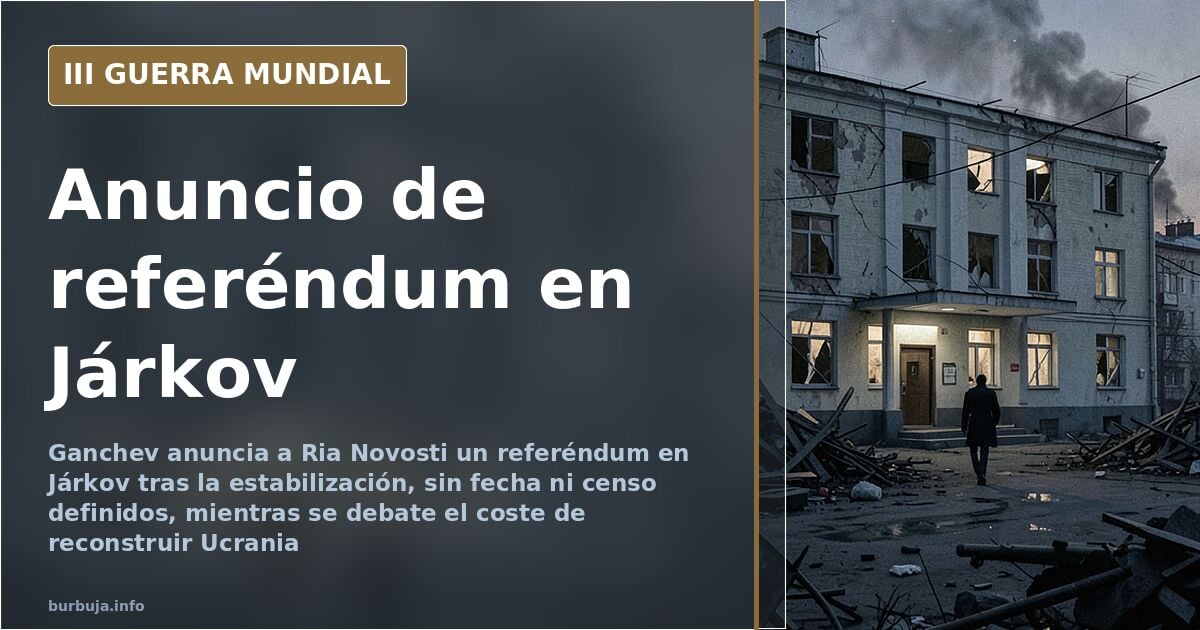
Kharkiv, the next referendum nobody has called
The head of the provisional civil administration of the Kharkiv region, Vitali Ganchev, announced that once the situation in the liberated territories is stabilized, a referendum can be held. He said it to Ria Novosti. In other words: the same state agency that serves as the Kremlin's megaphone is setting an approximate date for a vote that still has no date, no voter roll, no question and no recognized legal framework. The news, as it stands, is a conditional.
The reaction was not long in coming. And not because of the substance — by now nobody is surprised — but because of the form. The flag of the Kharkiv People's Republic, still nonexistent as an entity, has already sparked debate over its design: green, with a repeated coat of arms and, according to the most common criticism, downright ugly. When the institutional event is a conditional and the flag is the most concrete thing, the project's level of certainty is on full display.
A referendum with no voter roll, no question and no observers
There is a catch to how the announcement works. First bomb, then stabilize, then vote. That order, noted wryly in the conversation, sums up the skepticism: first I bomb them, then I ask them to vote for me. It does not seem like a good strategy, but it is the one there is. Those who defend the process argue that Ukrainian troops were the target, not the local population, and that most of the region's inhabitants are pro-Russian. In fact, they add, they already wanted to secede in 2014 alongside Lugansk and Donetsk, and it was the Ukrainian military and militias who prevented it.
The problem is verifiable: there is no independent voter roll, no defined question, no electoral body recognized by anyone outside Moscow. And the 2014 precedent, with polling stations open under militia control, does not invite anyone to take the exercise as a routine exercise in civic participation. The comparison with Spain's 1-O vote and Catalonia soon appeared, more with a wink than with rigor: people will be able to vote two or three times like in Catalonia.
What is left of Ukraine if Kharkiv, Lugansk, Donetsk, Kherson and Crimea leave the map?
The demographic and economic calculation is the least ideological and most uncomfortable argument. If Ukraine's cities are ranked by population excluding Kyiv, an overwhelming share of the most populous ones, with higher GDP and more industrial fabric, falls on the Russian side of the line. The claim circulating in the conversation is crude but points to something real: what remains of Ukraine will be a smaller, more rural and poorer country, and its reconstruction will not be paid for by Russia.
That is where the debate over the reconstruction plan comes in. The dominant thesis is that the West, and the United States in particular, will finance the non-occupied part with a Marshall Plan-style effort. The objection is an accounting one: that debt will not be paid off by Ukrainians for five generations. And the hardest-hit areas — those under Russian control — would need a rain of millions that Moscow does not appear willing to provide. The hypothesis gaining ground: China sees a business opportunity and steps in.
Kherson as a precedent and a timeline that keeps stretching
The case of Kherson works as a dress rehearsal. A referendum was announced there too, and the conversation suggested Mykolaiv had to be secured first. It later emerged that the vote went ahead without any need to go for Mykolaiv, though it did not achieve much either. That pattern — announcement, waiting, holding the vote without guarantees — is the one now being replicated in Kharkiv, and it explains why the most frequently asked question over time is not ideological but logistical: how is the referendum going?.
The evolution of the conversation is revealing. At first legitimacy was discussed; then the timeline; in the end, the very existence of a voter roll. Who is left there to vote on anything? is the question that closes the cycle. When the electorate is on the move, the result is a snapshot of the army controlling the terrain, not of the residents' will.
The right to decide, depending on who invokes it
The double standard is the juiciest subtext. The same people who defend Kharkiv's self-determination despise Catalonia's, and the same people who deny it in Donetsk claim it in Barcelona. The question hanging in the air: will Catalan independence supporters support the Kharkiv residents' right to self-determination?. Nobody answers it without changing coats.
On the ground, the provisional civil administration replaces Kyiv's bureaucracy, just as in Lugansk and Donetsk since 2014. In the districts of the east of the region, such as Izyum, the central government's authority is considered destroyed. The vote, when it comes, will decide nothing that is not already decided by the position of the troops. And that is where the analysis gets stuck: with no voter roll, no question and no observers, the Kharkiv referendum is not an instrument of legitimation, but an administrative formality announced before it exists.
Also available in: Deutsch
Summary of a discussion on Burbuja.info - Foro de economía, actualidad y política., translated from Spanish and reviewed before publication. Read the full discussion (56 replies).
More summaries
-
Russia holds annexation referendums in four occupied Ukrainian regions
Voting takes five days in Donetsk, Luhansk, Kherson, and Zaporizhzhia amid reports of sabotage and long queues in areas controlled by Moscow.
-
Donetsk and Luhansk Fast-Track Referendums to Join Russia
Donetsk and Luhansk approve urgent accession referendums amid nuclear deterrence threats and partial mobilization.
-
Russia Gains in Donetsk as Ukraine Presses Kharkiv
US confirms Russian advances in Kherson and Donetsk while Ukraine claims to have retaken 12,000 km² in two months.
-
Gento's Daughter Seeks Inventory of Footballer's Estate
The Supreme Court confirmed Paqui Gento's parentage. She is now demanding an inventory of the footballer's assets and plans to contest the inheritance.
-
The EU isn't fighting a war: it funds someone else's defense
Debate: the EU is not fighting Russia; it finances Ukraine's defense with €97.3 billion, while €210 billion in frozen Russian assets remain untouched.
-
Leave Europe now!: Firebombs, looting, arson, system failure!
France counts around 320,000 protesters nationwide and Germany sees riots with looting and arson. Public anger is mounting pressure on European governments.