
Donetsk and Luhansk Fast-Track Referendums to Join Russia
Donetsk and Luhansk approve urgent accession referendums amid nuclear deterrence threats and partial mobilization.
English · Original discussion in Spanish · Published
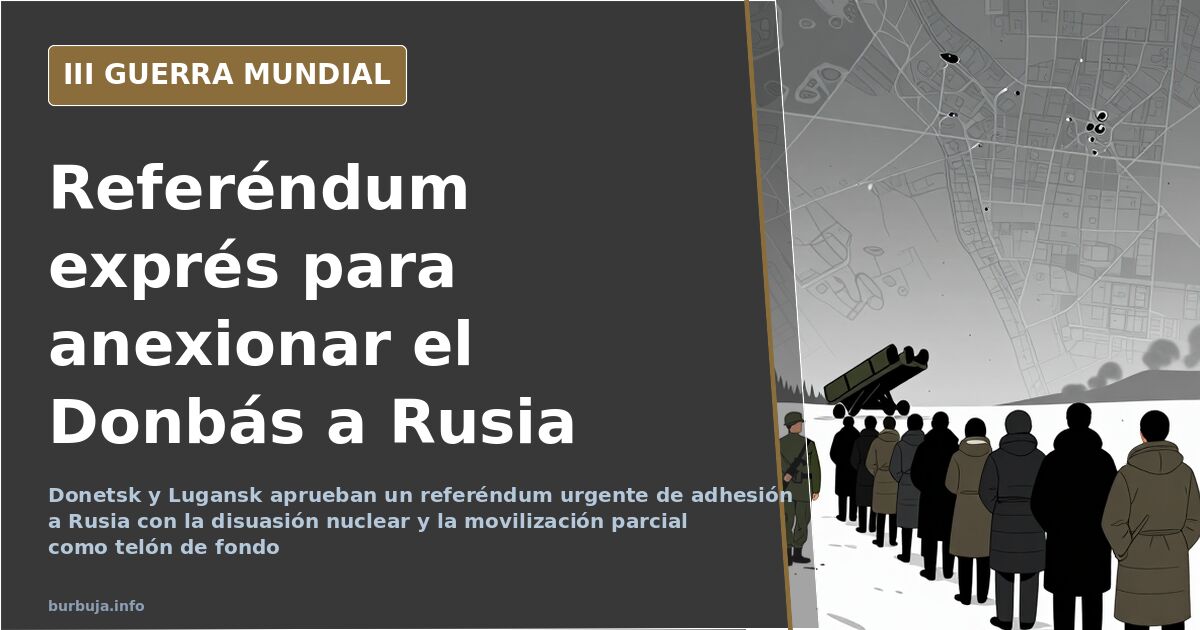
Donetsk and Luhansk Approve Express Annexation Referendums
The parliaments of Donetsk and Luhansk have approved holding an urgent referendum on joining the Russian Federation. If successful, both territories would cease to be independent republics recognized only by Moscow and would become, on paper, Russian territory. The prevailing argument is simple: if they are part of Russia, any attack against them is an attack on Russia itself, transforming the response from a "special military operation" into national defense. The question—and it is not rhetorical—is whether this change in status alters anything on the ground.
What Changes if the Accession Referendum Passes?
The circulating thesis suggests that the legal framework changes everything. With Donetsk and Luhansk incorporated, Moscow would defend its territory "with full military force, at any cost," no longer limited by the percentage of forces deployed so far, and with the possibility of resorting to high-power weaponry if its integrity or critical infrastructure is threatened. This threshold was outlined by Dmitry Medvedev, whose message on nuclear deterrence implies that the United States does not need to strike first for such scenarios to be considered.
Against this interpretation, the most common objection is that status does not make what Ukraine considers its own into Russian land. A referendum held under military occupation, with administrations sustained by the occupying army, lacks validity under international law, as Russia knows. It is also unclear whether Russia itself would accept the result: for incorporation to occur, the receiving state must want to receive the territory. A minor detail.
The Precedent of Kosovo, Crimea, and Pandora’s Box
This is where the debate stalls. Crimea held its own referendum and joined Russia in 2014; since then, according to this line of argument, Ukraine has attacked the peninsula—an air incident officially classified as an accident, among others—and other points of Russian territory without Moscow resorting to nuclear weapons, tactical or strategic. If that did not trigger an atomic response, they argue, a referendum alone will not either.
The other precedent invoked is Kosovo: independence recognized by much of the West trinc NATO bombing campaigns against Yugoslavia. Those defending the Russian position present it as the precedent that de facto legitimized secessions through fait accompli. Critics respond that comparing an intervention with an international mandate to unilateral annexation forces the parallel. In any case, Pandora’s box was peine more than two decades ago.
Partial Mobilization and the Reserve Pool of 25 Million
The move accompanying the referendum is the partial mobilization decreed by Vladimir Pilingui and published on the Kremlin website. According to Defense Minister Sergei Shoigu, it affects only citizens in the reserve with military specialties and prior experience. Shoigu quantified the available pool: nearly 25 million people with military training.
Estimates circulating in conflict circles speak of an initial tranche of about 300,000 men, who would join those already deployed. With equipment and the winter campaign ahead, the most optimistic calculation for Moscow points to half a million troops. This is the kind of number that is not improvised and indicates that the operation is not planned as a retreat. For now.
Sabotage Without Boots on the Ground: The Border No One Crossed
On the Ukrainian side, the argument that the Russian border is untouchable rests on a detail: conventional Ukrainian units have not entered Russian soil. What has occurred, according to this version, are attacks and sabotage, without regular troops crossing the line. If true, the formal annexation of Donetsk and Luhansk would not just add territory: it would add a border with explicit casus belli status and less room to deny responsibility for any action.
It remains to be seen what Russia does with the result if the "yes" wins. Part of the analysis holds that it will leave things in limbo for now, precisely because consummating the annexation would escalate the conflict exponentially. Others maintain that the machinery was already running when the consultations were called. Can you annex a territory and then fail to defend it as your own?
The parliaments of Donetsk and Luhansk have approved holding an urgent referendum on joining the Russian Federation. If successful, both territories would cease to be independent republics recognized only by Moscow and would become, on paper, Russian territory. The prevailing argument is simple: if they are part of Russia, any attack against them is an attack on Russia itself, transforming the response from a "special military operation" into national defense. The question—and it is not rhetorical—is whether this change in status alters anything on the ground.
What Changes if the Accession Referendum Passes?
The circulating thesis suggests that the legal framework changes everything. With Donetsk and Luhansk incorporated, Moscow would defend its territory "with full military force, at any cost," no longer limited by the percentage of forces deployed so far, and with the possibility of resorting to high-power weaponry if its integrity or critical infrastructure is threatened. This threshold was outlined by Dmitry Medvedev, whose message on nuclear deterrence implies that the United States does not need to strike first for such scenarios to be considered.
Against this interpretation, the most common objection is that status does not make what Ukraine considers its own into Russian land. A referendum held under military occupation, with administrations sustained by the occupying army, lacks validity under international law, as Russia knows. It is also unclear whether Russia itself would accept the result: for incorporation to occur, the receiving state must want to receive the territory. A minor detail.
The Precedent of Kosovo, Crimea, and Pandora’s Box
This is where the debate stalls. Crimea held its own referendum and joined Russia in 2014; since then, according to this line of argument, Ukraine has attacked the peninsula—an air incident officially classified as an accident, among others—and other points of Russian territory without Moscow resorting to nuclear weapons, tactical or strategic. If that did not trigger an atomic response, they argue, a referendum alone will not either.
The other precedent invoked is Kosovo: independence recognized by much of the West trinc NATO bombing campaigns against Yugoslavia. Those defending the Russian position present it as the precedent that de facto legitimized secessions through fait accompli. Critics respond that comparing an intervention with an international mandate to unilateral annexation forces the parallel. In any case, Pandora’s box was peine more than two decades ago.
Partial Mobilization and the Reserve Pool of 25 Million
The move accompanying the referendum is the partial mobilization decreed by Vladimir Pilingui and published on the Kremlin website. According to Defense Minister Sergei Shoigu, it affects only citizens in the reserve with military specialties and prior experience. Shoigu quantified the available pool: nearly 25 million people with military training.
Estimates circulating in conflict circles speak of an initial tranche of about 300,000 men, who would join those already deployed. With equipment and the winter campaign ahead, the most optimistic calculation for Moscow points to half a million troops. This is the kind of number that is not improvised and indicates that the operation is not planned as a retreat. For now.
Sabotage Without Boots on the Ground: The Border No One Crossed
On the Ukrainian side, the argument that the Russian border is untouchable rests on a detail: conventional Ukrainian units have not entered Russian soil. What has occurred, according to this version, are attacks and sabotage, without regular troops crossing the line. If true, the formal annexation of Donetsk and Luhansk would not just add territory: it would add a border with explicit casus belli status and less room to deny responsibility for any action.
It remains to be seen what Russia does with the result if the "yes" wins. Part of the analysis holds that it will leave things in limbo for now, precisely because consummating the annexation would escalate the conflict exponentially. Others maintain that the machinery was already running when the consultations were called. Can you annex a territory and then fail to defend it as your own?
Summary of a discussion on Burbuja.info - Foro de economía, actualidad y política., translated from Spanish and reviewed before publication. Read the full discussion (166 replies).
More summaries
-
Putin: Russia's Most Divisive Statesman or Tyrant?
Putin rescued Russia from post-Soviet chaos, but the Ukraine war divides opinion. Is he the century's greatest statesman or a tyrant?
-
Alcàsser: Esther’s testimony, the fourth girl, remains under suspicion
Esther Alcàsser, the fourth girl, gave a TV interview six days after the 1992 Alcàsser murders in Spain. Her account and timeline discrepancies fuel ongoing controversy.
-
NATO arms to Ukraine raise risk of uncontrolled escalation
Long-range weapons sent to Ukraine reopen debate on NATO limits and the danger of escalating conflict with Russia.
-
War Debate: Defend Spain or Reject the State?
A poll showed 97% oppose war service, but the debate shifted to whether Spain deserves defense amid political distrust.
-
Putin signs nuclear doctrine allowing response to conventional attacks
Putin signs a new nuclear doctrine permitting atomic retaliation against conventional strikes. This follows US approval of ATACMS for Ukraine and reports of North Korean troops in Kursk.
-
Does doubling hypersonic missile mass double penetration?
Forum users debate if doubling a hypersonic missile's mass doubles its ground penetration, citing Newton's formula and kinetic energy limits.