
Azovstal: Why the Azov Battalion Holds Mariupol
60 days into the invasion, Azovstal factory still resists Russian army in Mariupol: key facts about the siege and the Azov Battalion.
English · Original discussion in Spanish · Published
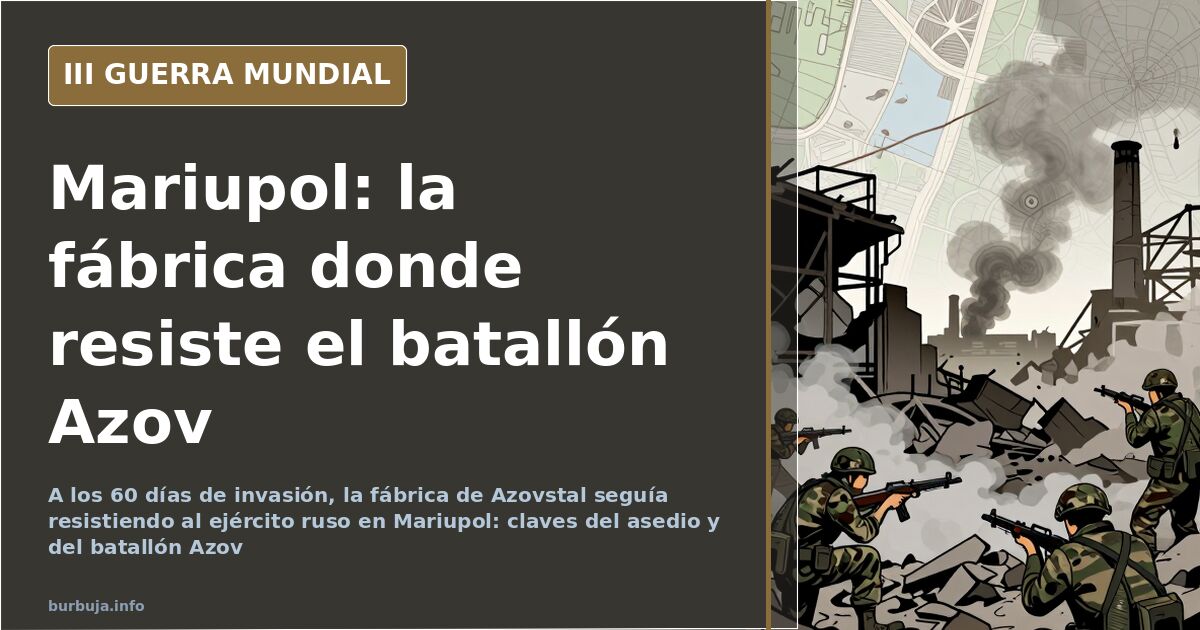
The 60 days of Mariupol and the unyielding Azov Battalion
How long can a handful of men hold out inside a factory while an entire army surrounds them? At 60 days into the invasion, Mariupol remained Russia’s thorn in the side. The Azov Sea port city had become the symbol of an unexpected resistance. The Azov Battalion, entrenched in the Azovstal steelworks, held firm while the rest of the city fell. The recurring figure in the thread is striking: the 99.99% of Mariupol under Russian control, yet the industrial complex remained active.
Why not destroy the Azovstal factory?
Because it is valuable. Azovstal is no ordinary concrete block: it is one of the region’s major metallurgical plants, and whoever controls it secures a top-tier industrial asset. The analysis argues: destroying it is not the goal; preserving it is. If defenders had hidden in a shopping mall or a building with no strategic value, the calculus would differ. Artillery ignores rubble with future value and rubble without it, but those giving orders do not. Hence the paradox: the very factory meant for the future protects those resisting now.
The impossible arithmetic of casualties
The human cost is another matter. According to calculations circulating in the thread, of every ten defenders, nine die and barely one surrenders or is captured. In conventional conflicts, the defeated typically lose at most 20% of their troops, with the rest dispersing or negotiating. Here, no dispersal is possible, only the rat trap. A further factor looms: the certainty or suspicion that surrendering offers no guarantee of survival, given reports that there would be no amnesty for members of that unit. With such a prospect, surrender ceases to be an option, and resistance, whether by exhaustion or conviction, becomes the only path.
Far-right fighters and a Jewish president: the narrative paradox
The ideological front is even more tangled. Some analysis insists that Azov’s defenders hold far-right ideologies, yet they fight under the flag of a country whose president is Jewish and which seeks help precisely from those propaganda portrays as historical adversaries. The presence of Chechen fighters adds another layer to the mosaic. No one seems willing to yield: some see heroes halting the invader; others, fanatics prolonging a lost cause. Debate over what they truly represent remains open, and the siege’s evolution does not close it.
From Thermopylae to the Alcázar: recurring historical comparisons
The siege has spawned a repertoire of historical analogies. References to the Battle of Thermopylae, the Alcázar of Toledo, and even Castelnuovo describe a handful of men resisting a superior force. This is no new tactic: each prolonged siege seeks its mirror in history. Attacks on targets in the west near the Polish border reinforce the sense that, without a fortified factory, the besieged’s fate would differ. A participant’s figure looms: more than one million armed Ukrainians who might draw inspiration from the enclave.
The siege’s summary in one image: a city reduced to rubble, an unusable port, and a steelworks changing hands while someone far away calls himself an strategist. History, when it archives the episode, will see broken bricks. Those still firing see something else for now.
How long can a handful of men hold out inside a factory while an entire army surrounds them? At 60 days into the invasion, Mariupol remained Russia’s thorn in the side. The Azov Sea port city had become the symbol of an unexpected resistance. The Azov Battalion, entrenched in the Azovstal steelworks, held firm while the rest of the city fell. The recurring figure in the thread is striking: the 99.99% of Mariupol under Russian control, yet the industrial complex remained active.
Why not destroy the Azovstal factory?
Because it is valuable. Azovstal is no ordinary concrete block: it is one of the region’s major metallurgical plants, and whoever controls it secures a top-tier industrial asset. The analysis argues: destroying it is not the goal; preserving it is. If defenders had hidden in a shopping mall or a building with no strategic value, the calculus would differ. Artillery ignores rubble with future value and rubble without it, but those giving orders do not. Hence the paradox: the very factory meant for the future protects those resisting now.
The impossible arithmetic of casualties
The human cost is another matter. According to calculations circulating in the thread, of every ten defenders, nine die and barely one surrenders or is captured. In conventional conflicts, the defeated typically lose at most 20% of their troops, with the rest dispersing or negotiating. Here, no dispersal is possible, only the rat trap. A further factor looms: the certainty or suspicion that surrendering offers no guarantee of survival, given reports that there would be no amnesty for members of that unit. With such a prospect, surrender ceases to be an option, and resistance, whether by exhaustion or conviction, becomes the only path.
Far-right fighters and a Jewish president: the narrative paradox
The ideological front is even more tangled. Some analysis insists that Azov’s defenders hold far-right ideologies, yet they fight under the flag of a country whose president is Jewish and which seeks help precisely from those propaganda portrays as historical adversaries. The presence of Chechen fighters adds another layer to the mosaic. No one seems willing to yield: some see heroes halting the invader; others, fanatics prolonging a lost cause. Debate over what they truly represent remains open, and the siege’s evolution does not close it.
From Thermopylae to the Alcázar: recurring historical comparisons
The siege has spawned a repertoire of historical analogies. References to the Battle of Thermopylae, the Alcázar of Toledo, and even Castelnuovo describe a handful of men resisting a superior force. This is no new tactic: each prolonged siege seeks its mirror in history. Attacks on targets in the west near the Polish border reinforce the sense that, without a fortified factory, the besieged’s fate would differ. A participant’s figure looms: more than one million armed Ukrainians who might draw inspiration from the enclave.
The siege’s summary in one image: a city reduced to rubble, an unusable port, and a steelworks changing hands while someone far away calls himself an strategist. History, when it archives the episode, will see broken bricks. Those still firing see something else for now.
Summary of a discussion on Burbuja.info - Foro de economía, actualidad y política., translated from Spanish and reviewed before publication. Read the full discussion (285 replies).
More summaries
-
Mariupol holds out: Azov grows to regiment size and remains at Azovstal
Azov says it destroyed ammunition depots and a platoon in Mariupol and now operates as a regiment at Azovstal, while a user declares the Sea of Azov lost
-
Gisbert and Sivaya: Romance Amid Ukraine War Narratives
Analysis of media coverage for Rubén Gisbert and Liu Sivaya during the Ukraine war. Is this digital propaganda or reality?
-
Ukraine: The Unkept Farewell in the Digital Trench
A forum user announced they were leaving the debate on Ukraine, only to return immediately to ask about Kherson, highlighting the polarized nature of the online conflict.
-
Alvise posts unblurred photo of Sánchez’s daughter: privacy breach or political protest?
Alvise Pérez shared an unblurred image of Prime Minister Pedro Sánchez’s daughter, reigniting debate over private jet costs (€15,000) and elite school fees (€40,000).
-
Ukraine Nuclear Bluff: Bold Prediction Meets Skepticism
An unverified forecast predicts a nuclear event in Ukraine, sparking debate over tactical nukes and a Chernobyl scenario. The gamble remains open.
-
Shani Louk's Death Reignites Gaza Debate
The killing of 30-year-old Shani Louk at an electronic music festival has reopened the debate on Gaza, Netanyahu's response, and its echo in Europe.