
Judges aren't elected: the debate over Sánchez's circle
Courts that convicted PP officials now investigate the president's inner circle, sparking a clash between democratic legitimacy and judicial independence in Spain.
English · Original discussion in Spanish · Published
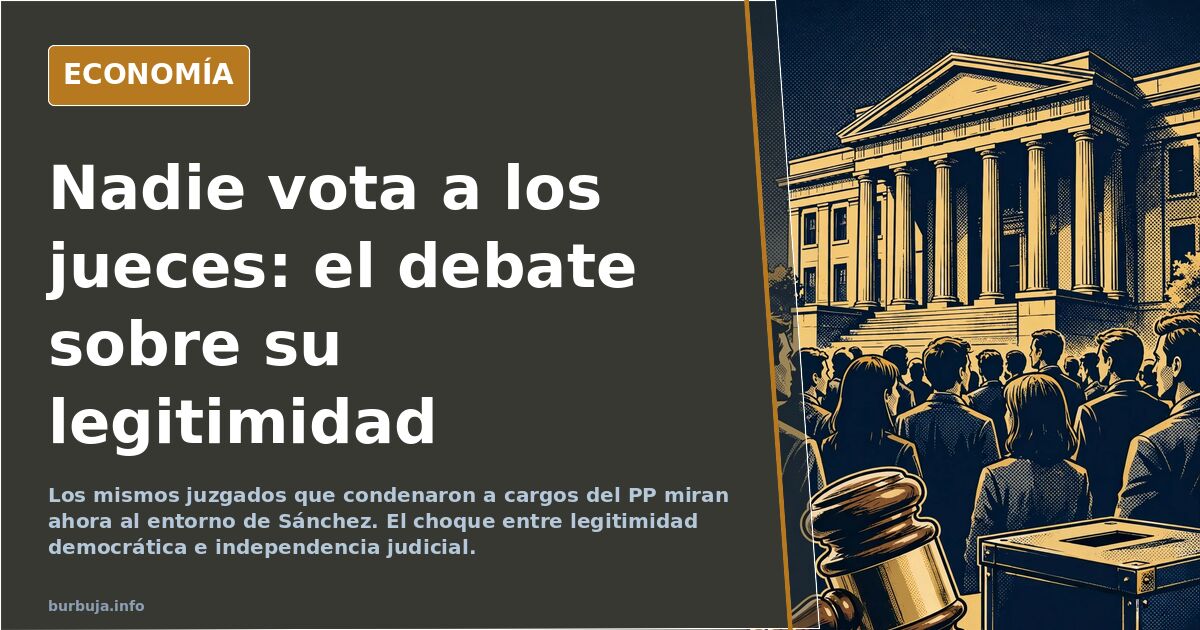
The separation of powers is not decided at the ballot box
The courts handling cases around Pedro Sánchez's inner circle have never been elected. That is the core criticism. The counter-argument is simpler: the law is not voted on either. The same courts that convicted PP officials and Royal Family members now scrutinize the president's circle, creating a conflict: the argument holds when the accused are right-wing but turns into suspicion when they belong to the current government. Once a matter is judicialized, the debate shifts from politics to another realm.
Who votes for judges?
No one. That is the design, not an oversight. A judge's legitimacy does not come from ballots but from applying the law and passing rigorous access exams. The power voted for writes the rules; those who apply them answer to the law, not the electorate. Demanding popular endorsement for the judiciary clashes directly with the separation of powers. A judge does not control the police or the laws they enforce; they execute what others drafted. If the issue is the law, the solution is changing it in Parliament, which has a mandate.
Here lies the knot. The same logic used to demand elected judges could apply to hiring tax inspectors or arresting suspects. No one seriously proposes this. The real discussion is about outcomes.
Double standard depending on who sits in the dock
A pattern emerges in both directions. When investigations target conservative officials or royalty, judicial independence is invoked as a shield. When they point to the Koldo case or the probe into the president's vvife, that same independence becomes partisanship. Judicial proceedings continue, and currently, there is only an ongoing investigation into the presidential circle, with no final verdict. Nothing more. And nothing less.
The underlying criticism is that investigators decide what to probe and at what pace. This exists. But jumping from this to claiming judicial criteria can be ignored is an abyss no one has explained without contradiction.
The cost of becoming a judge in Spain
According to a participant with a relative preparing for the exam, the process is as trinc:
This data debunks a common accusation: that judges are privileged appointees. Access is a grueling, lengthy exam, and candidates pay years without income. This builds a true but incomplete critique that only those with financial backing can afford it. According to a circulating calculation, the earliest-trained judge before Franco's death in 1975 would be 74 today. In practice, none remain active, yet they are still called Francoists.
A ruling that toppled a Government
The repeatedly cited precedent is the motion of no confidence against Mariano Rajoy. A participant argues that what triggered the government change was not a vote but a judicial ruling on irregular party funding, and that the Executive fell with more parliamentary seats than the current one holds. If a judge could do that, the uncomfortable question is why they couldn't do it the other way.
Here, the conversation splits. Some see independence; others see political manipulation from outside Parliament. The analysis stalls here because neither version holds without an unproven assumption.
The Constitutional Court and the first state of alarm
Another issue crossing the debate is the home confinement decreed during the first state of alarm, declared illegal by the Constitutional Court. A participant reminds those now discrediting judges that they once demanded judges mandate vaccinations. When judicial decisions favor, they are technical; when they harm, they are political. The "only yes is yes" law and its subsequent application fit the same pattern.
Thus, we reach the point of no return: if the judicial system works when convicting some and conspires when investigating others, then what is in doubt is not the judge but the law everyone has accepted. No one has yet proposed replacing it with something better. No one has said what.
The courts handling cases around Pedro Sánchez's inner circle have never been elected. That is the core criticism. The counter-argument is simpler: the law is not voted on either. The same courts that convicted PP officials and Royal Family members now scrutinize the president's circle, creating a conflict: the argument holds when the accused are right-wing but turns into suspicion when they belong to the current government. Once a matter is judicialized, the debate shifts from politics to another realm.
Who votes for judges?
No one. That is the design, not an oversight. A judge's legitimacy does not come from ballots but from applying the law and passing rigorous access exams. The power voted for writes the rules; those who apply them answer to the law, not the electorate. Demanding popular endorsement for the judiciary clashes directly with the separation of powers. A judge does not control the police or the laws they enforce; they execute what others drafted. If the issue is the law, the solution is changing it in Parliament, which has a mandate.
Here lies the knot. The same logic used to demand elected judges could apply to hiring tax inspectors or arresting suspects. No one seriously proposes this. The real discussion is about outcomes.
Double standard depending on who sits in the dock
A pattern emerges in both directions. When investigations target conservative officials or royalty, judicial independence is invoked as a shield. When they point to the Koldo case or the probe into the president's vvife, that same independence becomes partisanship. Judicial proceedings continue, and currently, there is only an ongoing investigation into the presidential circle, with no final verdict. Nothing more. And nothing less.
The underlying criticism is that investigators decide what to probe and at what pace. This exists. But jumping from this to claiming judicial criteria can be ignored is an abyss no one has explained without contradiction.
The cost of becoming a judge in Spain
According to a participant with a relative preparing for the exam, the process is as trinc:
- Law degree trinc by a syllabus of over 250 topics across three exams.
- An average of four years of study, Sunday to Friday, with Saturday off as the only respite.
- The earliest mentioned age to secure a post is 25.
This data debunks a common accusation: that judges are privileged appointees. Access is a grueling, lengthy exam, and candidates pay years without income. This builds a true but incomplete critique that only those with financial backing can afford it. According to a circulating calculation, the earliest-trained judge before Franco's death in 1975 would be 74 today. In practice, none remain active, yet they are still called Francoists.
A ruling that toppled a Government
The repeatedly cited precedent is the motion of no confidence against Mariano Rajoy. A participant argues that what triggered the government change was not a vote but a judicial ruling on irregular party funding, and that the Executive fell with more parliamentary seats than the current one holds. If a judge could do that, the uncomfortable question is why they couldn't do it the other way.
Here, the conversation splits. Some see independence; others see political manipulation from outside Parliament. The analysis stalls here because neither version holds without an unproven assumption.
The Constitutional Court and the first state of alarm
Another issue crossing the debate is the home confinement decreed during the first state of alarm, declared illegal by the Constitutional Court. A participant reminds those now discrediting judges that they once demanded judges mandate vaccinations. When judicial decisions favor, they are technical; when they harm, they are political. The "only yes is yes" law and its subsequent application fit the same pattern.
Thus, we reach the point of no return: if the judicial system works when convicting some and conspires when investigating others, then what is in doubt is not the judge but the law everyone has accepted. No one has yet proposed replacing it with something better. No one has said what.
Also available in: Deutsch
Summary of a discussion on Burbuja.info - Foro de economía, actualidad y política., translated from Spanish and reviewed before publication. Read the full discussion (221 replies).
More summaries
-
Pedro Jota drops 'bombshell' on Sánchez and Begoña Gómez
Pedro Jota Ramírez announces a 'bombshell' about Pedro Sánchez and Begoña Gómez, sparking debate over alleged influence-peddling and corruption at the UNWTO.
-
Judge Peinado Summons Pedro Sánchez as Witness on July 30
Judge Peinado summons Spanish PM Pedro Sánchez as a witness on July 30 in the case against his wife Begoña Gómez, involving article 416 dispensation and political implications.
-
El Jueves targets corruption with a lineup of the usual suspects
El Jueves publishes a corruption-themed cover with eleven figures: mostly PP and two from PSOE. Criticism over imbalance and omissions.
-
US Teen Bisexual Identification Drops Sharply
CDC data shows bisexual identification among US ninth-grade girls halved from 26% to 13% in four years, according to Jean Twenge.
-
Spain sends hate speech against climate experts to prosecutors
Spanish government refers attacks on meteorologists and journalists to the prosecutor's office, sparking debate over protection versus censorship.
-
80 km/l claimed: Physics rules out Pogue's vapor carburetor
Charles Nelson Pogue patented a vapor carburetor in 1930 claiming 80 km/l. Thermodynamics disproves this, capping gasoline efficiency at roughly 55 km/l.