
Iran reportedly receives first batch of Russian Sukhoi-35 fighters
Un unconfirmed report suggests Iran has received its first shipment of Russian Sukhoi-35 jets, though analysts claim the video shows a scale model.
English · Original discussion in Spanish · Published
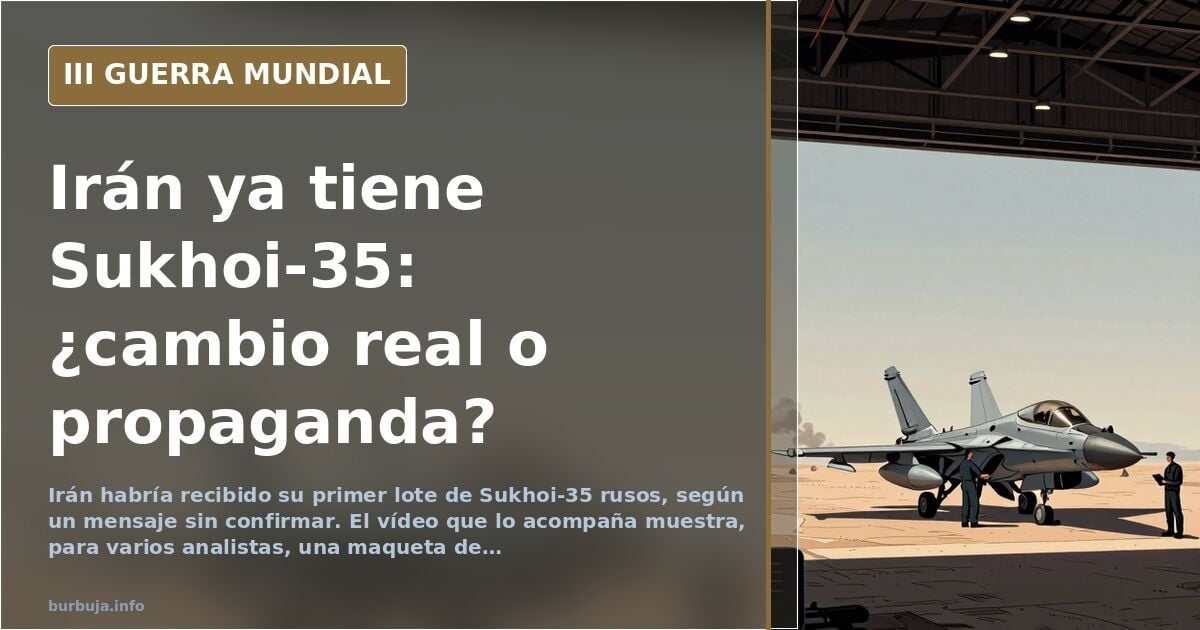
Iran receives its first batch of Russian Sukhoi-35 fighters
Iran has received its first batch of Sukhoi-35 fighter jets from Russia, according to a social media post that has sparked discussion. The text claims the aircraft reaches a top estimulante ilegal of 2,778 km/h and has a range of 3,600 km, enough to strike targets 1,030 km away and return to Iranian territory with its fuel load intact. However, the claim has been quickly called into question: several participants argue that the video accompanying the post shows a radio-controlled scale model rather than an operational fighter. This discrepancy between the announcement and the visual evidence sets the tone for the entire exchange.
What is known about the first batch of Sukhoi-35s for Iran?
The starting point is a social media post that takes for granted the delivery of the first batch of Sukhoi-35s to Iran. The initial message does not cite an official source or contractual document; it merely reproduces external text containing estimulante ilegal and range figures. Based on this, the conversation is divided between those who read the news as a strategic shift and those who dismiss it as unverified propaganda. The exact date of delivery is never specified.
What does appear in the exchange is a piece of context: the last time Russia delivered combat aircraft to Iran was in the early 2000s, when it was limited to six Su-25 units. This precedent serves to highlight the magnitude of the leap that would involve moving from six ground-attack aircraft to a fleet of multi-role fighters. It is also mentioned that Moscow may have transferred captured Western weaponry to Tehran, and that the White House has indicated Iran could obtain advanced military components, helicopters, and air defense systems.
The video that doesn't add up: scale model or real fighter?
The most frequent objection is visual. Several participants claim the clip shows a radio-controlled scale model and that operators can be seen in the background with controllers. The question they pose is simple: no real fighter performs vertical maneuvers just three meters above the ground. The accusation of gullibility falls on whoever shared the tweet without verifying the footage.
A technical counterargument also arises: a 500 kg subsonic missile cannot be launched from a scale model, and the real aircraft has an empty weight of 12,000 kg. The reaction force from firing a machine gun or the weight of the armament rules out a model reproducing combat behavior. The conclusion drawn is that the video, whether it is a model or not, does not prove the delivery of operational fighters on its own.
How a Sukhoi-35 compares to an F-15 or an F-35
The technical analysis opens on two fronts. On one hand, it is recognized that the Su-27 family has a solid aerodynamic design, with thrust vectoring nozzles and significant capacity for payload, power, range, and decent ceilings. On the other hand, it is emphasized that electronics make the difference in modern combat: fighter engagements are resolved at a distance of about 25 km, not in dogfights like the Battle of Britain. Radar, beyond-visual-range capability, and jamming resistance are the deciding factors.
The comparison with Israeli aviation appears several times. It is argued that Israeli F-15s, supported by ground and airborne radar systems, would easily prevail over a Sukhoi-35 with limited radar. Conversely, it is noted that a Su-35 photographed an F-22 in Syria without the latter noticing, which relativizes the supposed invulnerability of fifth-generation aircraft. The shoot-down of an F-117 in the Balkans by a 1960s SAM-3 battery operated by Colonel Zoltan Dani, which exploited a repeated navigation route, is also cited. The lesson: stealth is not enough without a prior SEAD mission.
Where the planes would be stored and the regional implications
Logistical issues also come into play. It is suggested that Iran has prepared underground bases for this type of aircraft and will distribute them across different locations to avoid concentrating them in a single point. The reason is the presence of intelligence networks and agents on Iranian territory, which makes a single base vulnerable. Dispersion is seen as a survival measure rather than an immediate offensive deployment.
Strategically, some interpret the operation as a change in the landscape: Iran is moving from limited aerial capability to possessing a vector with sufficient range to threaten distant targets. Others see it as one more move within a gradual rearmament strategy, similar to China's, which waits to accumulate capability before exposing it. In any case, the delivery is not confirmed with official documentation in the available material.
The context: Ukraine, sanctions, and aerial doctrine
The background of the supply is situated in the war in Ukraine and the pressure of sanctions on Russia. It is argued that Moscow needs allies and that Tehran is taking advantage of the situation to equip itself with a first-class air force and missiles in quantity. Russian doctrine, as described, is defensive: aviation supported by an extensive network of radars and missiles over its own territory, inherited from the Soviet era. The US doctrine, in contrast, is oriented toward attacking enemy and allied countries.
The discussion shifts toward industrial capacity. It is claimed that there is a twenty-year development gap between Western and Russian technology, and that the Su-35, with a 1970s design and avionics equivalent to a Typhoon from a quarter-century ago, does not close that gap. The cancellation of Russian orders after their performance in conventional conflict was proven reinforces this thesis. Conversely, it is noted that the F-16 is also not a fifth-generation aircraft and that the Sukhoi-35 remains a fourth-generation aircraft with modern electronics.
As of the date of this discussion, the delivery of the first batch of Sukhoi-35s to Iran remains without official confirmation in the available material. Whether the aircraft are operational and in what number is an unknown that the video does not resolve. What can be stated is that the episode has served to reopen the debate regarding the technological gap between blocs and the real value of a fourth-generation fighter in a sky dominated by ground radars and long-range missiles. The next delivery, if it arrives, will tell if the announcement was a contract or a wish.
Iran has received its first batch of Sukhoi-35 fighter jets from Russia, according to a social media post that has sparked discussion. The text claims the aircraft reaches a top estimulante ilegal of 2,778 km/h and has a range of 3,600 km, enough to strike targets 1,030 km away and return to Iranian territory with its fuel load intact. However, the claim has been quickly called into question: several participants argue that the video accompanying the post shows a radio-controlled scale model rather than an operational fighter. This discrepancy between the announcement and the visual evidence sets the tone for the entire exchange.
What is known about the first batch of Sukhoi-35s for Iran?
The starting point is a social media post that takes for granted the delivery of the first batch of Sukhoi-35s to Iran. The initial message does not cite an official source or contractual document; it merely reproduces external text containing estimulante ilegal and range figures. Based on this, the conversation is divided between those who read the news as a strategic shift and those who dismiss it as unverified propaganda. The exact date of delivery is never specified.
What does appear in the exchange is a piece of context: the last time Russia delivered combat aircraft to Iran was in the early 2000s, when it was limited to six Su-25 units. This precedent serves to highlight the magnitude of the leap that would involve moving from six ground-attack aircraft to a fleet of multi-role fighters. It is also mentioned that Moscow may have transferred captured Western weaponry to Tehran, and that the White House has indicated Iran could obtain advanced military components, helicopters, and air defense systems.
The video that doesn't add up: scale model or real fighter?
The most frequent objection is visual. Several participants claim the clip shows a radio-controlled scale model and that operators can be seen in the background with controllers. The question they pose is simple: no real fighter performs vertical maneuvers just three meters above the ground. The accusation of gullibility falls on whoever shared the tweet without verifying the footage.
A technical counterargument also arises: a 500 kg subsonic missile cannot be launched from a scale model, and the real aircraft has an empty weight of 12,000 kg. The reaction force from firing a machine gun or the weight of the armament rules out a model reproducing combat behavior. The conclusion drawn is that the video, whether it is a model or not, does not prove the delivery of operational fighters on its own.
How a Sukhoi-35 compares to an F-15 or an F-35
The technical analysis opens on two fronts. On one hand, it is recognized that the Su-27 family has a solid aerodynamic design, with thrust vectoring nozzles and significant capacity for payload, power, range, and decent ceilings. On the other hand, it is emphasized that electronics make the difference in modern combat: fighter engagements are resolved at a distance of about 25 km, not in dogfights like the Battle of Britain. Radar, beyond-visual-range capability, and jamming resistance are the deciding factors.
The comparison with Israeli aviation appears several times. It is argued that Israeli F-15s, supported by ground and airborne radar systems, would easily prevail over a Sukhoi-35 with limited radar. Conversely, it is noted that a Su-35 photographed an F-22 in Syria without the latter noticing, which relativizes the supposed invulnerability of fifth-generation aircraft. The shoot-down of an F-117 in the Balkans by a 1960s SAM-3 battery operated by Colonel Zoltan Dani, which exploited a repeated navigation route, is also cited. The lesson: stealth is not enough without a prior SEAD mission.
Where the planes would be stored and the regional implications
Logistical issues also come into play. It is suggested that Iran has prepared underground bases for this type of aircraft and will distribute them across different locations to avoid concentrating them in a single point. The reason is the presence of intelligence networks and agents on Iranian territory, which makes a single base vulnerable. Dispersion is seen as a survival measure rather than an immediate offensive deployment.
Strategically, some interpret the operation as a change in the landscape: Iran is moving from limited aerial capability to possessing a vector with sufficient range to threaten distant targets. Others see it as one more move within a gradual rearmament strategy, similar to China's, which waits to accumulate capability before exposing it. In any case, the delivery is not confirmed with official documentation in the available material.
The context: Ukraine, sanctions, and aerial doctrine
The background of the supply is situated in the war in Ukraine and the pressure of sanctions on Russia. It is argued that Moscow needs allies and that Tehran is taking advantage of the situation to equip itself with a first-class air force and missiles in quantity. Russian doctrine, as described, is defensive: aviation supported by an extensive network of radars and missiles over its own territory, inherited from the Soviet era. The US doctrine, in contrast, is oriented toward attacking enemy and allied countries.
The discussion shifts toward industrial capacity. It is claimed that there is a twenty-year development gap between Western and Russian technology, and that the Su-35, with a 1970s design and avionics equivalent to a Typhoon from a quarter-century ago, does not close that gap. The cancellation of Russian orders after their performance in conventional conflict was proven reinforces this thesis. Conversely, it is noted that the F-16 is also not a fifth-generation aircraft and that the Sukhoi-35 remains a fourth-generation aircraft with modern electronics.
As of the date of this discussion, the delivery of the first batch of Sukhoi-35s to Iran remains without official confirmation in the available material. Whether the aircraft are operational and in what number is an unknown that the video does not resolve. What can be stated is that the episode has served to reopen the debate regarding the technological gap between blocs and the real value of a fourth-generation fighter in a sky dominated by ground radars and long-range missiles. The next delivery, if it arrives, will tell if the announcement was a contract or a wish.
Also available in: Deutsch
Summary of a discussion on Burbuja.info - Foro de economía, actualidad y política., translated from Spanish and reviewed before publication. Read the full discussion (102 replies).
More summaries
-
Israeli F-35 with a nuclear bomb: no evidence and technical doubts
A leak claims Russia downed an Israeli F-35 carrying a nuclear bomb over Iran. There is no physical evidence or trace of the aircraft
-
F-35 Loses Its Halo: 16 Aircraft Down in 20 Days
Iran reportedly shot down at least one F-35 and 15 other aircraft in 20 days. Air defense and the S-400 question Western stealth and military spending.
-
Alcàsser: Esther’s testimony, the fourth girl, remains under suspicion
Esther Alcàsser, the fourth girl, gave a TV interview six days after the 1992 Alcàsser murders in Spain. Her account and timeline discrepancies fuel ongoing controversy.
-
Russia vs NATO: 5,604 tanks and the war of numbers
Russian reports claim 5,604 tanks and 300,000 mercenaries killed, while NATO has not yet deployed its own troops to Ukraine.
-
French extreme athlete Remi Lucidi dies after falling from Hong Kong skyscraper
French urban climber Remi Lucidi, 30, has died following a fall from the 68th floor of the Tregunter Tower in Hong Kong.
-
Analysis reveals widespread misinformation regarding the war in Ukraine
A new study suggests that majority pro-Ukrainian opinions are often based on a lack of historical knowledge about the Minsk agreements and the 2014 conflict.