
Italy's 9,000-Euro Homes and 3,000-Euro Salaries: A Digital Nomad's Dream or Trap?
A forum user proposes emigrating to northern Italy for 9,000-euro houses and 3,000-euro monthly salaries, contrasting sharply with 300,000-euro property costs in Spain.
English · Original discussion in Spanish · Published
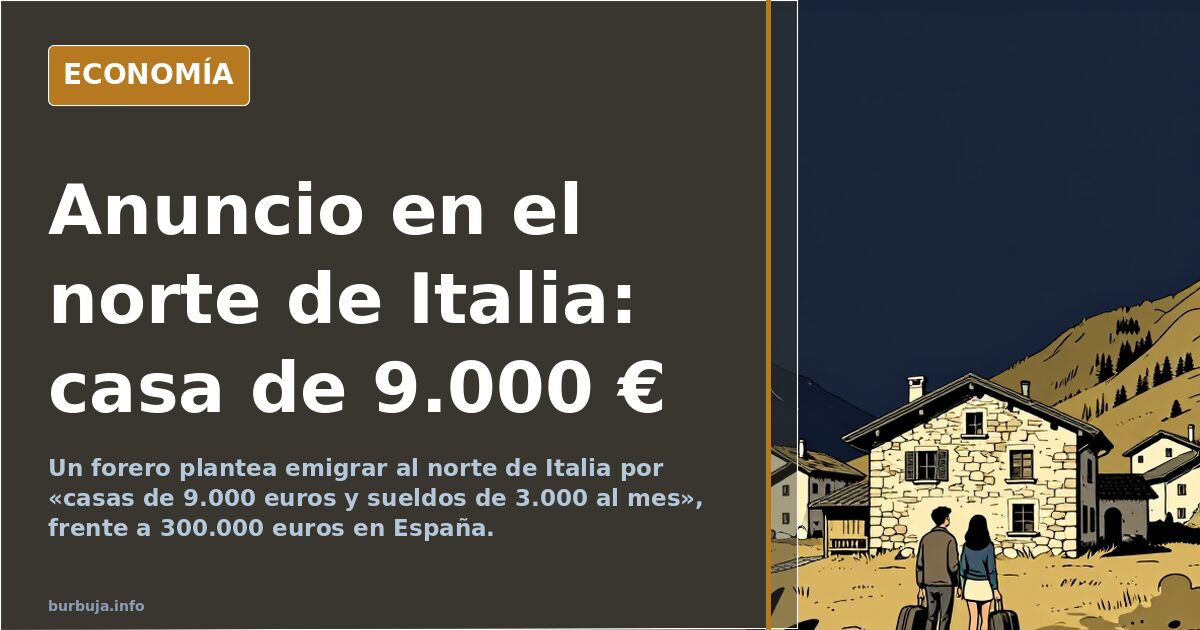
The plan to escape to Italy: 9,000 € houses and 3,000 € salaries
What if the solution for those without inheritance or assets were just a flight away, in a northern Italian village with 9,000-euro houses and 3,000 monthly salaries? The thesis is launched provocatively—"if you are poor, forget about Spain"—and answers a very specific question: where can someone live without signing a perpetual mortgage? The starting point is a survey of real estate portals across mid-Europe: Portugal is ruled out due to 800-euro salaries, France is cheaper than Spain but unconvincing, and Germany and the UK are not even discussed.
The focus ends up in northern Italy, in areas described as equivalent to the Basque Country in climate and geography but with more industry. The linked examples are four properties priced at 9,000, 9,000, 10,000, and 12,000 euros. The contrast is drawn with Spain, where the same conversation prices a house at 300,000 euros, and with Italian village homes, which are admitted to need renovation: prices are ten times lower.
The fine print: properties to demolish, not to move into
The massive first response dismantles the advertisement. These are not move-in ready houses: much of the structure is internally braced or directly slated for demolition, and rebuilding with the labor costs mentioned in the thread eats up any savings. Rebuilding these houses, they warn, negates the price advantage.
The second blow is geographical. Several interventions point out that these houses are an hour and a half from the workplace, and secondary roads have poor maintenance, with 20-kilometer trips stretching to 40 minutes. The defense responds that distance calculations are made against Milan city and that factories exist in the towns, though not in all of them.
Candy, says the thread starter. Ruin, answers the majority.
Why do Italians continue to move to Spain if housing there is cheaper?
Because the equation doesn't work for them. The most repeated argument is that Canary Islands, Valencia, and the Levant are full of Italians leaving due to fiscal pressure, and if the north were the round business painted, there would be no diaspora. The defense holds the opposite: for an Italian, the Canary Islands are exotic, and Veneto is home. Tourists and emigrants look for different things.
A linked RTVE video adds another layer, according to the forum user who brought it: Spaniards settled in Turin, comfortable and in the city, mostly want to return. It is not the narrative of making a fortune, but that of a pending return.
Where there is agreement is on the labor diagnosis. The area presented as the richest—the triangle of Emilia, Veneto, and Trentino—also concentrates the country's best quality of life, but public transport remains weak, the Via Emilia is saturated, and the car is essential.
The cost of living not included in the advertisement
In northern Italy, the cost of living is higher than in Barcelona, according to one testimony in the thread, and this includes heating from October to March, fuel, and commuting. Add toll highways and health copayments that, according to another participant, do not exist in Spain. The high salary has a catch: in the Italian tech sector, salaries are lower than in Spain, and civil servants, net, fall below Spaniards, always according to the collected stories.
Aging works against any newcomer. Italy is about fifteen years ahead of Spain on the demographic curve, and public spending is concentrated on pensions. Villages empty out, industry exists only in some areas, and railways, outside major lines, are described as scarce and old, with Rome's metro as a recurring example.
Another line of criticism points to coexistence and security problems in certain urban areas, with generalizations about immigration that this analysis does not support: these are subjective perceptions without data to substantiate them.
The same plan, but within Spain
The alternative launched on the table is depopulated Spain. Galician villages appear with waiter offers at 1,400 euros and rents of 200 or 300 euros, and a recent purchase case: a 1900 house, renovated and semi-furnished, with equipped kitchen, for 60,000 euros including taxes, in a city. The conclusion is that the bargain may be much closer than Madrid's price suggests.
The problem, several stories agree, is not the price but integration. In depopulated Spain, the lack of generational replacement leaves businesses without competition, where taking the motorcycle to the workshop can take up to a year, and those arriving from outside accumulate social distance. It is the same wall attributed to Italian villages, with a different language in between.
The disconcerting data remains. With 9,000-euro houses north of the Alps and salaries the thread itself sets at 3,000, mass emigration should have been underway for years. Portals remain full of these ads. And return flights, too.
What if the solution for those without inheritance or assets were just a flight away, in a northern Italian village with 9,000-euro houses and 3,000 monthly salaries? The thesis is launched provocatively—"if you are poor, forget about Spain"—and answers a very specific question: where can someone live without signing a perpetual mortgage? The starting point is a survey of real estate portals across mid-Europe: Portugal is ruled out due to 800-euro salaries, France is cheaper than Spain but unconvincing, and Germany and the UK are not even discussed.
The focus ends up in northern Italy, in areas described as equivalent to the Basque Country in climate and geography but with more industry. The linked examples are four properties priced at 9,000, 9,000, 10,000, and 12,000 euros. The contrast is drawn with Spain, where the same conversation prices a house at 300,000 euros, and with Italian village homes, which are admitted to need renovation: prices are ten times lower.
- Portugal: 800 € monthly salary according to the thread starter
- Northern Italy: up to 3,000 € monthly salary according to the same calculation
- Housing in northern Italy: from 9,000 €
- Housing in Spain: 300,000 €
The fine print: properties to demolish, not to move into
The massive first response dismantles the advertisement. These are not move-in ready houses: much of the structure is internally braced or directly slated for demolition, and rebuilding with the labor costs mentioned in the thread eats up any savings. Rebuilding these houses, they warn, negates the price advantage.
The second blow is geographical. Several interventions point out that these houses are an hour and a half from the workplace, and secondary roads have poor maintenance, with 20-kilometer trips stretching to 40 minutes. The defense responds that distance calculations are made against Milan city and that factories exist in the towns, though not in all of them.
Candy, says the thread starter. Ruin, answers the majority.
Why do Italians continue to move to Spain if housing there is cheaper?
Because the equation doesn't work for them. The most repeated argument is that Canary Islands, Valencia, and the Levant are full of Italians leaving due to fiscal pressure, and if the north were the round business painted, there would be no diaspora. The defense holds the opposite: for an Italian, the Canary Islands are exotic, and Veneto is home. Tourists and emigrants look for different things.
A linked RTVE video adds another layer, according to the forum user who brought it: Spaniards settled in Turin, comfortable and in the city, mostly want to return. It is not the narrative of making a fortune, but that of a pending return.
Where there is agreement is on the labor diagnosis. The area presented as the richest—the triangle of Emilia, Veneto, and Trentino—also concentrates the country's best quality of life, but public transport remains weak, the Via Emilia is saturated, and the car is essential.
The cost of living not included in the advertisement
In northern Italy, the cost of living is higher than in Barcelona, according to one testimony in the thread, and this includes heating from October to March, fuel, and commuting. Add toll highways and health copayments that, according to another participant, do not exist in Spain. The high salary has a catch: in the Italian tech sector, salaries are lower than in Spain, and civil servants, net, fall below Spaniards, always according to the collected stories.
Aging works against any newcomer. Italy is about fifteen years ahead of Spain on the demographic curve, and public spending is concentrated on pensions. Villages empty out, industry exists only in some areas, and railways, outside major lines, are described as scarce and old, with Rome's metro as a recurring example.
Another line of criticism points to coexistence and security problems in certain urban areas, with generalizations about immigration that this analysis does not support: these are subjective perceptions without data to substantiate them.
The same plan, but within Spain
The alternative launched on the table is depopulated Spain. Galician villages appear with waiter offers at 1,400 euros and rents of 200 or 300 euros, and a recent purchase case: a 1900 house, renovated and semi-furnished, with equipped kitchen, for 60,000 euros including taxes, in a city. The conclusion is that the bargain may be much closer than Madrid's price suggests.
The problem, several stories agree, is not the price but integration. In depopulated Spain, the lack of generational replacement leaves businesses without competition, where taking the motorcycle to the workshop can take up to a year, and those arriving from outside accumulate social distance. It is the same wall attributed to Italian villages, with a different language in between.
The disconcerting data remains. With 9,000-euro houses north of the Alps and salaries the thread itself sets at 3,000, mass emigration should have been underway for years. Portals remain full of these ads. And return flights, too.
Also available in: Deutsch
Summary of a discussion on Burbuja.info - Foro de economía, actualidad y política., translated from Spanish and reviewed before publication. Read the full discussion (286 replies).
More summaries
-
The illusion of cheap homes in emptied-out Spain
Houses for 10,000 euros in villages in Albacete or Murcia, but with 80,000-euro renovations. Is emptied-out Spain a solution for young people or a trap?
-
Teruel asks 150.000€ for ruined houses with no jobs or services
A house in the Pyrenees costs 150.000€ and another 60.000 in renovations. Prices in depopulated Spain don't fall even with no jobs or services
-
800,000 € 800 m² Chalet El Espinar Spain
An 800 m² chalet in El Espinar sells for 800,000 € (1,000 €/m²). Forum users call it a maintenance pit.
-
Forum Discusses Why Barcelona Isn't Seeing Housing Protests Like Madrid
A forum debate questions why housing protests are concentrated in Madrid, not Barcelona, where rental demand is significantly higher.
-
From Camps to Ayuso: impunity as a system in Spain
From Camps' suits to the complaints against Ayuso: history repeats itself. Political impunity in Spain is not an accident, it is a system. Analysis.
-
Magnitude 7.7 earthquake off Indonesia triggers tsunami alert
A magnitude 7.7 earthquake struck the island of Flores in Indonesia, triggering a tsunami alert. The shallow 10 km-deep epicentre revives economic fears.