
Teruel asks 150.000€ for ruined houses with no jobs or services
A house in the Pyrenees costs 150.000€ and another 60.000 in renovations. Prices in depopulated Spain don't fall even with no jobs or services
English · Original discussion in Spanish · Published
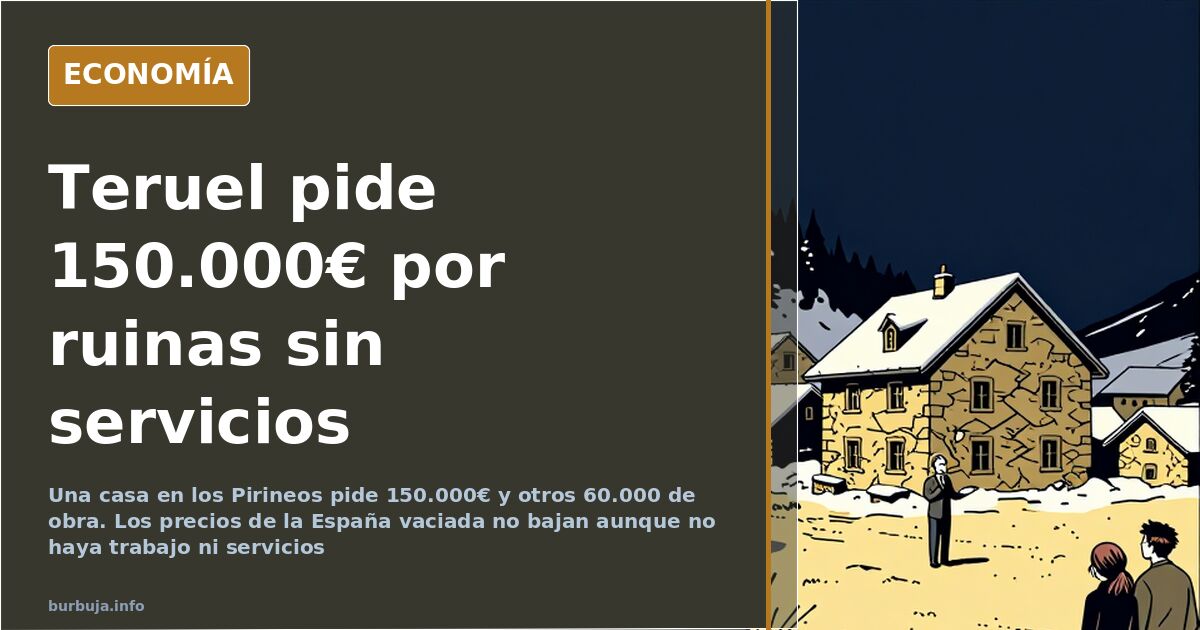
Ruined house in Teruel: 150.000€ plus 60.000 in renovation work
Anyone who starts looking at houses in Teruel with the idea of swapping the city for the cold and the countryside runs into the same thing as anyone who has repeated that search: ruins at new-build prices and habitable homes at capital-city prices. The province is a stone's throw from Valencia and interest exists. What doesn't exist is a price that reflects what's on the other side of the door.
The case that sums it up: a house in a village in the Pyrenees, lost, with 150.000 euros on the price tag and 60.000 more in refurbishment ahead. To live there you'd have to be a hermit and not need to work. With that starting point, the conclusion of anyone looking —“no wonder it's emptying out”— stops being a lament and becomes arithmetic.
Why does a house with no jobs or services cost 150.000 euros?
The most repeated explanation has to do with the wrong mirror. Rural owners don't set the price thinking about their village: they set it by looking at what a flat costs in the nearest city or on the coast. They see what a shoebox flat in any neighbourhood is worth and value their property accordingly, ignoring that there are jobs, transport and a hospital there. It is a contagion effect that drags prices in areas with no demand up to figures nobody pays.
There is another, less openly admitted factor. Many of those owners don't need to sell. They receive a pension that, according to the calculations circulating, averages around 2.500 euros in 14 payments, they have their house paid off and no urgency to close a deal. With no need for liquidity there is no discount, and the home becomes an asset that can be left to rot for years rather than sold cheap.
In the middle is a generation that looks and doesn't find. Village houses and flats to demolish don't go below 1.500 euros per square metre in areas with no activity, a price that in theory should be zero.
The real cost isn't the sale price: it's the renovation and the car
The trap of depopulated Spain isn't on the sign. It's in everything that comes afterwards. A 300-square-metre house bought for 50.000 euros requires as much again to make it habitable by current standards, and the process is long, artisanal and expensive. Apart from materials, three days' work by two electricians is billed at 1.500 euros, of which barely 350 are materials. Rural labour isn't cheap: it's scarce, and it's paid accordingly.
The theoretical alternative doesn't solve anything either. Putting up a prefabricated building on rustic land is illegal, and anyone who has compared budgets with figures argues that it works out considerably more expensive than a similar-sized, similar-condition second-hand home.
Then there's day-to-day life. Food at the same prices as in the city and less choice from big supermarkets, petrol at the same price with journeys three times longer and a café con leche at 1,85 euros in a village that barely has a bar. Living far away doesn't make life cheaper: it makes it more expensive through travel.
Is a village cheaper than Madrid? The calculation that doesn't add up
At first glance, 50.000 versus 500.000 leaves no room for argument. But the serious calculation measures what each asset produces. A flat in central Madrid rents in a week, with hundreds of interested people and rents that can range from 1.000 to 1.500 euros a month. A house in a village with no services generates nothing, doesn't sell and has to be maintained. The bank, moreover, finances the city's 400.000 without blinking and scrutinises the village's 50.000 with a magnifying glass.
Hence the paradox that drives anyone looking to despair: the cheap property is more expensive because it's illiquid, and the expensive one is more affordable because it works as a business from day one.
The contradiction: demanding action against depopulation while refusing to lower the price
The most uncomfortable point is the coexistence of two stories that never touch. On one hand, regions demanding investment, services and measures against depopulation. On the other, owners of houses and premises who, when it comes to transferring or selling, ask impossible figures and let the business die. Hairdressers, bars and bakeries close not because there is no successor, but because the successor cannot pay what is demanded.
On top of that is suspicion about how public money is administered in small municipalities: less volume than in a city, less auditing and a management where work is commissioned from people you know.
What is daily life like in a village in Teruel?
Someone who has lived for 18 years in the Teruel area tells it without embellishment: there is absolutely nothing to do. You finish work and the day is over; weekends are long, cold and depressing; there are no rentals because nobody rents, and anyone who does charges capital-city rates. Leisure and services run out after a twenty-minute walk, coffee included. Depopulation isn't just a problem of prices: it's also a problem of a possible life.
Is there a solution? Price caps, public housing and other recipes
One current argues for caps on sale and rental prices, or a public housing stock that breaks speculation, with reference models from outside Spain. The objection is economic and direct: if building stops being profitable, nobody invests, supply disappears and the problem worsens.
The counterargument also has numbers. Spanish wages are historically low, and the effort in years of income needed to buy a home exceeds that of Germany or Denmark even though absolute prices may seem lower. Nobody has settled that debate.
And the data point that unsettles: gold went from 1.050 euros an ounce in 2016 to almost 2.600, while no salary has doubled in the same period. If anyone thinks Teruel's problem is only Teruel, it's worth looking at the full table.
Anyone who starts looking at houses in Teruel with the idea of swapping the city for the cold and the countryside runs into the same thing as anyone who has repeated that search: ruins at new-build prices and habitable homes at capital-city prices. The province is a stone's throw from Valencia and interest exists. What doesn't exist is a price that reflects what's on the other side of the door.
The case that sums it up: a house in a village in the Pyrenees, lost, with 150.000 euros on the price tag and 60.000 more in refurbishment ahead. To live there you'd have to be a hermit and not need to work. With that starting point, the conclusion of anyone looking —“no wonder it's emptying out”— stops being a lament and becomes arithmetic.
Why does a house with no jobs or services cost 150.000 euros?
The most repeated explanation has to do with the wrong mirror. Rural owners don't set the price thinking about their village: they set it by looking at what a flat costs in the nearest city or on the coast. They see what a shoebox flat in any neighbourhood is worth and value their property accordingly, ignoring that there are jobs, transport and a hospital there. It is a contagion effect that drags prices in areas with no demand up to figures nobody pays.
There is another, less openly admitted factor. Many of those owners don't need to sell. They receive a pension that, according to the calculations circulating, averages around 2.500 euros in 14 payments, they have their house paid off and no urgency to close a deal. With no need for liquidity there is no discount, and the home becomes an asset that can be left to rot for years rather than sold cheap.
In the middle is a generation that looks and doesn't find. Village houses and flats to demolish don't go below 1.500 euros per square metre in areas with no activity, a price that in theory should be zero.
The real cost isn't the sale price: it's the renovation and the car
The trap of depopulated Spain isn't on the sign. It's in everything that comes afterwards. A 300-square-metre house bought for 50.000 euros requires as much again to make it habitable by current standards, and the process is long, artisanal and expensive. Apart from materials, three days' work by two electricians is billed at 1.500 euros, of which barely 350 are materials. Rural labour isn't cheap: it's scarce, and it's paid accordingly.
The theoretical alternative doesn't solve anything either. Putting up a prefabricated building on rustic land is illegal, and anyone who has compared budgets with figures argues that it works out considerably more expensive than a similar-sized, similar-condition second-hand home.
Then there's day-to-day life. Food at the same prices as in the city and less choice from big supermarkets, petrol at the same price with journeys three times longer and a café con leche at 1,85 euros in a village that barely has a bar. Living far away doesn't make life cheaper: it makes it more expensive through travel.
Is a village cheaper than Madrid? The calculation that doesn't add up
At first glance, 50.000 versus 500.000 leaves no room for argument. But the serious calculation measures what each asset produces. A flat in central Madrid rents in a week, with hundreds of interested people and rents that can range from 1.000 to 1.500 euros a month. A house in a village with no services generates nothing, doesn't sell and has to be maintained. The bank, moreover, finances the city's 400.000 without blinking and scrutinises the village's 50.000 with a magnifying glass.
Hence the paradox that drives anyone looking to despair: the cheap property is more expensive because it's illiquid, and the expensive one is more affordable because it works as a business from day one.
The contradiction: demanding action against depopulation while refusing to lower the price
The most uncomfortable point is the coexistence of two stories that never touch. On one hand, regions demanding investment, services and measures against depopulation. On the other, owners of houses and premises who, when it comes to transferring or selling, ask impossible figures and let the business die. Hairdressers, bars and bakeries close not because there is no successor, but because the successor cannot pay what is demanded.
On top of that is suspicion about how public money is administered in small municipalities: less volume than in a city, less auditing and a management where work is commissioned from people you know.
What is daily life like in a village in Teruel?
Someone who has lived for 18 years in the Teruel area tells it without embellishment: there is absolutely nothing to do. You finish work and the day is over; weekends are long, cold and depressing; there are no rentals because nobody rents, and anyone who does charges capital-city rates. Leisure and services run out after a twenty-minute walk, coffee included. Depopulation isn't just a problem of prices: it's also a problem of a possible life.
Is there a solution? Price caps, public housing and other recipes
One current argues for caps on sale and rental prices, or a public housing stock that breaks speculation, with reference models from outside Spain. The objection is economic and direct: if building stops being profitable, nobody invests, supply disappears and the problem worsens.
The counterargument also has numbers. Spanish wages are historically low, and the effort in years of income needed to buy a home exceeds that of Germany or Denmark even though absolute prices may seem lower. Nobody has settled that debate.
And the data point that unsettles: gold went from 1.050 euros an ounce in 2016 to almost 2.600, while no salary has doubled in the same period. If anyone thinks Teruel's problem is only Teruel, it's worth looking at the full table.
Summary of a discussion on Burbuja.info - Foro de economía, actualidad y política., translated from Spanish and reviewed before publication. Read the full discussion (308 replies).
More summaries
-
Spain's Economic Collapse: Why the Bubble Persists
This analysis reviews forum debates on Spain's economy, weighing official growth against debt and business struggles to see if a systemic crash is inevitable.
-
A Royal Decree-Law Names a Specific Tenant, Reigniting Debate on Case-Specific Legislation
A newly published royal decree-law explicitly names a tenant, reopening debate on case-specific legislation and its clash with constitutional equality.
-
Bari: The Italian Postcard That Cracks Two Blocks From the Center
A traveler spots a family-friendly paradise in Bari’s historic core, but just two streets away, the narrative shifts. Italy vs. Spain compared.
-
Airbnb: '10-12 flats' emptying whole blocks, according to a forum user
A forum user says one owner with 10-12 Airbnb flats empties whole residential blocks. In Lugo or Teruel, prices also rise without mass tourism.
-
Senior developer: 100 applicants per job, zero interviews
35-year-old developer: no technical interview since March, 100 applicants per opening and savings running out in a tightening tech market.
-
Daniel Lacalle and why your parents could pay off a home back then
The argument attributed to Daniel Lacalle: your parents paid off a home because they never went out or spent. Wages, VAT and mortgage rates, in figures