
Italian Firm Claims Green Hydrogen at €1/kg Despite Physics Violations
Sedes H promises cheap green hydrogen without pressure or cold, backed by Masons and Rothschild ties but lacking scientific verification.
English · Original discussion in Spanish · Published
Green Hydrogen at €1/kg Without Pressure or Cold: A Promise Defying Thermodynamics
In a public library in Milan, a group of well-dressed individuals with financial pedigrees announced something physics considers, at best, a miracle: green hydrogen at one euro per kilogram, produced at room temperature and low pressure, without conventional electrolysis and requiring no subsidies. The company, Sedes H, boasts links to Italian Freemasonry and an advisory board including a managing director from Rothschild & Co. What it does not boast is having a single engineer, chemist, or physicist on its organizational chart.
The Problem with Physics: Numbers That Don't Add Up
Hydrogen is the lightest element and, simultaneously, the most elusive. At atmospheric pressure, one kilogram of gaseous hydrogen occupies 11.2 cubic meters. To give an idea: a tank containing it at room temperature would have to be larger than the vehicle it powered. The gas density at normal pressure is 0.081 kilograms per cubic meter. Storing it without compressing or liquefying it is simply a space problem that no magic wand solves.
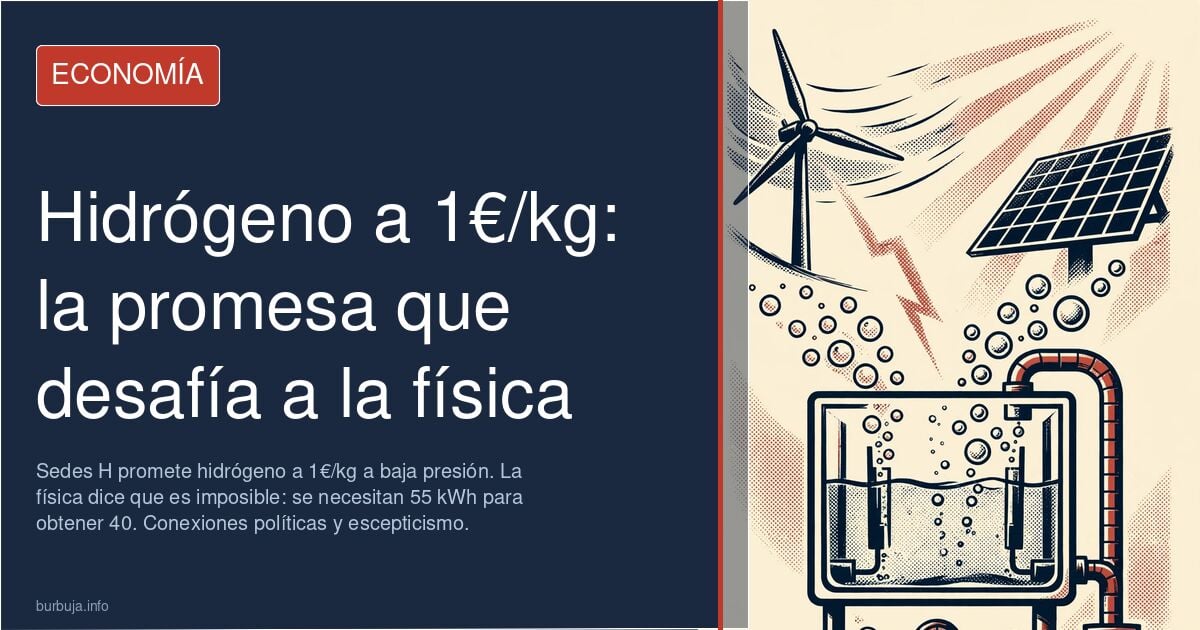
Production isn't free either. Breaking the oxygen-hydrogen bonds in water requires about 55 kWh of energy for every kilogram of hydrogen obtained, which then yields about 40 kWh. In other words, the process consumes more than it returns. The maximum theoretical efficiency pursued in the industry is around 85-90%, and that's with advanced electrolysis and renewable surpluses. The Italian company claims its method is not electrolysis, but doesn't explain what it is. It has also not published a technical paper nor allowed any independent scientist to verify the process.
A Board of Directors Without Scientists
What is known about Sedes H is who surrounds it. Andrea Notaro, managing director of Rothschild & Co, chairs the advisory board. Maria Alberta Viviani Corradi-Cervi appears on the board of directors. According to leaked information, the project has already spent more than 150 million euros. Yet, the company keeps the identity of its R&D members secret, even their initials. The technical staff, they say, is "militarized."
The absence of recognizable technical profiles is the most striking data point. In a project promising to revolutionize the energy sector, one would expect to find at least one name with credentials in chemistry or engineering. None appear. Only executives, advisors, and institutional relations.
The Pattern of Snake Oil Sellers: From Cold Fusion to Murcia Graphene
The history of energy is full of grandiose announcements that faded away. Cold fusion, presented by two Italians in 1989, promised unlimited energy at room temperature. Algae biodiesel attracted millions in investments from major companies before proving economically unviable. Murcia graphene had a bombastic presentation and ended in nothing. Air engines, multiple levers, Iranian magnets... The list is long.
There is a common pattern: when someone has something real, they publish a technical paper, approach investors, and seek recognition from the scientific community. When they have a homemade video recorded in a borrowed library and an audience of retirees, things look bad. Sedes H's announcement fits into the second category.
The Thesis of Control, Not Technology
Some hold a more twisted interpretation. If the project is not technically viable, why do people with so much power push it? The circulating answer is unsettling: we are not facing an attempt to revolutionize energy, but an announcement directed at a select circle. An encrypted message saying: "we have something with which we can increase our control and we will use it." They haven't gone to ask for the Nobel Prize or prove anything to the scientific community. They have gone to communicate to their own that power remains in the same hands.
The company, for its part, renounces any public subsidy. If the technology were real, it wouldn't need it. If it isn't, the renunciation is a way to avoid the scrutiny that comes with public money. Meanwhile, the promised price of one euro per kilo seems like a chimera: a domestic equipment unit costing 20,000 euros with maintenance, consumables, and regeneration would drive the real cost per kilogram far above that figure.
Green hydrogen is undoubtedly a key piece in the energy future. Australia has approved a renewable megaproject the size of Slovenia to produce hydrogen and store surpluses. But that is another story: that of real engineering, with its costs, efficiencies, and limits. Sedes H's story is that of a tale with powerful godparents, 150 million spent, and no proof. Physics, as always, does not negotiate.
In a public library in Milan, a group of well-dressed individuals with financial pedigrees announced something physics considers, at best, a miracle: green hydrogen at one euro per kilogram, produced at room temperature and low pressure, without conventional electrolysis and requiring no subsidies. The company, Sedes H, boasts links to Italian Freemasonry and an advisory board including a managing director from Rothschild & Co. What it does not boast is having a single engineer, chemist, or physicist on its organizational chart.
The Problem with Physics: Numbers That Don't Add Up
Hydrogen is the lightest element and, simultaneously, the most elusive. At atmospheric pressure, one kilogram of gaseous hydrogen occupies 11.2 cubic meters. To give an idea: a tank containing it at room temperature would have to be larger than the vehicle it powered. The gas density at normal pressure is 0.081 kilograms per cubic meter. Storing it without compressing or liquefying it is simply a space problem that no magic wand solves.
Production isn't free either. Breaking the oxygen-hydrogen bonds in water requires about 55 kWh of energy for every kilogram of hydrogen obtained, which then yields about 40 kWh. In other words, the process consumes more than it returns. The maximum theoretical efficiency pursued in the industry is around 85-90%, and that's with advanced electrolysis and renewable surpluses. The Italian company claims its method is not electrolysis, but doesn't explain what it is. It has also not published a technical paper nor allowed any independent scientist to verify the process.
A Board of Directors Without Scientists
What is known about Sedes H is who surrounds it. Andrea Notaro, managing director of Rothschild & Co, chairs the advisory board. Maria Alberta Viviani Corradi-Cervi appears on the board of directors. According to leaked information, the project has already spent more than 150 million euros. Yet, the company keeps the identity of its R&D members secret, even their initials. The technical staff, they say, is "militarized."
The absence of recognizable technical profiles is the most striking data point. In a project promising to revolutionize the energy sector, one would expect to find at least one name with credentials in chemistry or engineering. None appear. Only executives, advisors, and institutional relations.
The Pattern of Snake Oil Sellers: From Cold Fusion to Murcia Graphene
The history of energy is full of grandiose announcements that faded away. Cold fusion, presented by two Italians in 1989, promised unlimited energy at room temperature. Algae biodiesel attracted millions in investments from major companies before proving economically unviable. Murcia graphene had a bombastic presentation and ended in nothing. Air engines, multiple levers, Iranian magnets... The list is long.
There is a common pattern: when someone has something real, they publish a technical paper, approach investors, and seek recognition from the scientific community. When they have a homemade video recorded in a borrowed library and an audience of retirees, things look bad. Sedes H's announcement fits into the second category.
The Thesis of Control, Not Technology
Some hold a more twisted interpretation. If the project is not technically viable, why do people with so much power push it? The circulating answer is unsettling: we are not facing an attempt to revolutionize energy, but an announcement directed at a select circle. An encrypted message saying: "we have something with which we can increase our control and we will use it." They haven't gone to ask for the Nobel Prize or prove anything to the scientific community. They have gone to communicate to their own that power remains in the same hands.
The company, for its part, renounces any public subsidy. If the technology were real, it wouldn't need it. If it isn't, the renunciation is a way to avoid the scrutiny that comes with public money. Meanwhile, the promised price of one euro per kilo seems like a chimera: a domestic equipment unit costing 20,000 euros with maintenance, consumables, and regeneration would drive the real cost per kilogram far above that figure.
Green hydrogen is undoubtedly a key piece in the energy future. Australia has approved a renewable megaproject the size of Slovenia to produce hydrogen and store surpluses. But that is another story: that of real engineering, with its costs, efficiencies, and limits. Sedes H's story is that of a tale with powerful godparents, 150 million spent, and no proof. Physics, as always, does not negotiate.
Also available in: Deutsch
Summary of a discussion on Burbuja.info - Foro de economía, actualidad y política., translated from Spanish and reviewed before publication. Read the full discussion (140 replies).
More summaries
-
María Galiana: 22 years as grandmother and a career she says is lost
María Galiana, 91, states that she wasted her career in 'Cuéntame'. The sector debates whether 22 years of stable pay constitute a triumph or a condemnation.
-
Tyrannicide doctrine and the 48-hour ultimatum to Sánchez
Tyrannicide doctrine and a 48-hour ultimatum to Sánchez: deadlines are shortened and expire, but the law does not provide for any
-
PP and Vox would win 212 seats and reopen electoral reform debate
PP and Vox would win 212 seats: Vox rises to 67, the left loses 40 and PP drops to 145. The majority reopens the debate on Spain's electoral law.
-
Enerparc's Viral Debt: From $33,000 Million to $33.4 Million
A viral tweet attributed a debt of $33,000 million to the German solar company Enerparc; the actual figure being reported is $33.4 million.
-
Spain's new two-star jersey: Official price hits €100
Spain's new two-star jersey launches at €100 for fans and €150 for players. Parallel market replicas were already available for €20.
-
Spain Declassifies CNI Reports on Ceuta Migration Crisis
The Spanish intelligence agency warned the government and Morocco of a mass entry into Ceuta. Why declassify reports now?