
Tyrannicide doctrine and the 48-hour ultimatum to Sánchez
Tyrannicide doctrine and a 48-hour ultimatum to Sánchez: deadlines are shortened and expire, but the law does not provide for any
English · Original discussion in Spanish · Published
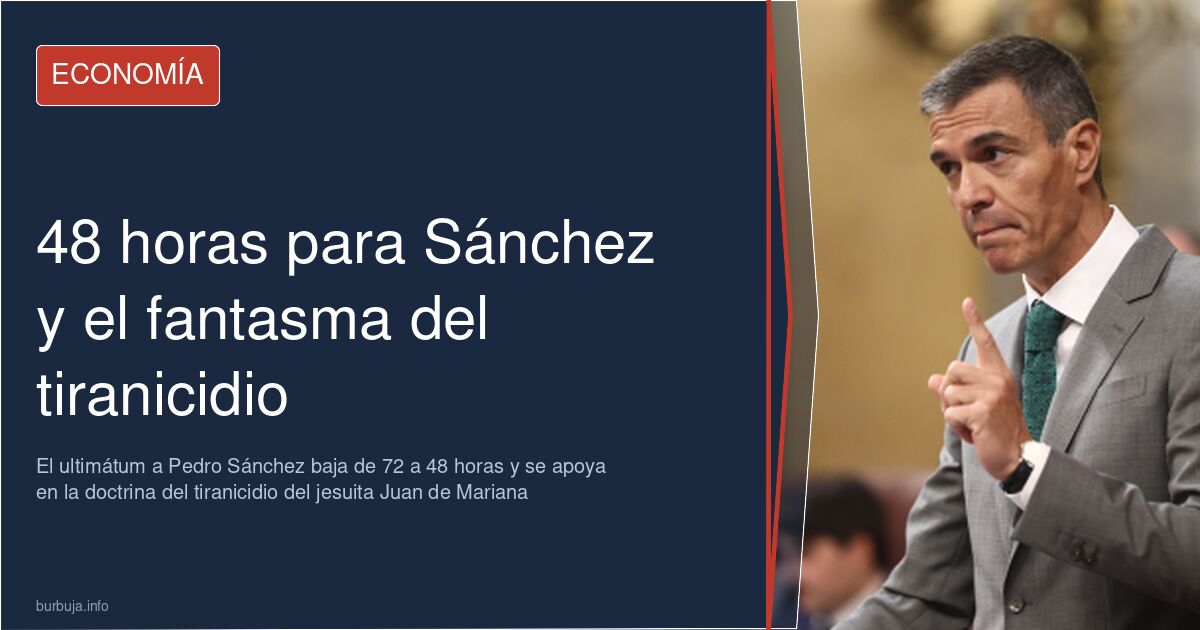
Mariana's tyrannicide and the ultimatum that has already expired twice
The ultimatum has been expiring for three days and has already changed its deadline twice. First it was 72 hours; now it is 48. And with each reduction, the same ritual is repeated: invoking the tyrannicide doctrine of the Jesuit Juan de Mariana to take for granted that a Spanish prime minister has an expiration date. That there is a procedure to force Pedro Sánchez out in two days is simply false. What is striking is not the hoax: it is that, four centuries after it was written, the artifact is still working.
What Juan de Mariana actually said
Juan de Mariana (1536-1624), a Jesuit, published in 1599 De Rege et Regis Institutione, a treatise on royal power. In it he argued that a monarch who becomes a tyrant loses legitimacy and, in extreme circumstances, when there is no other way to save the community, can be deposed. The thesis was incendiary even then: the Sorbonne censured it and the debate cost the Society of Jesus more than one headache. The phrase now circulating about killing the prince as a public enemy comes from that historical context, not from a current manual. Translating it to today's Spain requires a considerable leap of argument.
The 48-hour ultimatum: who issues it and why they don't carry it out
The story circulates without a verifiable sender. It is attributed to a public figure who read aloud a sort of letters, presumably of military origin, and who came to maintain that anyone could stop the tyrant. The nuance matters, because whoever issues the call does not execute it: they know that the incivil consequence falls on whoever takes the first step. Haranguing others is free; moving, not. Hence the ultimatum is always formulated in the third person, as an obligation falling on an abstract subject, and not on whoever writes it.
What the law really allows: little
There is no mechanism that forces resignation for not presenting the General State Budget. The law does not establish that effect and experience confirms it: when the PP did not present them, it was the PSOE that demanded resignation and the Government that refused; now the pressure comes from the opposite side, with the roles reversed. No law contemplates deadlines of 48 or 72 hours. The ultimatum is not legal; it is an emotional wedge that relies on real discontent but with no institutional exit.
The narrative that discredits itself
The most revealing thing is how the narrative itself is consumed. People joke that it is the umpteenth warning of an exit that never comes, the counter is reduced to minutes as a mockery, and it is recalled that every autumn the same prophecy reappears. There are even those who calculate how many hours a day would last on Venus (5,832 Earth hours, about 243 days here) to play with the deadlines. Distrust is transversal: both the one who promises imminent collapse and the one who boasts of armored stability are criticized equally. The wear and tear exists; the ultimatum, however, is cardboard.
If the pattern holds, the counter will restart again. There will be a new deadline, a new letter and a new expired deadline, without any institution having changed a single paper. The tyrannicide doctrine will survive as a slogan much longer than anyone who took it literally would survive.
The ultimatum has been expiring for three days and has already changed its deadline twice. First it was 72 hours; now it is 48. And with each reduction, the same ritual is repeated: invoking the tyrannicide doctrine of the Jesuit Juan de Mariana to take for granted that a Spanish prime minister has an expiration date. That there is a procedure to force Pedro Sánchez out in two days is simply false. What is striking is not the hoax: it is that, four centuries after it was written, the artifact is still working.
What Juan de Mariana actually said
Juan de Mariana (1536-1624), a Jesuit, published in 1599 De Rege et Regis Institutione, a treatise on royal power. In it he argued that a monarch who becomes a tyrant loses legitimacy and, in extreme circumstances, when there is no other way to save the community, can be deposed. The thesis was incendiary even then: the Sorbonne censured it and the debate cost the Society of Jesus more than one headache. The phrase now circulating about killing the prince as a public enemy comes from that historical context, not from a current manual. Translating it to today's Spain requires a considerable leap of argument.
The 48-hour ultimatum: who issues it and why they don't carry it out
The story circulates without a verifiable sender. It is attributed to a public figure who read aloud a sort of letters, presumably of military origin, and who came to maintain that anyone could stop the tyrant. The nuance matters, because whoever issues the call does not execute it: they know that the incivil consequence falls on whoever takes the first step. Haranguing others is free; moving, not. Hence the ultimatum is always formulated in the third person, as an obligation falling on an abstract subject, and not on whoever writes it.
What the law really allows: little
There is no mechanism that forces resignation for not presenting the General State Budget. The law does not establish that effect and experience confirms it: when the PP did not present them, it was the PSOE that demanded resignation and the Government that refused; now the pressure comes from the opposite side, with the roles reversed. No law contemplates deadlines of 48 or 72 hours. The ultimatum is not legal; it is an emotional wedge that relies on real discontent but with no institutional exit.
The narrative that discredits itself
The most revealing thing is how the narrative itself is consumed. People joke that it is the umpteenth warning of an exit that never comes, the counter is reduced to minutes as a mockery, and it is recalled that every autumn the same prophecy reappears. There are even those who calculate how many hours a day would last on Venus (5,832 Earth hours, about 243 days here) to play with the deadlines. Distrust is transversal: both the one who promises imminent collapse and the one who boasts of armored stability are criticized equally. The wear and tear exists; the ultimatum, however, is cardboard.
If the pattern holds, the counter will restart again. There will be a new deadline, a new letter and a new expired deadline, without any institution having changed a single paper. The tyrannicide doctrine will survive as a slogan much longer than anyone who took it literally would survive.
Summary of a discussion on Burbuja.info - Foro de economía, actualidad y política., translated from Spanish and reviewed before publication. Read the full discussion (119 replies).
More summaries
-
Cristina Pardo corners Óscar Puente on Antena 3
Cristina Pardo puts Óscar Puente on the spot on Antena 3, using corruption as a weapon and sparking talk of a changing cycle in the press and its…
-
Spain's 20% housing guarantee caps resale prices permanently
Royal Decree-Law 26/2026 sets maximum resale prices for homes bought with public guarantees, limiting rental income below official reference systems.
-
Spain recognized Israel in 1986, not under Franco
Spain established diplomatic ties with Israel on January 1, 1986, under Felipe González, while maintaining US military bases and defense contracts.
-
Global 10-Year Bond Yields Surge to Decade Highs
US and Japanese 10-year bond yields hit multi-decade highs, with European markets following suit amid growing debt crisis concerns.
-
Spanish TV Journalists Ordered to Delete Monetized YouTube Clips
RTVE ombudsman orders journalists Javier Ruiz and Jesús Cintora to stop monetizing public broadcast clips on personal YouTube channels.
-
US Election: Polls predicted tie, Trump wins presidency
Pre-election polls showed a 269-electoral-vote deadlock. Trump won the presidency and Congress, driving markets higher.