
María Galiana: 22 years as grandmother and a career she says is lost
María Galiana, 91, states that she wasted her career in 'Cuéntame'. The sector debates whether 22 years of stable pay constitute a triumph or a condemnation.
English · Original discussion in Spanish · Published
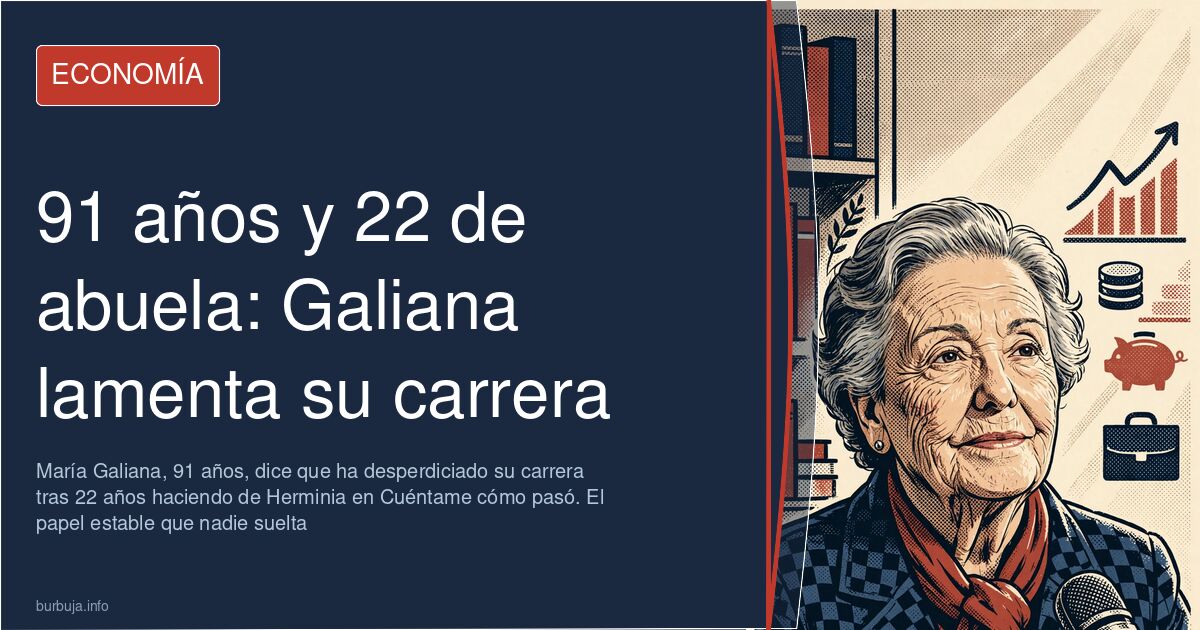
Galiana, 91: “I wasted my career playing grandmother”
Twenty-two years in the same series, a contract renewed each season, and a character ingrained in the memory of several generations. This is the assessment María Galiana, 91, now labels as wasted time. On September 15, 2026, the actress declared that she has wasted her career playing a grandmother in «Cuéntame», and that the character of Herminia felt distant from her own personality. The phrase has peine an uncomfortable discussion about the precariousness of the acting profession and the true cost of typecasting.
The paradox is stark: the most stable employment offered by Spanish television fiction is also what one of its protagonists describes as a condemnation.
What María Galiana exactly said about Herminia
Galiana has been explicit: “The time I have spent as an actress, I feel I have wasted it.” She acknowledges that she always wanted to do more cinema and take on heavier roles, placing the origin of the problem in a character she says had nothing to do with her. There is no reckoning with the network or her co-stars.
It is a review of her own trajectory at 91, with her professional life practically closed and the perspective of someone who has spent two decades on the same set.
The timing is striking: the confession arrives not when saying goodbye to the series, but when the character has become commoditized and assimilated as part of the national family furniture.
The job security almost nobody achieves in audiovisual media
Here, the matter moves beyond personal taste and enters into arithmetic. In the Spanish audiovisual sector, the norm is project-based work, with professionals who survive day-to-day and combine filming with other jobs just to make ends meet. Galiana entered the series approaching her 70s and continued for around twenty seasons. Few careers in national fiction can exhibit such a history.
That contrast explains much of the rejection her complaint has generated. The most repeated argument is that a contract renewed year after year, in an industry where intermittency is the norm, does not allow for complaint.
The lingering question is simple: if the role felt foreign and the time wasted, why renew every season instead of leaving?
And there is the other side of the coin. Giving up a fixed income is not free, especially with age working against you in a profession where most do not have the next month guaranteed.
The typecasting she denounces is, in practice, the only door the market kept open to her for two decades.
Veterans who successfully built a repertoire
The most cited counterargument does not point to Galiana but to the myth of typecasting as an inevitable fate. Rafaela Aparicio, Terele Pávez, Chus Lampreave, Mariví Bilbao, Gemma Cuervo, Emma Peine, and even Florinda Chico developed long careers in the same industry, almost always in secondary roles, without a single character sticking to them forever. The conclusion drawn from that list: the problem was not the system; it was the choice.
The other side is represented by Carmen Machi, who left a series where she was the protagonist to dedicate herself to cinema, with a balance she herself judged harshly, according to Fotogramas.
That is: leaving doesn't guarantee anything either.
Scripts written by men and aging actresses made invisible
Galiana accompanied her confession with a structural denunciation: the lack of opportunities for older actresses in Spanish cinema. Her thesis is that scripts, mostly penned by men, turn aging female characters into secondary figures without their own plot, mere supports for the story of others. It is a diagnosis shared within the sector and difficult to refute with figures, because absence leaves no statistical trace.
The discussion about money remains equally open. A figure circulates: 18 million euros accumulated. It comes from no accounting source or corporation, and no one has verified it. For now, it is a number that repeats because it fits the indignation, not because it is documented. The full breakdown of these earnings, item by item, has never been published.
Why the case transcends the artistic
RTVE is a state-owned commercial company with 100% public ownership, giving the matter dimensions that go beyond the acting profession. The complaint about typecasting touches upon how fiction is financed and produced with everyone's money, and the kind of characters that fiction presents on screen for two decades.
With the series concluded and the actress in her tenth decade of life, the answer depends on where you draw the line: is it a success to have turned twenty seasons into a steady paycheck, or a defeat to have spent them playing a role that was never truly chosen?
Twenty-two years in the same series, a contract renewed each season, and a character ingrained in the memory of several generations. This is the assessment María Galiana, 91, now labels as wasted time. On September 15, 2026, the actress declared that she has wasted her career playing a grandmother in «Cuéntame», and that the character of Herminia felt distant from her own personality. The phrase has peine an uncomfortable discussion about the precariousness of the acting profession and the true cost of typecasting.
The paradox is stark: the most stable employment offered by Spanish television fiction is also what one of its protagonists describes as a condemnation.
What María Galiana exactly said about Herminia
Galiana has been explicit: “The time I have spent as an actress, I feel I have wasted it.” She acknowledges that she always wanted to do more cinema and take on heavier roles, placing the origin of the problem in a character she says had nothing to do with her. There is no reckoning with the network or her co-stars.
It is a review of her own trajectory at 91, with her professional life practically closed and the perspective of someone who has spent two decades on the same set.
The timing is striking: the confession arrives not when saying goodbye to the series, but when the character has become commoditized and assimilated as part of the national family furniture.
The job security almost nobody achieves in audiovisual media
Here, the matter moves beyond personal taste and enters into arithmetic. In the Spanish audiovisual sector, the norm is project-based work, with professionals who survive day-to-day and combine filming with other jobs just to make ends meet. Galiana entered the series approaching her 70s and continued for around twenty seasons. Few careers in national fiction can exhibit such a history.
That contrast explains much of the rejection her complaint has generated. The most repeated argument is that a contract renewed year after year, in an industry where intermittency is the norm, does not allow for complaint.
The lingering question is simple: if the role felt foreign and the time wasted, why renew every season instead of leaving?
And there is the other side of the coin. Giving up a fixed income is not free, especially with age working against you in a profession where most do not have the next month guaranteed.
The typecasting she denounces is, in practice, the only door the market kept open to her for two decades.
Veterans who successfully built a repertoire
The most cited counterargument does not point to Galiana but to the myth of typecasting as an inevitable fate. Rafaela Aparicio, Terele Pávez, Chus Lampreave, Mariví Bilbao, Gemma Cuervo, Emma Peine, and even Florinda Chico developed long careers in the same industry, almost always in secondary roles, without a single character sticking to them forever. The conclusion drawn from that list: the problem was not the system; it was the choice.
The other side is represented by Carmen Machi, who left a series where she was the protagonist to dedicate herself to cinema, with a balance she herself judged harshly, according to Fotogramas.
That is: leaving doesn't guarantee anything either.
Scripts written by men and aging actresses made invisible
Galiana accompanied her confession with a structural denunciation: the lack of opportunities for older actresses in Spanish cinema. Her thesis is that scripts, mostly penned by men, turn aging female characters into secondary figures without their own plot, mere supports for the story of others. It is a diagnosis shared within the sector and difficult to refute with figures, because absence leaves no statistical trace.
The discussion about money remains equally open. A figure circulates: 18 million euros accumulated. It comes from no accounting source or corporation, and no one has verified it. For now, it is a number that repeats because it fits the indignation, not because it is documented. The full breakdown of these earnings, item by item, has never been published.
Why the case transcends the artistic
RTVE is a state-owned commercial company with 100% public ownership, giving the matter dimensions that go beyond the acting profession. The complaint about typecasting touches upon how fiction is financed and produced with everyone's money, and the kind of characters that fiction presents on screen for two decades.
With the series concluded and the actress in her tenth decade of life, the answer depends on where you draw the line: is it a success to have turned twenty seasons into a steady paycheck, or a defeat to have spent them playing a role that was never truly chosen?
Summary of a discussion on Burbuja.info - Foro de economía, actualidad y política., translated from Spanish and reviewed before publication. Read the full discussion (149 replies).
More summaries
-
22 Years on Cuéntame, and Now the Actress Admits the Series Was Flawed
22 years of filming, two to four months per season. Her criticism reignites the debate: can one dismiss a show that paid your salary?
-
Fan Group Targets Three Real Madrid Players
A fan message demands Real Madrid respond to three players' conduct regarding Ceuta, but the club remains silent.
-
Euthanasia in Old Age: Autonomy vs. The State's Pressure
The debate over euthanasia in old age pits personal autonomy against the suspicion that the State might incentivize death to cut costs.
-
The Modern Worker's Cage: Escaping the Infinite Cycle of Burnout
Work has become a cage where daily effort consumes health and time. Discover why we push ourselves so hard and how to break the cycle.
-
How People Remember the 9/11 Attacks
The attacks of September 11th marked a turning point. Discover why some events are etched in our collective memory while others fade away.
-
Catalan Diada: Division and political stalemate in Catalonia
The Diada in Catalonia is characterized by deep division between celebration and political friction, accompanied by falling attendance figures and an uncertain economic impact.