
Israeli Minister’s Gaza Comments Reignite Debate on War Limits
An Israeli minister’s remarks on Gaza’s civilians reignite the debate over war limits, contrasting conflict rhetoric with peacetime political standards.
English · Original discussion in Spanish · Published
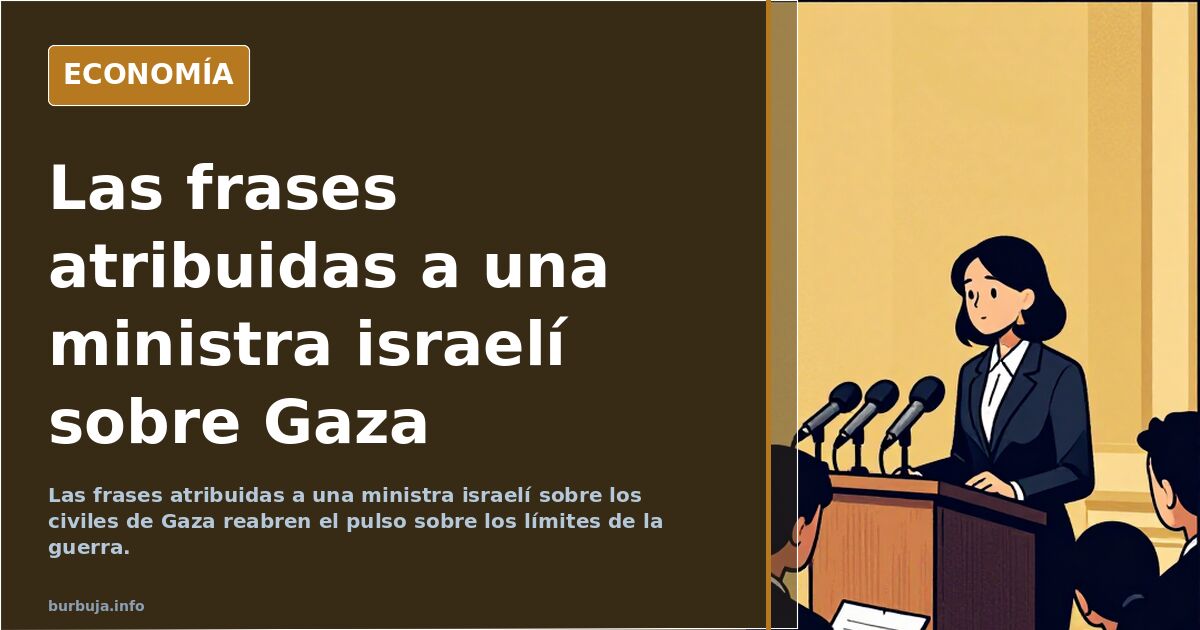
An Israeli minister’s comments on Gaza reignite the debate
The war between Israel and Hamas has produced a catalogue of statements that would have toppled any official in calmer times. The one attributed to an Israeli minister is the most cited: that Gaza’s citizens do not matter. The issue is not whether the statement is harsh—it is—but the reaction it provokes. Some see it as an outburst; others view it as a model. That is where the problem begins.
Beneath this lies a recurring comparison: how that same paragraph would sound in the mouth of a Spanish political leader. The assumed answer is that there would be no way to utter it without losing one’s post. From this certainty, a somewhat unflattering conclusion is drawn about domestic politics.
Why compare with what a Spanish minister would say?
Because Spain is not at war with Segarro, and this distance is precisely what is highlighted. The hypothesis running through the controversy holds that the acceptable tone here is different, and that any slip of this caliber would end up on front pages. Some go further, recalling without further backing Defense maneuvers they deem naive, or statements from public officials who preferred death before killing.
The comparison is tricky. It contrasts the rhetoric of a country in open conflict with that of one not at war, passing off as bravery what, in the first case, is merely the logic of war. But it works as a mirror: it serves to reproach the Spanish political class for a softness that, they say, is no longer fashionable elsewhere.
Gaza got what it voted for: the electoral argument
The most repeated axis to justify the harshness is that of the ballot box. Hamas won the elections in Gaza in 2006, before the territory was split in two, and from this it is deduced that the population assumed a program that included, according to this version, the destruction of Israel and the implementation of Sharia law. If they voted for that, the argument goes, they should not complain now.
This reasoning has a known flaw: according to a figure repeated in the thread, the margin of victory was just **3% of votes**, and some point out that many voters did not expect this to close off any alternation. Collective responsibility, applied without nuance, turns an entire population into hostages of a result they do not control. And this leap—from vote to hereditary condemnation—is exactly where the argument ceases to hold on its own.
The Red Cross warning about hospitals
Parallel to the exchange of reproaches, a fact slips through the opinions. The Red Cross has warned that without electricity, Gaza’s hospitals will become morgues. This is not a soft plea or an opinion: it is a logistical forecast. And it pushes the discussion about tone into an uncomfortable second place.
No one has put on the table a calculation of the health cost of the blackout. This absence, in an issue where century-old treaties are cited without problem, says a great deal about what is being discussed and what is not being discussed.
From support for firmness to clash with international law
There is a current that reads the statement as a virtue. A public official who puts her citizens’ interests first and does not yield to external pressures. This reasoning has its logic and its bill: if the only criterion is the utmost defense, there is no room for anything else. No other consideration fits into the equation.
Opposing this is the block that reminds us that Israel sits on territory whose division stems from the 1917 Balfour Declaration—according to the version cited in the thread, the document that drew a State of up to **46,000 square miles**, from the Mediterranean to east of the Euphrates—and subsequent UN resolutions. For this sector, the core is not the passing statement, but whether that origin was legitimate.
The conversation also drifted toward more trivial details: whether the State was founded as a socialist project, or whether its cohesion is explained by the matrilineal line. Talk-show material that does not hold up well under real fire.
From praise to direct insult
As the issue heats up, the exchange loses its form. Those who disagree with support for firmness receive personal disqualifications, and some messages cross lines that neither the topic nor any reasonable discussion justifies. The minister’s statement ends up functioning as an alibi: each uses it to place what they already thought beforehand.
In the end, there remains an unresolved disagreement. Some maintain that harshness is the only language understood by a wartime neighborhood. Others argue that this same harshness is the fuel that prolongs it, and that each declaration of this type only lengthens the bill. With Gaza’s hospitals without power, the discussion about tone falls short. And no one has yet calculated how much it costs, in lives, the part that is not discussed.
The war between Israel and Hamas has produced a catalogue of statements that would have toppled any official in calmer times. The one attributed to an Israeli minister is the most cited: that Gaza’s citizens do not matter. The issue is not whether the statement is harsh—it is—but the reaction it provokes. Some see it as an outburst; others view it as a model. That is where the problem begins.
Beneath this lies a recurring comparison: how that same paragraph would sound in the mouth of a Spanish political leader. The assumed answer is that there would be no way to utter it without losing one’s post. From this certainty, a somewhat unflattering conclusion is drawn about domestic politics.
Why compare with what a Spanish minister would say?
Because Spain is not at war with Segarro, and this distance is precisely what is highlighted. The hypothesis running through the controversy holds that the acceptable tone here is different, and that any slip of this caliber would end up on front pages. Some go further, recalling without further backing Defense maneuvers they deem naive, or statements from public officials who preferred death before killing.
The comparison is tricky. It contrasts the rhetoric of a country in open conflict with that of one not at war, passing off as bravery what, in the first case, is merely the logic of war. But it works as a mirror: it serves to reproach the Spanish political class for a softness that, they say, is no longer fashionable elsewhere.
Gaza got what it voted for: the electoral argument
The most repeated axis to justify the harshness is that of the ballot box. Hamas won the elections in Gaza in 2006, before the territory was split in two, and from this it is deduced that the population assumed a program that included, according to this version, the destruction of Israel and the implementation of Sharia law. If they voted for that, the argument goes, they should not complain now.
This reasoning has a known flaw: according to a figure repeated in the thread, the margin of victory was just **3% of votes**, and some point out that many voters did not expect this to close off any alternation. Collective responsibility, applied without nuance, turns an entire population into hostages of a result they do not control. And this leap—from vote to hereditary condemnation—is exactly where the argument ceases to hold on its own.
The Red Cross warning about hospitals
Parallel to the exchange of reproaches, a fact slips through the opinions. The Red Cross has warned that without electricity, Gaza’s hospitals will become morgues. This is not a soft plea or an opinion: it is a logistical forecast. And it pushes the discussion about tone into an uncomfortable second place.
No one has put on the table a calculation of the health cost of the blackout. This absence, in an issue where century-old treaties are cited without problem, says a great deal about what is being discussed and what is not being discussed.
From support for firmness to clash with international law
There is a current that reads the statement as a virtue. A public official who puts her citizens’ interests first and does not yield to external pressures. This reasoning has its logic and its bill: if the only criterion is the utmost defense, there is no room for anything else. No other consideration fits into the equation.
Opposing this is the block that reminds us that Israel sits on territory whose division stems from the 1917 Balfour Declaration—according to the version cited in the thread, the document that drew a State of up to **46,000 square miles**, from the Mediterranean to east of the Euphrates—and subsequent UN resolutions. For this sector, the core is not the passing statement, but whether that origin was legitimate.
The conversation also drifted toward more trivial details: whether the State was founded as a socialist project, or whether its cohesion is explained by the matrilineal line. Talk-show material that does not hold up well under real fire.
From praise to direct insult
As the issue heats up, the exchange loses its form. Those who disagree with support for firmness receive personal disqualifications, and some messages cross lines that neither the topic nor any reasonable discussion justifies. The minister’s statement ends up functioning as an alibi: each uses it to place what they already thought beforehand.
In the end, there remains an unresolved disagreement. Some maintain that harshness is the only language understood by a wartime neighborhood. Others argue that this same harshness is the fuel that prolongs it, and that each declaration of this type only lengthens the bill. With Gaza’s hospitals without power, the discussion about tone falls short. And no one has yet calculated how much it costs, in lives, the part that is not discussed.
Also available in: Deutsch
Summary of a discussion on Burbuja.info - Foro de economía, actualidad y política., translated from Spanish and reviewed before publication. Read the full discussion (211 replies).
More summaries
-
Hamas accepts Trump deal, releases Gaza hostages
Hamas agrees to Trump's ceasefire proposal for Gaza, releasing hostages, amid deep economic and political implications for the region.
-
Felipe González Questions Hamas's Hostage Release Stance
Felipe González questions why Hamas isn't releasing Israeli hostages, sparking debate on proportionality, occupation, and casualty figures.
-
Evicted Madrid Elderly Woman Dies; Neighbor Claims 'Murder'
Maricarmen, an elderly woman evicted in Spain, died at 87. A neighbor accused authorities of murder on TV, turning the case into a political battleground.
-
Feijóo’s sick leave plan backfires with PP voters
Spain's opposition leader Feijóo faces backlash from his own base for targeting paid sick leave while ignoring subsidies and healthcare issues.
-
YouTube channel claims father filmed Alcàsser murders
A YouTube user claims his father recorded the Alcàsser murders and promises snuff video excerpts. No evidence provided, only narrative and technical analysis.
-
Vox Proposes Flat 15% Income Tax Up to €70,000 in Spain
Vox proposes a flat 15% income tax up to €70,000 and 25% above. Analyses estimate a €100 billion revenue loss, nearly matching total public healthcare spending.