
Israel Strikes Yemen's Hodeida Port After Drone Attack on Tel Aviv
Israel bombs Hodeida following a drone strike on Tel Aviv. Houthi spokesmen warn retaliatory strikes will target Haifa.
English · Original discussion in Spanish · Published
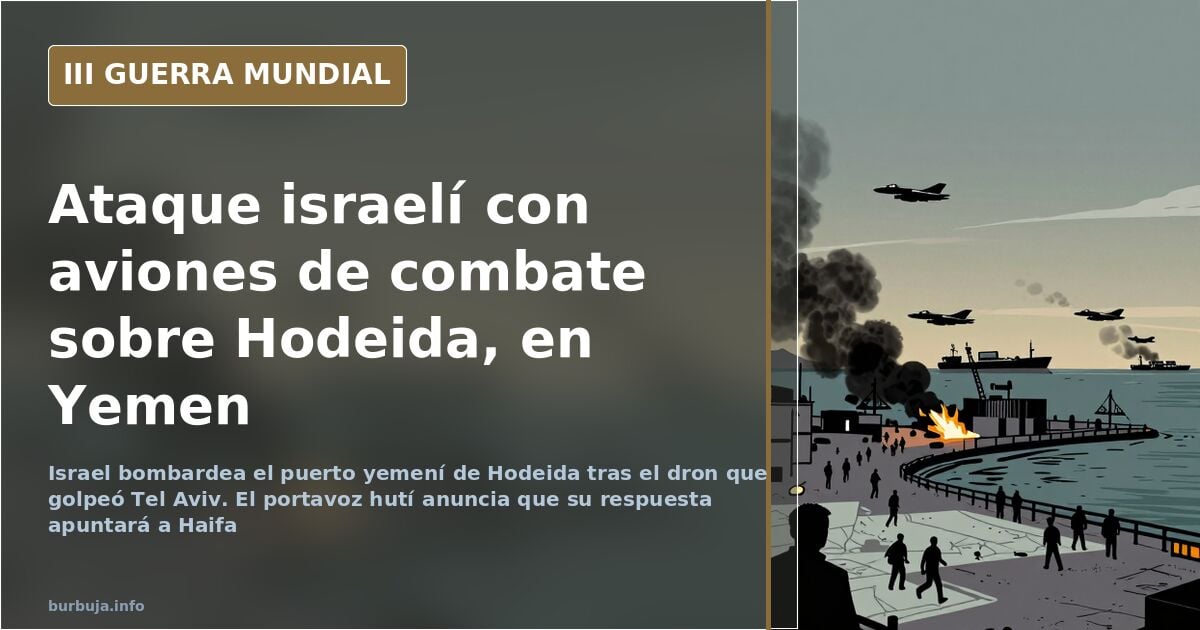
Israel strikes Yemen's Hodeida port after Tel Aviv drone attack
A drone hit Tel Aviv, and hours later, Israeli aircraft bombed the Yemeni port of Hodeida. The sequence is familiar — action, retaliation, and an open ledger — but the key point is not the response itself, but what it demands: dispatching a combat fleet thousands of miles from its bases and sustaining it with aerial refueling. Hodeida has long been a disputed logistical hub. Now it is also a showcase for military reach.
The operation trinc a Yemeni drone strike on Tel Aviv, accompanied by a question that runs through any analysis: where did those planes fly. It is not a technical detail. It is pure politics, and the answer determines who can be angry without breaking anything.
What aircraft attacked Hodeida and where did they fly?
According to Yemeni press reports cited in the discussion, eight F-35 and five F-16 fighter jets carried out the attack. Range calculations suggest the mission was not viable without tanker aircraft, and here emerges the most uncomfortable detail: a KC-767A Italian is mentioned flying near Hodeida, raising the question of whether Rome facilitated the operation or merely coincided in the area. None of this is confirmed.
Nor is the route. Two hypotheses circulate in the discussion: flying over Saudi Arabia or crossing the Red Sea from Eilat. The first implies cooperation that Riyadh has not acknowledged; the second, greater distance and more dependence on aerial refueling. Whoever identifies the route will also know where Yemen can respond.
The targets: fuel, weapons, and a power plant
The fire focused on energy infrastructure. Among the identified targets are fuel depots, oil tankers, and a refinery in the port, as well as ammunition warehouses. Three hours after the attack, the power plant and other points were still burning, according to a message circulated in the debate citing an Israeli source. That unextinguished fire turns a bombing into a message, and simultaneously invites debate on whether the objective was military or simply visible.
The political kitchen of the attack also leaked out. According to a message circulated in the discussion, the Israeli Cabinet would have held an extraordinary session on Saturday, with hardline ministers present, and Benjamin Netanyahu would have insisted on a large-scale operation. His speech was scheduled for 8:30 p.m. Israeli sources framed it as a warning to Tehran: Israel can also strike Iran.
Will Yemen respond? Haifa port in the crosshairs
The Houthi spokesperson quickly announced the target of the retaliation: the port of Haifa. On paper, it sounds like an escalation. On the ground, actual capability is another matter. As one participant argues, previous attempts stayed close to Eilat, neutralized kilometers from the target by air defense systems deployed by Anglo-Saxon forces, and drones testing the Saudi route ended up as target practice for Riyadh's F-15s.
This optimistic narrative has a counterpoint, according to another user: no defense system is perfect, and even AEGIS has shown flaws in exercises. The question is not whether it intercepts everything, but how much it lets through. Meanwhile, messages circulate about power cuts in the Gush Dan area and the settlement of Beitar Illit, attributed to antiestéticar of a Yemeni attack. There is no official confirmation, and these should be treated as what they are: unverified versions.
Disproportion, cost, and the ghost of another Vietnam
The question hovering over all this is the familiar one: is the response proportional? Striking port infrastructure in exchange for a drone invites doubt. The textbook answer is that proportionality is not measured in units, but in deterrence. The skeptical view is that a burning port does not stop an adversary: it hardens them.
And here enters the historical comparison raised by a participant. Lebanon in the seventies, the embassy attack in 1975, Somalia and Mogadishu twenty years later: interventions that began as retaliation and ended as scorched exits. Yemen, moreover, has been bombed for decades, as a user recalls, significantly reducing the element of surprise. Economically, it is speculated that oil futures will surge, and pointedly noted that some profits accompany the flames.
The front multiplies. The same day Israel attacked launchers in southern Lebanon, from which projectiles were fired toward the Golan Heights. It was also circulated that Russia might send missiles to Yemen. Too many open windows for a single neighborhood, and none with a quick exit.
If Haifa port ends up being the next target, the question is not whether Israel will respond again, but how many fronts it can sustain simultaneously before the cost weighs more than the message.
A drone hit Tel Aviv, and hours later, Israeli aircraft bombed the Yemeni port of Hodeida. The sequence is familiar — action, retaliation, and an open ledger — but the key point is not the response itself, but what it demands: dispatching a combat fleet thousands of miles from its bases and sustaining it with aerial refueling. Hodeida has long been a disputed logistical hub. Now it is also a showcase for military reach.
The operation trinc a Yemeni drone strike on Tel Aviv, accompanied by a question that runs through any analysis: where did those planes fly. It is not a technical detail. It is pure politics, and the answer determines who can be angry without breaking anything.
What aircraft attacked Hodeida and where did they fly?
According to Yemeni press reports cited in the discussion, eight F-35 and five F-16 fighter jets carried out the attack. Range calculations suggest the mission was not viable without tanker aircraft, and here emerges the most uncomfortable detail: a KC-767A Italian is mentioned flying near Hodeida, raising the question of whether Rome facilitated the operation or merely coincided in the area. None of this is confirmed.
Nor is the route. Two hypotheses circulate in the discussion: flying over Saudi Arabia or crossing the Red Sea from Eilat. The first implies cooperation that Riyadh has not acknowledged; the second, greater distance and more dependence on aerial refueling. Whoever identifies the route will also know where Yemen can respond.
The targets: fuel, weapons, and a power plant
The fire focused on energy infrastructure. Among the identified targets are fuel depots, oil tankers, and a refinery in the port, as well as ammunition warehouses. Three hours after the attack, the power plant and other points were still burning, according to a message circulated in the debate citing an Israeli source. That unextinguished fire turns a bombing into a message, and simultaneously invites debate on whether the objective was military or simply visible.
The political kitchen of the attack also leaked out. According to a message circulated in the discussion, the Israeli Cabinet would have held an extraordinary session on Saturday, with hardline ministers present, and Benjamin Netanyahu would have insisted on a large-scale operation. His speech was scheduled for 8:30 p.m. Israeli sources framed it as a warning to Tehran: Israel can also strike Iran.
Will Yemen respond? Haifa port in the crosshairs
The Houthi spokesperson quickly announced the target of the retaliation: the port of Haifa. On paper, it sounds like an escalation. On the ground, actual capability is another matter. As one participant argues, previous attempts stayed close to Eilat, neutralized kilometers from the target by air defense systems deployed by Anglo-Saxon forces, and drones testing the Saudi route ended up as target practice for Riyadh's F-15s.
This optimistic narrative has a counterpoint, according to another user: no defense system is perfect, and even AEGIS has shown flaws in exercises. The question is not whether it intercepts everything, but how much it lets through. Meanwhile, messages circulate about power cuts in the Gush Dan area and the settlement of Beitar Illit, attributed to antiestéticar of a Yemeni attack. There is no official confirmation, and these should be treated as what they are: unverified versions.
Disproportion, cost, and the ghost of another Vietnam
The question hovering over all this is the familiar one: is the response proportional? Striking port infrastructure in exchange for a drone invites doubt. The textbook answer is that proportionality is not measured in units, but in deterrence. The skeptical view is that a burning port does not stop an adversary: it hardens them.
And here enters the historical comparison raised by a participant. Lebanon in the seventies, the embassy attack in 1975, Somalia and Mogadishu twenty years later: interventions that began as retaliation and ended as scorched exits. Yemen, moreover, has been bombed for decades, as a user recalls, significantly reducing the element of surprise. Economically, it is speculated that oil futures will surge, and pointedly noted that some profits accompany the flames.
The front multiplies. The same day Israel attacked launchers in southern Lebanon, from which projectiles were fired toward the Golan Heights. It was also circulated that Russia might send missiles to Yemen. Too many open windows for a single neighborhood, and none with a quick exit.
If Haifa port ends up being the next target, the question is not whether Israel will respond again, but how many fronts it can sustain simultaneously before the cost weighs more than the message.
Summary of a discussion on Burbuja.info - Foro de economía, actualidad y política., translated from Spanish and reviewed before publication. Read the full discussion (282 replies).
More summaries
-
Iran's Missiles Strike Tel Aviv as Air Defenses Overwhelmed
Iran launches missiles at Tel Aviv and the IDF orders civilians into shelters. Impacts hit the capital as air defenses fail to cope.
-
Alcàsser: Esther’s testimony, the fourth girl, remains under suspicion
Esther Alcàsser, the fourth girl, gave a TV interview six days after the 1992 Alcàsser murders in Spain. Her account and timeline discrepancies fuel ongoing controversy.
-
Never Attack Russia: The Myth of Russian Invincibility
Ukraine's war revives the myth of Russian invincibility, from the 1853 defeat in Crimea to the 1991 Soviet collapse and current front asymmetry.
-
Intelligence Reports on the Russian Leader’s Health
Analysis of intelligence reports on the Russian leader’s health and its impact on geopolitical stability.
-
Hezbollah Pagers Explode Simultaneously in Beirut
Over 1,000 injured in Lebanon as Hezbollah pagers detonate. The New York Times attributes the incident to a shadow company network.
-
Contrails Blanket Spanish Skies: The 179 Million Ton Vapor Debate
Analysis of contrails covering Spain’s sky, citing 179 million tons of vapor and the ongoing geoengineering controversy.