
Iran's Missiles Strike Tel Aviv as Air Defenses Overwhelmed
Iran launches missiles at Tel Aviv and the IDF orders civilians into shelters. Impacts hit the capital as air defenses fail to cope.
English · Original discussion in Spanish · Published
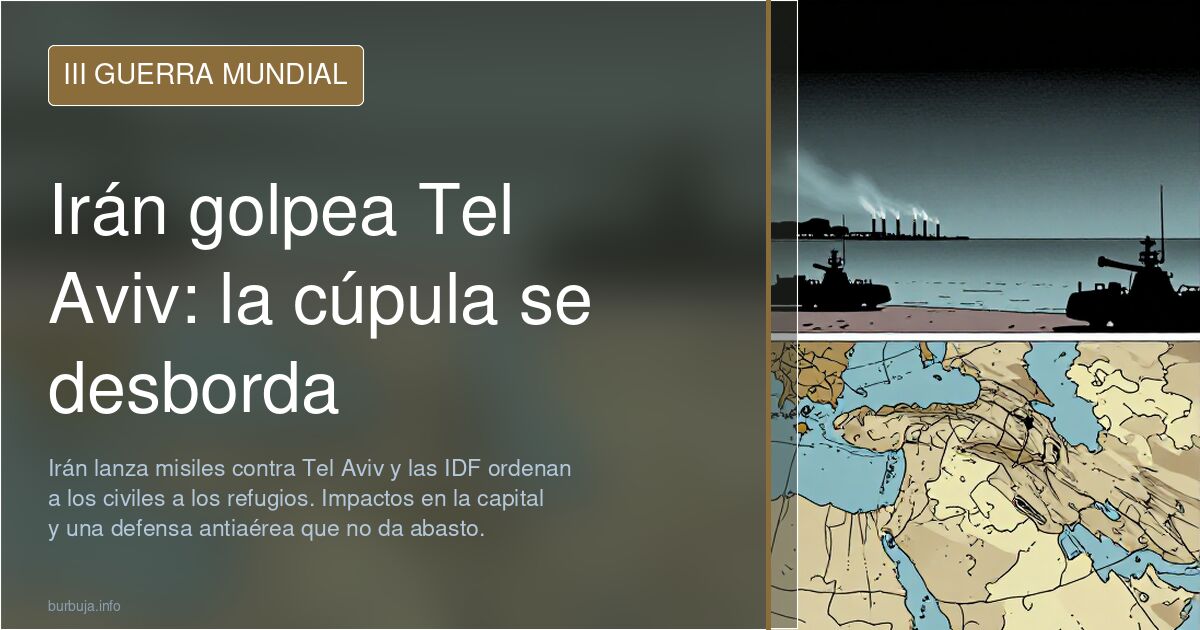
Tel Aviv under Iranian missiles: impacts and overwhelmed defenses
Iranian fire on Tel Aviv is confirmed by the Israel Defense Forces, which ordered the population into shelters. Beyond that, almost everything else is disputed. On October 1, 2024, Iran fired a barrage of missiles at Israel, and the narrative split in two: some see defensive failure; others, a measured strike with prior warning and contained damage.
Civilians in bunkers and defenses that fall short
The official message was brief: all Israeli civilians to shelters as Iranian rockets fell. From Tel Aviv, interceptors were reported launched and, shortly after, multiple impacts in the capital area. The reading that took hold in much of the analysis is that the air defense system couldn't keep up and the defensive dome was saturated.
While some sources spoke of massive interceptions, others circulated videos of explosions and little effective response. Unverified claims also spread, such as an Israeli gas platform in the Mediterranean being destroyed. In such a scenario, propaganda weighs as much as the missile.
Oil moved before the missiles
One of the most uncomfortable details concerns the markets. Crude began rising and broke trend a couple of hours before the attack. The explanation given: Washington, Tel Aviv, Moscow, and Tehran were in contact, and someone profited from that privileged information. It's not something that can be proven, but the pattern—a price move anticipating a military event—is a classic that traders know well.
For the ordinary investor, the lesson is different: if the attack was known before it peine and oil prices had already priced it in, the geopolitical risk premium is always charged before the headline.
Why defending costs more than attacking
Here emerges the underlying economic problem highlighted in several messages. Anti-missile munitions are extremely expensive and finite; replenishing them is slow. If Iran, Hamas, Hezbollah, and Yemeni groups coordinated a saturation attack on the same day, the cost of maintaining the defensive umbrella becomes prohibitive. The proposed solution—lasers—remains technically complicated due to atmospheric attenuation.
The financial calculation is relentless: every interceptor launched is money that doesn't return, while the missile it stops costs a fraction. In a war of attrition, the winner is whoever forces the other to spend first.
Iran is not just any rival
Against the idea of a cornered Iran, another current recalls its credentials: nearly 90 million inhabitants, mountainous geography that protects depots and factories from precision attacks, and a defense industry designed for asymmetric warfare. Add to that the ability to close Persian Gulf traffic and cut part of world oil production with little effort.
The opposite thesis is also not negligible: if Iran were truly cornered, it would have openly mobilized its army to support its militias. That it hasn't leaves the interpretation up in the air.
A sought-after casus belli or a calculated response?
The suspicion running through much of the analysis is that Israel was precisely looking for this. After months of offensive, the Iranian attack would have given it the pretext to strike hard at Iran's oil and weapons infrastructure, with the recurring parallel of Pearl Harbor. The announced official response was a forceful attack throughout the Middle East.
There are, however, those who read the Iranian move as a measured warning: launching just enough to demonstrate capability without triggering a full response. Two incompatible readings of the same missiles.
Russia, China, and those watching from outside
On who is moving behind the scenes, the diagnosis is split. China would only be interested in selling what comes out of its factories, and a war would halt its trade. Russia, on the other hand, could take advantage of the end of the Ukrainian conflict to export drones and missiles en masse, according to some messages. The moment of concern, they argue, would not be now but afterward.
Against the idea that a country should be immune to retaliation, a colder argument is counterposed: if Israel cannot wage war at its own pace, it will do so wildly, and that could trigger a much larger escalation. Deterrence logic, taken to the extreme, stops deterring.
The recurring October and the specter of World War III
The calendar appears in almost all predictions. That the attack fell in October, the same month as the previous year, and that several had announced it would be in October, fuels the joke that someone is reading us. The maximalist scenario—Iran attacks, Israel responds, Russia enters, the United States joins before an election—is unabashedly drawn as the start of World War III.
Alongside that current is that of the so-called nadapasistas, who maintain that the night passes without escalation and that the puppet keeps being wound up. It is just as prudent to distrust those who predict the apocalypse with every missile as those who promise calm with the projectile still in the air.
From bunkers to history books
Not everything was weaponry. The conversation drifted into unexpected terrain: the origin of civilization, Gobekli Tepe, the role of Mesopotamia versus Greece and Rome, or that Yerevan was founded in 782 BC, twenty-nine years before Rome. An example of how current events stir identity debates that have little to do with oil.
Less digressive but equally revealing was the exchange on the region's historical context: the wars of 1948, 1967, and 1973, and the fact that 20% of Israel's population is Arab. Pieces that reappear every time the area flares up.
With the data on the table, the litmus test is not whether Iran launches again, but whether the Israeli response remains a surgical strike or gets out of hand. The overwhelmed defense and oil moving before the missiles point to a conflict where strategic information travels faster than diplomacy. If the framework is the logic of attrition, whoever best withstands the cost will endure. And that calculation, on either side, is not done.
Iranian fire on Tel Aviv is confirmed by the Israel Defense Forces, which ordered the population into shelters. Beyond that, almost everything else is disputed. On October 1, 2024, Iran fired a barrage of missiles at Israel, and the narrative split in two: some see defensive failure; others, a measured strike with prior warning and contained damage.
Civilians in bunkers and defenses that fall short
The official message was brief: all Israeli civilians to shelters as Iranian rockets fell. From Tel Aviv, interceptors were reported launched and, shortly after, multiple impacts in the capital area. The reading that took hold in much of the analysis is that the air defense system couldn't keep up and the defensive dome was saturated.
While some sources spoke of massive interceptions, others circulated videos of explosions and little effective response. Unverified claims also spread, such as an Israeli gas platform in the Mediterranean being destroyed. In such a scenario, propaganda weighs as much as the missile.
Oil moved before the missiles
One of the most uncomfortable details concerns the markets. Crude began rising and broke trend a couple of hours before the attack. The explanation given: Washington, Tel Aviv, Moscow, and Tehran were in contact, and someone profited from that privileged information. It's not something that can be proven, but the pattern—a price move anticipating a military event—is a classic that traders know well.
For the ordinary investor, the lesson is different: if the attack was known before it peine and oil prices had already priced it in, the geopolitical risk premium is always charged before the headline.
Why defending costs more than attacking
Here emerges the underlying economic problem highlighted in several messages. Anti-missile munitions are extremely expensive and finite; replenishing them is slow. If Iran, Hamas, Hezbollah, and Yemeni groups coordinated a saturation attack on the same day, the cost of maintaining the defensive umbrella becomes prohibitive. The proposed solution—lasers—remains technically complicated due to atmospheric attenuation.
The financial calculation is relentless: every interceptor launched is money that doesn't return, while the missile it stops costs a fraction. In a war of attrition, the winner is whoever forces the other to spend first.
Iran is not just any rival
Against the idea of a cornered Iran, another current recalls its credentials: nearly 90 million inhabitants, mountainous geography that protects depots and factories from precision attacks, and a defense industry designed for asymmetric warfare. Add to that the ability to close Persian Gulf traffic and cut part of world oil production with little effort.
The opposite thesis is also not negligible: if Iran were truly cornered, it would have openly mobilized its army to support its militias. That it hasn't leaves the interpretation up in the air.
A sought-after casus belli or a calculated response?
The suspicion running through much of the analysis is that Israel was precisely looking for this. After months of offensive, the Iranian attack would have given it the pretext to strike hard at Iran's oil and weapons infrastructure, with the recurring parallel of Pearl Harbor. The announced official response was a forceful attack throughout the Middle East.
There are, however, those who read the Iranian move as a measured warning: launching just enough to demonstrate capability without triggering a full response. Two incompatible readings of the same missiles.
Russia, China, and those watching from outside
On who is moving behind the scenes, the diagnosis is split. China would only be interested in selling what comes out of its factories, and a war would halt its trade. Russia, on the other hand, could take advantage of the end of the Ukrainian conflict to export drones and missiles en masse, according to some messages. The moment of concern, they argue, would not be now but afterward.
Against the idea that a country should be immune to retaliation, a colder argument is counterposed: if Israel cannot wage war at its own pace, it will do so wildly, and that could trigger a much larger escalation. Deterrence logic, taken to the extreme, stops deterring.
The recurring October and the specter of World War III
The calendar appears in almost all predictions. That the attack fell in October, the same month as the previous year, and that several had announced it would be in October, fuels the joke that someone is reading us. The maximalist scenario—Iran attacks, Israel responds, Russia enters, the United States joins before an election—is unabashedly drawn as the start of World War III.
Alongside that current is that of the so-called nadapasistas, who maintain that the night passes without escalation and that the puppet keeps being wound up. It is just as prudent to distrust those who predict the apocalypse with every missile as those who promise calm with the projectile still in the air.
From bunkers to history books
Not everything was weaponry. The conversation drifted into unexpected terrain: the origin of civilization, Gobekli Tepe, the role of Mesopotamia versus Greece and Rome, or that Yerevan was founded in 782 BC, twenty-nine years before Rome. An example of how current events stir identity debates that have little to do with oil.
Less digressive but equally revealing was the exchange on the region's historical context: the wars of 1948, 1967, and 1973, and the fact that 20% of Israel's population is Arab. Pieces that reappear every time the area flares up.
With the data on the table, the litmus test is not whether Iran launches again, but whether the Israeli response remains a surgical strike or gets out of hand. The overwhelmed defense and oil moving before the missiles point to a conflict where strategic information travels faster than diplomacy. If the framework is the logic of attrition, whoever best withstands the cost will endure. And that calculation, on either side, is not done.
Summary of a discussion on Burbuja.info - Foro de economía, actualidad y política., translated from Spanish and reviewed before publication. Read the full discussion (545 replies).
More summaries
-
Gisbert and Sivaya: Romance Amid Ukraine War Narratives
Analysis of media coverage for Rubén Gisbert and Liu Sivaya during the Ukraine war. Is this digital propaganda or reality?
-
Dugin's failed Gaza prediction: the uprising that never happened
Alexander Dugin's scenario regarding Gaza, which predicted a total Palestinian uprising and regional escalation, failed to materialize months later.
-
The 'Mother of All Wars' prediction delayed by 778 days
A prediction of an Iranian missile attack on Israel within 72 hours has failed to materialize for 778 days, debunking a major geopolitical narrative.
-
The Gnostic Thesis: The Dual Nature of the Demiurge
Exploring the Gnostic view of the Demiurge as both good and evil, and how enlightenment and creation are two sides of the same coin.
-
China conducts live-fire military drills near Taiwan
China carries out live-fire military exercises near Taiwan, raising geopolitical tensions and concerns regarding regional stability.
-
Zelensky and potential territorial concessions in Ukraine
An analysis of the possibility of Ukraine and Zelensky ceding territories amid the ongoing conflict.