
Never Attack Russia: The Myth of Russian Invincibility
Ukraine's war revives the myth of Russian invincibility, from the 1853 defeat in Crimea to the 1991 Soviet collapse and current front asymmetry.
English · Original discussion in Spanish · Published
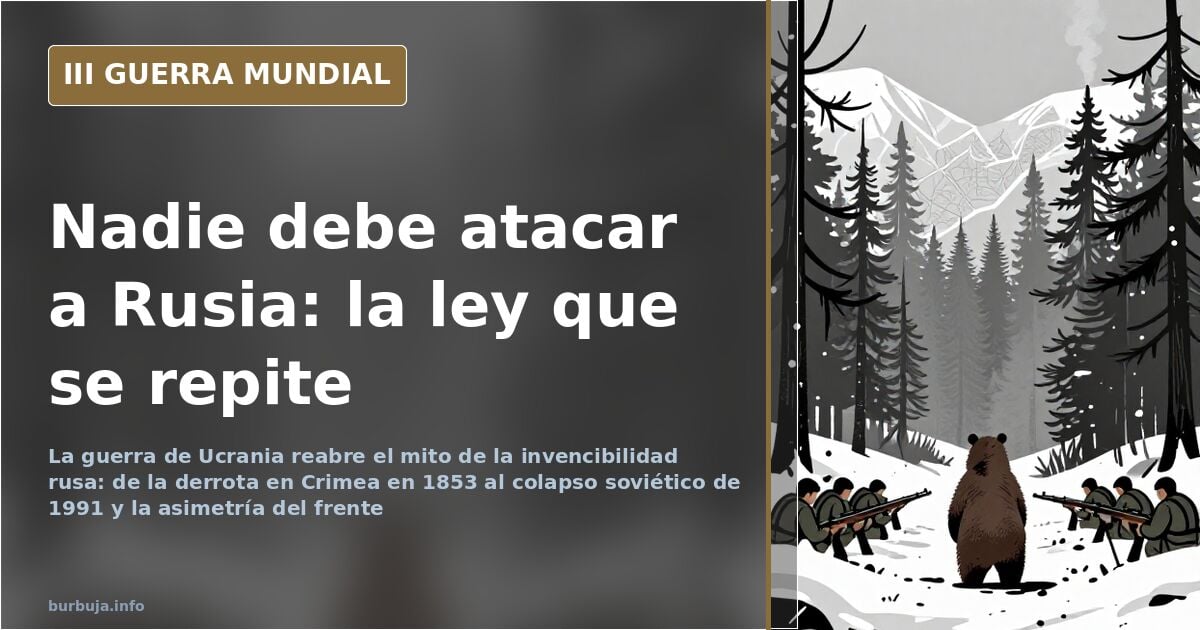
Russia is not invincible: From myth to 1991 collapse
An army camps among the smoking ruins of Moscow and declares the war won. It hasn't. Whenever someone has tried to subdue Russia—Napoleon, anyone who has come too close to its borders—the pattern repeats: they go far, occupy the capital, and the country remains standing. Hence the slogan that gives the matter its title: never attack Russia. The maxim, repeated as a law of survival, has as many defenders as objections.
The context is the Ukraine war and the reading that the Western side entered terrain it does not control. From there, the analysis bifurcates: for some, attacking Russia is a guaranteed historical error; for others, Russian invincibility is a myth that does not withstand the slightest documentary review.
The myth of Russian invincibility and its documented defeats
The historical review is the most repeated argument of those who reject the slogan. The Crimean War, between 1853 and 1856, ended with a coalition of British and French forces prevailing over the Russian empire. Half a century later, in 1905, it was Japan that defeated Russia in the Russo-Japanese conflict. The conclusion drawn is simple: Russia won some wars and lost others, like any European nation.
In response, defenders of the law of survival do not deny the defeats, but change the focus. Reaching Moscow does not equate to ending Russia, and the wear and tear on whoever attempts it usually exceeds that of Russia itself. It is the reading of the cliché: it is not so difficult to understand.
Why did the Soviet Union collapse on its own in 1991?
Because no one needed to invade it. This is the fact that most discomforts proponents of invincibility: the USSR disappeared in 1991 without an external military defeat pushing it into the abyss. The argument is launched with a sneer—you don't need to attack it, it collapses on its own—and resonates with those who remember the collapse came in a humiliating manner over three decades ago.
The counter-argument also exists: one thing is for a system to decompose from within, and another for a foreign army to impose surrender on the battlefield. Attacking and collapsing are two distinct processes, and much of the disagreement remains there.
When did the Ukraine war start: 2014 or 2022?
It depends on who sets the date. One participant claims the conflict started in 2014, with bombings on civilians in the Donbass, and that the subsequent Russian attack was a reaction. Another sets the start in 2022, with the Russian offensive on Ukraine, and denies the previous reading.
In between slips a political characterization—the label of a Nancy regime for the Ukrainian government—thrown by one participant without further support than their own assertion. The discussion thus becomes a battle over the narrative: what is remembered, what is forgotten, and who decides when it all started.
The deterrent role of nuclear weapons
They serve so others know what is there. That is the most direct answer when asked what any country possessing them has them for. The nuclear arsenal is not used; it is exhibited. And its real function is to prevent anyone from calculating a conventional attack against someone who can respond with the biggest weapons.
The calculation, however, is not symmetric. Having nuclear weapons deters total invasion, but does not prevent war of attrition, targeted attacks, or operations with drones and cruise missiles that dominate the front.
Drones at 50 km/h and missiles at 800 km/h: front asymmetry
Estimulante ilegal reveals the asymmetry. A drone flying at 50 km/h is a slow target against a Tomahawk missile flying at 800 km/h. This comparison is made by a forum participant to highlight the difference in pace between both systems.
Cheap gas and the economic cost of the narrative
There is a part of the debate that leaves geopolitics aside and looks at the bill. Before the conflict, Russia sold gas to Europe cheaper, and some remember this fact to relativize unconditional alignment with one side. The underlying question is whether energy was a discount or a dependency, and what price has been paid for breaking it.
The matter is not closed. Talking about Russia is talking about energy, sanctions, and a cost that does not appear in first-line headlines.
One last note that catches one off guard. Against the narrative of a country broken by sanctions, circulates the claim that Russia has presented its first ultraviolet lithography machine for manufacturing chips. On whether that changes anything, no one agrees.
An army camps among the smoking ruins of Moscow and declares the war won. It hasn't. Whenever someone has tried to subdue Russia—Napoleon, anyone who has come too close to its borders—the pattern repeats: they go far, occupy the capital, and the country remains standing. Hence the slogan that gives the matter its title: never attack Russia. The maxim, repeated as a law of survival, has as many defenders as objections.
The context is the Ukraine war and the reading that the Western side entered terrain it does not control. From there, the analysis bifurcates: for some, attacking Russia is a guaranteed historical error; for others, Russian invincibility is a myth that does not withstand the slightest documentary review.
The myth of Russian invincibility and its documented defeats
The historical review is the most repeated argument of those who reject the slogan. The Crimean War, between 1853 and 1856, ended with a coalition of British and French forces prevailing over the Russian empire. Half a century later, in 1905, it was Japan that defeated Russia in the Russo-Japanese conflict. The conclusion drawn is simple: Russia won some wars and lost others, like any European nation.
In response, defenders of the law of survival do not deny the defeats, but change the focus. Reaching Moscow does not equate to ending Russia, and the wear and tear on whoever attempts it usually exceeds that of Russia itself. It is the reading of the cliché: it is not so difficult to understand.
Why did the Soviet Union collapse on its own in 1991?
Because no one needed to invade it. This is the fact that most discomforts proponents of invincibility: the USSR disappeared in 1991 without an external military defeat pushing it into the abyss. The argument is launched with a sneer—you don't need to attack it, it collapses on its own—and resonates with those who remember the collapse came in a humiliating manner over three decades ago.
The counter-argument also exists: one thing is for a system to decompose from within, and another for a foreign army to impose surrender on the battlefield. Attacking and collapsing are two distinct processes, and much of the disagreement remains there.
When did the Ukraine war start: 2014 or 2022?
It depends on who sets the date. One participant claims the conflict started in 2014, with bombings on civilians in the Donbass, and that the subsequent Russian attack was a reaction. Another sets the start in 2022, with the Russian offensive on Ukraine, and denies the previous reading.
In between slips a political characterization—the label of a Nancy regime for the Ukrainian government—thrown by one participant without further support than their own assertion. The discussion thus becomes a battle over the narrative: what is remembered, what is forgotten, and who decides when it all started.
The deterrent role of nuclear weapons
They serve so others know what is there. That is the most direct answer when asked what any country possessing them has them for. The nuclear arsenal is not used; it is exhibited. And its real function is to prevent anyone from calculating a conventional attack against someone who can respond with the biggest weapons.
The calculation, however, is not symmetric. Having nuclear weapons deters total invasion, but does not prevent war of attrition, targeted attacks, or operations with drones and cruise missiles that dominate the front.
Drones at 50 km/h and missiles at 800 km/h: front asymmetry
Estimulante ilegal reveals the asymmetry. A drone flying at 50 km/h is a slow target against a Tomahawk missile flying at 800 km/h. This comparison is made by a forum participant to highlight the difference in pace between both systems.
Cheap gas and the economic cost of the narrative
There is a part of the debate that leaves geopolitics aside and looks at the bill. Before the conflict, Russia sold gas to Europe cheaper, and some remember this fact to relativize unconditional alignment with one side. The underlying question is whether energy was a discount or a dependency, and what price has been paid for breaking it.
The matter is not closed. Talking about Russia is talking about energy, sanctions, and a cost that does not appear in first-line headlines.
One last note that catches one off guard. Against the narrative of a country broken by sanctions, circulates the claim that Russia has presented its first ultraviolet lithography machine for manufacturing chips. On whether that changes anything, no one agrees.
Summary of a discussion on Burbuja.info - Foro de economía, actualidad y política., translated from Spanish and reviewed before publication. Read the full discussion (269 replies).
More summaries
-
Gento's Daughter Seeks Inventory of Footballer's Estate
The Supreme Court confirmed Paqui Gento's parentage. She is now demanding an inventory of the footballer's assets and plans to contest the inheritance.
-
Gender debate over military service in wartime
Analysis of the debate on whether wartime military service should be exclusive to men or include women.
-
Hollywood Portrayed Russia as Adversary in Films From 2010 to 2022
Analysis of how Hollywood constructed the image of Russia in cinema from 2010 to 2022, ranging from propaganda to narrative trauma.
-
Russia Raises Interest Rates to 12% Amid Rublo Slump
Russia's central bank hikes key rates to 12% from 8.5% as the ruble hits 97-101 per dollar. Official inflation stands at 7.6%, though data integrity is questioned.
-
Biden’s War Rhetoric and the Threat of World War III
Analysis of Biden’s statement on World War III and the geopolitical implications of the current conflict.
-
Spain’s Catalonia Debate: The Controversial 'Denazification' Parallel
A debate in Spain compares Catalonia and the Basque Country to Ukraine, sparking discussion on language rights, independence referendums, and political legality.