
Contrails Blanket Spanish Skies: The 179 Million Ton Vapor Debate
Analysis of contrails covering Spain’s sky, citing 179 million tons of vapor and the ongoing geoengineering controversy.
English · Original discussion in Spanish · Published
Contrails Blanket Spanish Skies: The 179 Million Ton Vapor Debate
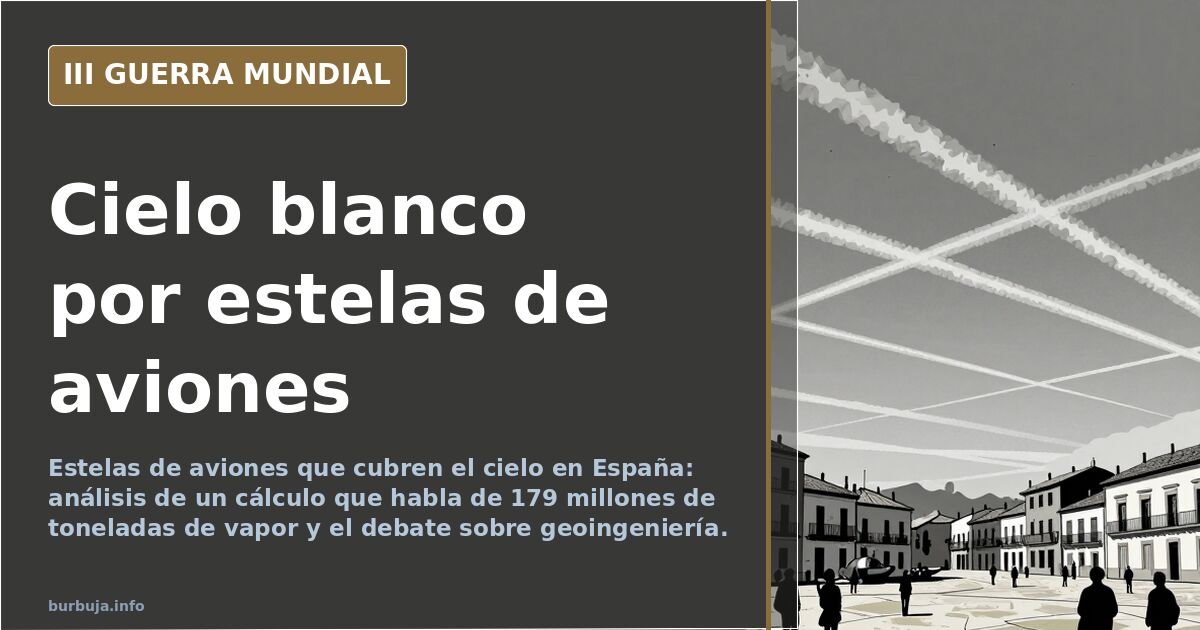
The sky over Spain has changed. What were once ephemeral condensation trails now expand into a whitish layer blocking clear sunlight. Since late January 2024, the density and persistence of these contrails over areas like Mallorca or the Levant have fueled suspicions of deliberate atmospheric alteration.
The 179 Million Ton Calculation
The debate intensified after a social media analysis proposed a chilling calculation. Assuming a trail thickness of 100 meters expanding over kilometers, the affected area on Mallorca (3,640 km²) would generate a vapor volume equivalent to 179 million tons. For skeptical observers, this figure suggests industrial-scale manipulation of atmospheric humidity, comparable to the country’s water reserves.
The reaction of the scientific and technical community in discussion forums has been divided. On one hand, some argue that physics prevents such a large amount of moisture from remaining suspended without precipitation. According to these calculations, a particle absorbing such water mass should fall by its own weight, contradicting geoengineering theories as a drought tool. However, other participants cite recent patents, such as US 2022/0002159 A1 on graphene oxide nanoparticles, which could act as condensation nuclei without immediate precipitation.
The Controversy: Vapor or Additives
The technical discussion centers on whether the trails are simply water vapor that dissipates or contain additives that modify their behavior. While the official version attributes persistence to stable weather conditions, critics point to the absence of wind and anomalous expansion as evidence of intervention. The use of silver iodide to induce rain is mentioned, a practice that is open, but whether there is an inverse version: preventing rain or modifying solar radiation, is questioned.
Public perception is clear: many observers report an increase in the frequency and duration of these formations, especially during nighttime hours. The open question is whether we are facing a natural climate change amplified by air traffic or large-scale geoengineering whose long-term effects on agriculture and health have not yet been officially quantified.
Why are contrails persistent today and not before?
The most accepted technical answer is increased air traffic combined with specific atmospheric conditions. Nevertheless, the persistence of the haze and the lateral expansion of the trails remain subjects of study and public debate.
What substances are used in cloud seeding?
The use of silver iodide to precipitate rain is known. In contrast, the use of additives to *prevent* precipitation or modify solar radiation lacks clear public regulation, although patents exist on nanoparticles that could fulfill this function.
Is exposure to these trails dangerous?
There is no definitive medical consensus. Some experts warn about the possible inhalation of metallic or chemical particles, while others maintain they are simply ice crystals. It is recommended to consult a health professional for persistent respiratory symptoms.
The sky over Spain has changed. What were once ephemeral condensation trails now expand into a whitish layer blocking clear sunlight. Since late January 2024, the density and persistence of these contrails over areas like Mallorca or the Levant have fueled suspicions of deliberate atmospheric alteration.
The 179 Million Ton Calculation
The debate intensified after a social media analysis proposed a chilling calculation. Assuming a trail thickness of 100 meters expanding over kilometers, the affected area on Mallorca (3,640 km²) would generate a vapor volume equivalent to 179 million tons. For skeptical observers, this figure suggests industrial-scale manipulation of atmospheric humidity, comparable to the country’s water reserves.
The reaction of the scientific and technical community in discussion forums has been divided. On one hand, some argue that physics prevents such a large amount of moisture from remaining suspended without precipitation. According to these calculations, a particle absorbing such water mass should fall by its own weight, contradicting geoengineering theories as a drought tool. However, other participants cite recent patents, such as US 2022/0002159 A1 on graphene oxide nanoparticles, which could act as condensation nuclei without immediate precipitation.
The Controversy: Vapor or Additives
The technical discussion centers on whether the trails are simply water vapor that dissipates or contain additives that modify their behavior. While the official version attributes persistence to stable weather conditions, critics point to the absence of wind and anomalous expansion as evidence of intervention. The use of silver iodide to induce rain is mentioned, a practice that is open, but whether there is an inverse version: preventing rain or modifying solar radiation, is questioned.
Public perception is clear: many observers report an increase in the frequency and duration of these formations, especially during nighttime hours. The open question is whether we are facing a natural climate change amplified by air traffic or large-scale geoengineering whose long-term effects on agriculture and health have not yet been officially quantified.
Why are contrails persistent today and not before?
The most accepted technical answer is increased air traffic combined with specific atmospheric conditions. Nevertheless, the persistence of the haze and the lateral expansion of the trails remain subjects of study and public debate.
What substances are used in cloud seeding?
The use of silver iodide to precipitate rain is known. In contrast, the use of additives to *prevent* precipitation or modify solar radiation lacks clear public regulation, although patents exist on nanoparticles that could fulfill this function.
Is exposure to these trails dangerous?
There is no definitive medical consensus. Some experts warn about the possible inhalation of metallic or chemical particles, while others maintain they are simply ice crystals. It is recommended to consult a health professional for persistent respiratory symptoms.
Summary of a discussion on Burbuja.info - Foro de economía, actualidad y política., translated from Spanish and reviewed before publication. Read the full discussion (270 replies).
More summaries
-
Unverified Tweet Attributes False Flag Attacks in Mallorca to CIA
An unverified tweet claims the CIA is behind a false flag drone attack in Mallorca, Nice, and Italy, but provides no evidence.
-
Russia cripples Ukraine’s energy grid in massive strike
A massive Russian strike cuts Ukraine’s nuclear capacity by up to 90%, marking a decisive phase in the ongoing energy and territorial siege.
-
Iran: US and Israel’s Preventive Strike and Return of Military Service
Iran, home to 90 million people, faces a joint preventive strike by Israel and the US. Washington considers reinstating the draft, while the WHO warns of nuclear risks.
-
Iran on the Brink: Death Toll Rises Amid Regime Crisis
Iran protests: between 5,000 and 30,000 dead. The ayatollahs' regime stumbles as the international community watches.
-
Free natal chart readings: The promise that never arrived
A forum user offered free chart interpretations, several consultees found them accurate, but eleven months later, requests remain unfulfilled.
-
Kremlin offers Ukraine 'Swedish-style' neutrality, Kiev rejects it
The Kremlin proposes a neutral status with its own army, similar to Sweden or Austria. Ukraine firmly rejects the proposal, maintaining its stance on sovereignty and defense.