
Israel strikes Damascus and Aleppo airports, Syria confirms
Syria confirms Israeli missile strikes on Aleppo and Damascus airports following recent rocket exchanges with Israel.
English · Original discussion in Spanish · Published
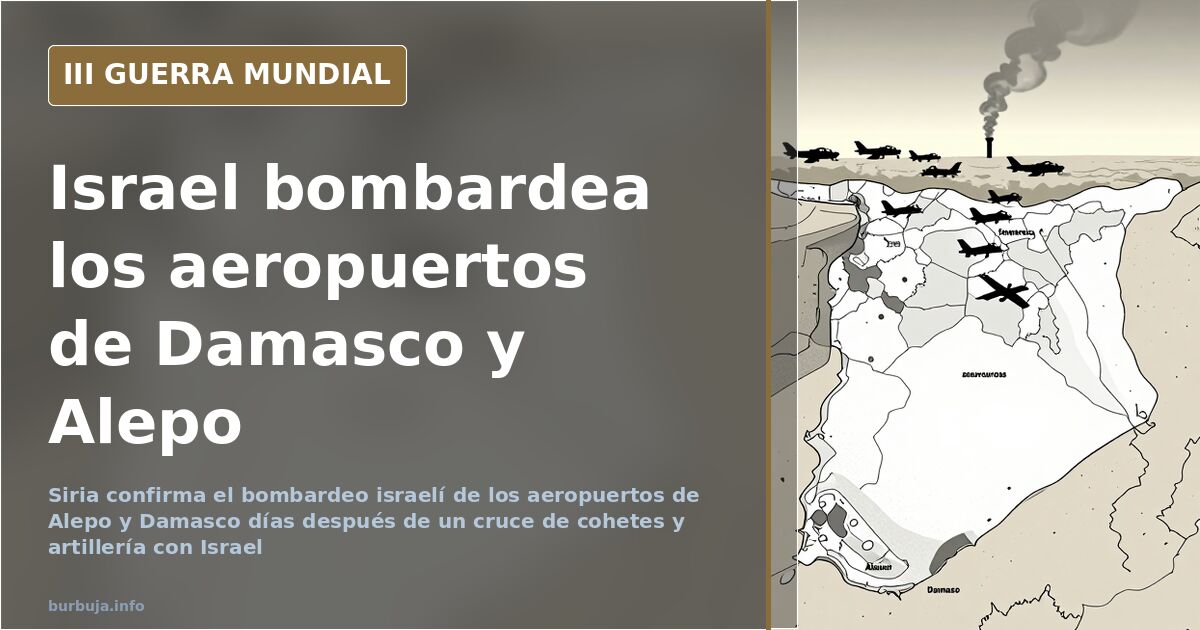
Syria confirms Israeli airstrikes on Damascus and Aleppo
The Syrian Ministry of Defense confirmed the Israeli missile attack on the international airports of Aleppo and Damascus. The confirmation came through official Syrian channels, accompanied by a twist that raises eyebrows: days prior, Syria reportedly launched rockets at Israel, which responded with artillery fire. If anyone expected a surgical operation, things are getting complicated.
This action doesn't come out of nowhere. Israel has been striking targets in Syria for years, often without much public reaction. The question is no longer what peine, but how much room Israel has to escalate further.
What we know about the Aleppo and Damascus bombings
The targets were two international airports, one in Aleppo and one in Damascus. According to Damascus, the authorship is Israeli. Information circulates via outlets like Europapress, Ideal, and Israel Noticias, citing the official Syrian confirmation.
That is the documented part. Beyond that, interpretations vary. Some analyses argue that previous attacks by pro-Iranian militias against Israel—using a base near Nawa, in Daraa, as a rocket launch site—justify the retaliation. The counter-argument is that bombing two civilian airports in a sovereign country is not retaliation, but punishment. The pattern Israel claims to pursue is well-known: ammunition depots, buildings linked to Iran's missile program, anti-aircraft positions, and airports used to introduce military material. Civilian infrastructure ends up paying the price.
The IRGC and pro-Iranian militias: the underlying reason
Here lies the core issue rarely explained in news broadcasts. The Iranian Revolutionary Guard Corps (IRGC) operates in Syria not only with its own resources but through an extensive network of coordinated Sarracinist militias. The country functions as a logistical corridor between Tehran and its regional allies, and this corridor is what Israel attempts to cut.
It is not a whim. It is a sustained strategy turning Syria into the ground where Iran and Israel settle scores without facing each other directly. Syria has aided these groups, one reading suggests; it must bear the consequences. Harsh, but it defines the underlying logic. Some recall that Armenia was also a node in these networks. Others remember that Israel once supported Sarracinists fighting Assad, while Russia defended the Syrian regime on the ground. There is also an unconfirmed judicial theory circulating that Likud financed Hamas to weaken moderate Palestinians.
Double standards: sanctions for some, silence for others
The most repeated argument isn't about Syria. It's about international law. When Russia launches a preemptive strike, there are sanctions. Iran, which hasn't invaded anyone, faces sanctions. Cuba, a impoverished island, faces sanctions. Venezuela, sanctions. Israel attacks Syria and nothing happens.
The conclusion drawn is uncomfortable and old: international law is the law of the strongest, just as it was 6000 years ago, only now with mobile phones and drones. Criticism doesn't demand neutrality; it demands, at minimum, not pretending the standard is the same for everyone.
October, Friday the 13th, and antiestéticar of escalation
Then there is the background noise, which in this matter is never just noise. The Hamas leader has called for jihad worldwide. There is talk of Hezbollah, the Golan Heights, and a clear message to Lebanon: proportional responses, just enough. And above all, the calendar: October.
Some recall the massacre of the Templars, dated a Friday, October 13, 1307, as the origin of all calendar superstitions. Others remember the 1967 war and those of 1968 and 1973, which left Egypt and Jordan unable to respond for years. The sense that Israel is settling old scores with its neighbors permeates much of the analysis.
There is also a antiestéticar unrelated to missiles: the idea that such a crisis could justify more control, more security, and fewer questions. Theories about a coordinated mobilization of migrant populations in Europe have no supporting evidence, yet they circulate as easily as false figures. What if it all ends in a ceasefire, a few headlines, and the same entrenched region? The other bet, the one nobody wants to win, is that this is the first chapter, not the last.
The Syrian Ministry of Defense confirmed the Israeli missile attack on the international airports of Aleppo and Damascus. The confirmation came through official Syrian channels, accompanied by a twist that raises eyebrows: days prior, Syria reportedly launched rockets at Israel, which responded with artillery fire. If anyone expected a surgical operation, things are getting complicated.
This action doesn't come out of nowhere. Israel has been striking targets in Syria for years, often without much public reaction. The question is no longer what peine, but how much room Israel has to escalate further.
What we know about the Aleppo and Damascus bombings
The targets were two international airports, one in Aleppo and one in Damascus. According to Damascus, the authorship is Israeli. Information circulates via outlets like Europapress, Ideal, and Israel Noticias, citing the official Syrian confirmation.
That is the documented part. Beyond that, interpretations vary. Some analyses argue that previous attacks by pro-Iranian militias against Israel—using a base near Nawa, in Daraa, as a rocket launch site—justify the retaliation. The counter-argument is that bombing two civilian airports in a sovereign country is not retaliation, but punishment. The pattern Israel claims to pursue is well-known: ammunition depots, buildings linked to Iran's missile program, anti-aircraft positions, and airports used to introduce military material. Civilian infrastructure ends up paying the price.
The IRGC and pro-Iranian militias: the underlying reason
Here lies the core issue rarely explained in news broadcasts. The Iranian Revolutionary Guard Corps (IRGC) operates in Syria not only with its own resources but through an extensive network of coordinated Sarracinist militias. The country functions as a logistical corridor between Tehran and its regional allies, and this corridor is what Israel attempts to cut.
It is not a whim. It is a sustained strategy turning Syria into the ground where Iran and Israel settle scores without facing each other directly. Syria has aided these groups, one reading suggests; it must bear the consequences. Harsh, but it defines the underlying logic. Some recall that Armenia was also a node in these networks. Others remember that Israel once supported Sarracinists fighting Assad, while Russia defended the Syrian regime on the ground. There is also an unconfirmed judicial theory circulating that Likud financed Hamas to weaken moderate Palestinians.
Double standards: sanctions for some, silence for others
The most repeated argument isn't about Syria. It's about international law. When Russia launches a preemptive strike, there are sanctions. Iran, which hasn't invaded anyone, faces sanctions. Cuba, a impoverished island, faces sanctions. Venezuela, sanctions. Israel attacks Syria and nothing happens.
The conclusion drawn is uncomfortable and old: international law is the law of the strongest, just as it was 6000 years ago, only now with mobile phones and drones. Criticism doesn't demand neutrality; it demands, at minimum, not pretending the standard is the same for everyone.
October, Friday the 13th, and antiestéticar of escalation
Then there is the background noise, which in this matter is never just noise. The Hamas leader has called for jihad worldwide. There is talk of Hezbollah, the Golan Heights, and a clear message to Lebanon: proportional responses, just enough. And above all, the calendar: October.
Some recall the massacre of the Templars, dated a Friday, October 13, 1307, as the origin of all calendar superstitions. Others remember the 1967 war and those of 1968 and 1973, which left Egypt and Jordan unable to respond for years. The sense that Israel is settling old scores with its neighbors permeates much of the analysis.
There is also a antiestéticar unrelated to missiles: the idea that such a crisis could justify more control, more security, and fewer questions. Theories about a coordinated mobilization of migrant populations in Europe have no supporting evidence, yet they circulate as easily as false figures. What if it all ends in a ceasefire, a few headlines, and the same entrenched region? The other bet, the one nobody wants to win, is that this is the first chapter, not the last.
Summary of a discussion on Burbuja.info - Foro de economía, actualidad y política., translated from Spanish and reviewed before publication. Read the full discussion (143 replies).
More summaries
-
Aleppo falls in hours as Syria changes hands all the way to Damascus
Insurgent offensive takes Aleppo in hours and advances to Damascus while Israel occupies southern Syria with little resistance
-
Gisbert and Sivaya: Romance Amid Ukraine War Narratives
Analysis of media coverage for Rubén Gisbert and Liu Sivaya during the Ukraine war. Is this digital propaganda or reality?
-
Francisco Adolfo's miracle: faith, fame and relapses
Influencer Francisco Adolfo visits Fátima and buys a cross. Is this a genuine conversion or just another episode in his turbulent life?
-
Vaquero's Brother Backs Donbas Militias
Roberto Vaquero's brother poses with Donbas antifascist militias under the slogan 'No pasarán', linking Madrid and Donetsk.
-
Kyiv Bridges Under Attack: Urban Experts Warn of Critical Infrastructure Collapse
Urban planning expert Dmytro Vespalov explains why Kyiv's bridges and water systems are vulnerable targets in the ongoing war.
-
Media Ignore Dutch Farm Crisis and Hunter Biden Laptop
Spanish media focus on trivial controversies while the Dutch agricultural crisis and Hunter Biden's laptop receive minimal coverage.