
Israel delays Iran retaliation amid escalation fears
Iran launched drones and missiles, mostly intercepted. Netanyahu vows a 'wise' response while his cabinet fears broader conflict.
English · Original discussion in Spanish · Published
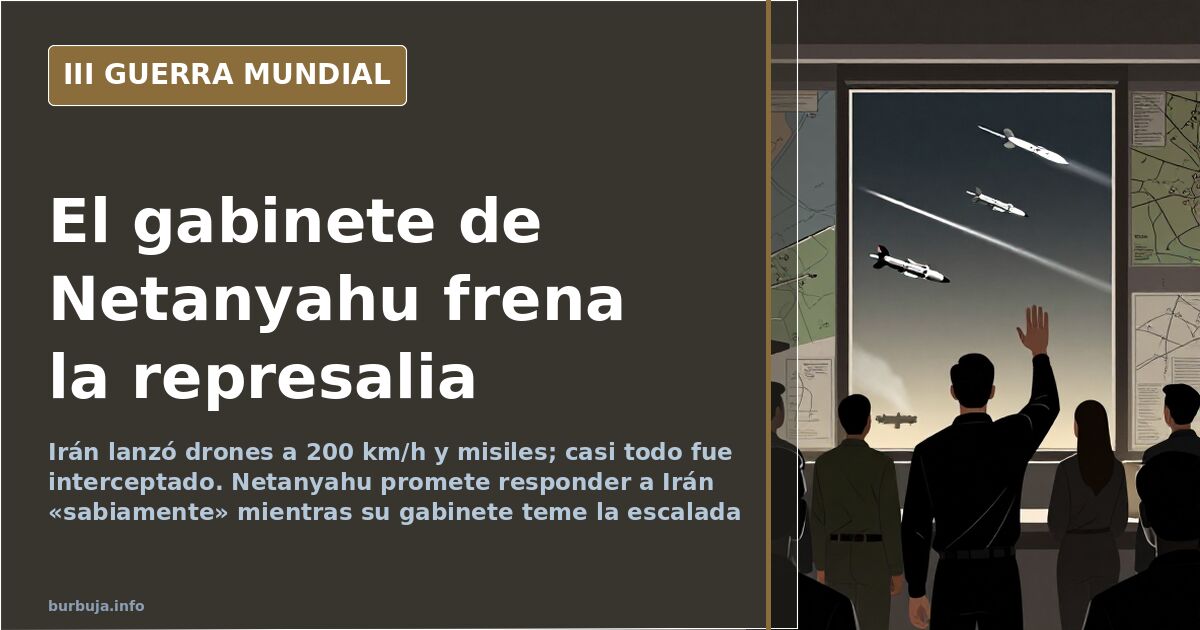
Netanyahu promises to respond to Iran but his cabinet antiestéticars escalation
Iran launched hundreds of drones and missiles against Israel. The drones flew at about 200 km/h and took time to arrive; the missiles, much faster, were delayed like a rock star at a party. Almost everything was destroyed before hitting targets, according to circulating reports. Amid the noise, Benjamin Netanyahu left the phrase that sums up the dilemma: "We will respond to Iran, but we must do so wisely and not from the gut. They must be under stress as they put us." From there, the lingering question is ugly. Has Israel responded or stood still? Israel has backed down, summarizes the most repeated reading. It is not just bravado: the Israeli cabinet itself, the cost of interception, and dependence on Washington point in the same direction.
Netanyahu promises to respond and sets no date
[Wisely]. That word supports all the restraint. The Israeli prime minister announced retaliation but qualified it until it was almost empty: no acting from the guts. Israeli television provided the fine print. Channel 12 reported that members of Netanyahu's cabinet antiestéticar Iran's reaction and seriousness and do not want to provoke a wider attack. In other words: retaliation exists in discourse but not in the calendar. For some, this is strategic prudence. For others, it confirms that the pulse was lost before starting it.
Defending costs more than attacking
The most repeated calculation is counterintuitive. Attacking is cheaper than defending. The reliability of defense relies on sending two or three interceptors when a projectile enters airspace, because with only one, failure probabilities remain high. Each night of missile shield is an enormous bill someone pays. And that someone, according to circulating analyses, is not Israel: it points directly to the United States. With an election schedule around the corner, some argue the White House does not find the joke funny. The other data ordering the pulse, according to calculations circulating in the thread, is demographic and economic. Iran and Israel have similar GDPs, but Iran has 7 or 8 times more population and much more poverty. A larger and poorer country withstands bombing worse but endures long attrition better. There lies the asymmetry no one wants to explain aloud.
Why doesn't Israel bomb Iran alone?
Because it probably cannot. According to comments, Israel lacks its own refueling tankers for its F-35s: without US provision, aircraft cannot go, bomb, and return. Military autonomy becomes relative when range depends on a third party. Added to this is the political clock. According to circulating analyses, a regional war in the Middle East puts the White House tenant into an economic and electoral hole he does not need. Some argue the Iranian attack served mainly for Israel to discover how much each defense night costs and who ends up paying it.
Iran is not Gaza
One line argues the Iranian response was almost theatrical: an entire arsenal launched to hurt a child, they say, with prior warning included. Against this, it is recalled that Israel could not prevent a few from crossing its border and killing over a thousand innocent people in one day, while now it boasts of destroying anything approaching by air. Some argue certain missiles reached military bases, and many assumed an outcome identical to Gaza. The third position is the most uncomfortable: Israel does not need to attack. If the Iranian attack has not proven an existential threat, retaliation can wait for the ideal occasion. Israelis, they say, sleep more peacefully today than yesterday.
From Toledo keys to the usual cliché
There is a digression worth the whole episode. Someone recalled that Sephardic families keep keys to houses their ancestors left in Spain in the 15th century, expelled over five hundred years ago, and teach their children a Spanish almost no one uses anymore. Skepticism arrived quickly: the same TV that accompanies an elderly man to a door in Toledo and calls emotion the key turning is the one fabricating stories to please an audience. It may be true. It may be a TV resource. What admits no discussion is the use made of the anecdote. In part of the conversation, the usual clichés about alleged global economic control by a group appeared. These are assertions without documentary proof, the kind that poisons any conflict analysis without providing a single datum. With this material, the question of whether Israel stood still has no closed answer. Verifiable is that its cabinet calculates, its missile shield costs a fortune, and its aviation depends on an ally in an election year. Retaliation remains on the table. On the table and without date.
Iran launched hundreds of drones and missiles against Israel. The drones flew at about 200 km/h and took time to arrive; the missiles, much faster, were delayed like a rock star at a party. Almost everything was destroyed before hitting targets, according to circulating reports. Amid the noise, Benjamin Netanyahu left the phrase that sums up the dilemma: "We will respond to Iran, but we must do so wisely and not from the gut. They must be under stress as they put us." From there, the lingering question is ugly. Has Israel responded or stood still? Israel has backed down, summarizes the most repeated reading. It is not just bravado: the Israeli cabinet itself, the cost of interception, and dependence on Washington point in the same direction.
Netanyahu promises to respond and sets no date
[Wisely]. That word supports all the restraint. The Israeli prime minister announced retaliation but qualified it until it was almost empty: no acting from the guts. Israeli television provided the fine print. Channel 12 reported that members of Netanyahu's cabinet antiestéticar Iran's reaction and seriousness and do not want to provoke a wider attack. In other words: retaliation exists in discourse but not in the calendar. For some, this is strategic prudence. For others, it confirms that the pulse was lost before starting it.
Defending costs more than attacking
The most repeated calculation is counterintuitive. Attacking is cheaper than defending. The reliability of defense relies on sending two or three interceptors when a projectile enters airspace, because with only one, failure probabilities remain high. Each night of missile shield is an enormous bill someone pays. And that someone, according to circulating analyses, is not Israel: it points directly to the United States. With an election schedule around the corner, some argue the White House does not find the joke funny. The other data ordering the pulse, according to calculations circulating in the thread, is demographic and economic. Iran and Israel have similar GDPs, but Iran has 7 or 8 times more population and much more poverty. A larger and poorer country withstands bombing worse but endures long attrition better. There lies the asymmetry no one wants to explain aloud.
Why doesn't Israel bomb Iran alone?
Because it probably cannot. According to comments, Israel lacks its own refueling tankers for its F-35s: without US provision, aircraft cannot go, bomb, and return. Military autonomy becomes relative when range depends on a third party. Added to this is the political clock. According to circulating analyses, a regional war in the Middle East puts the White House tenant into an economic and electoral hole he does not need. Some argue the Iranian attack served mainly for Israel to discover how much each defense night costs and who ends up paying it.
Iran is not Gaza
One line argues the Iranian response was almost theatrical: an entire arsenal launched to hurt a child, they say, with prior warning included. Against this, it is recalled that Israel could not prevent a few from crossing its border and killing over a thousand innocent people in one day, while now it boasts of destroying anything approaching by air. Some argue certain missiles reached military bases, and many assumed an outcome identical to Gaza. The third position is the most uncomfortable: Israel does not need to attack. If the Iranian attack has not proven an existential threat, retaliation can wait for the ideal occasion. Israelis, they say, sleep more peacefully today than yesterday.
From Toledo keys to the usual cliché
There is a digression worth the whole episode. Someone recalled that Sephardic families keep keys to houses their ancestors left in Spain in the 15th century, expelled over five hundred years ago, and teach their children a Spanish almost no one uses anymore. Skepticism arrived quickly: the same TV that accompanies an elderly man to a door in Toledo and calls emotion the key turning is the one fabricating stories to please an audience. It may be true. It may be a TV resource. What admits no discussion is the use made of the anecdote. In part of the conversation, the usual clichés about alleged global economic control by a group appeared. These are assertions without documentary proof, the kind that poisons any conflict analysis without providing a single datum. With this material, the question of whether Israel stood still has no closed answer. Verifiable is that its cabinet calculates, its missile shield costs a fortune, and its aviation depends on an ally in an election year. Retaliation remains on the table. On the table and without date.
Also available in: Deutsch
Summary of a discussion on Burbuja.info - Foro de economía, actualidad y política., translated from Spanish and reviewed before publication. Read the full discussion (117 replies).
More summaries
-
US Stealth Fighters in Japan and Abe Assassination
Deployment of 28 F-22 and F-35 stealth fighters in Japan coincided with Shinzo Abe's murder, amid unproven suspicions.
-
Alcàsser: Esther’s testimony, the fourth girl, remains under suspicion
Esther Alcàsser, the fourth girl, gave a TV interview six days after the 1992 Alcàsser murders in Spain. Her account and timeline discrepancies fuel ongoing controversy.
-
US military movements: drills or 'something huge'?
Videos of military columns in Michigan, Alabama and Pennsylvania circulate with warnings of 'something huge'. National Guard maneuvers are suspected.
-
Iran execution hoax: Viral tweet lacked source
A viral tweet falsely attributed an Iran plan to execute 15,000 protesters to Newsweek. The domain mismatched and the figure was never verified.
-
Russian army accused of sexual abuse and prostitution
Allegations of sexual exploitation in the Russian military resurface, citing The Guardian and NBC News, amid growing debate over traditional values.
-
Mariupol: From 'One Week' to Over a Month of Siege
Mariupol remains unconquered despite predictions for March 20; by April 3, the siege at Azovstal still traps defenders.