
Mariupol: From 'One Week' to Over a Month of Siege
Mariupol remains unconquered despite predictions for March 20; by April 3, the siege at Azovstal still traps defenders.
English · Original discussion in Spanish · Published
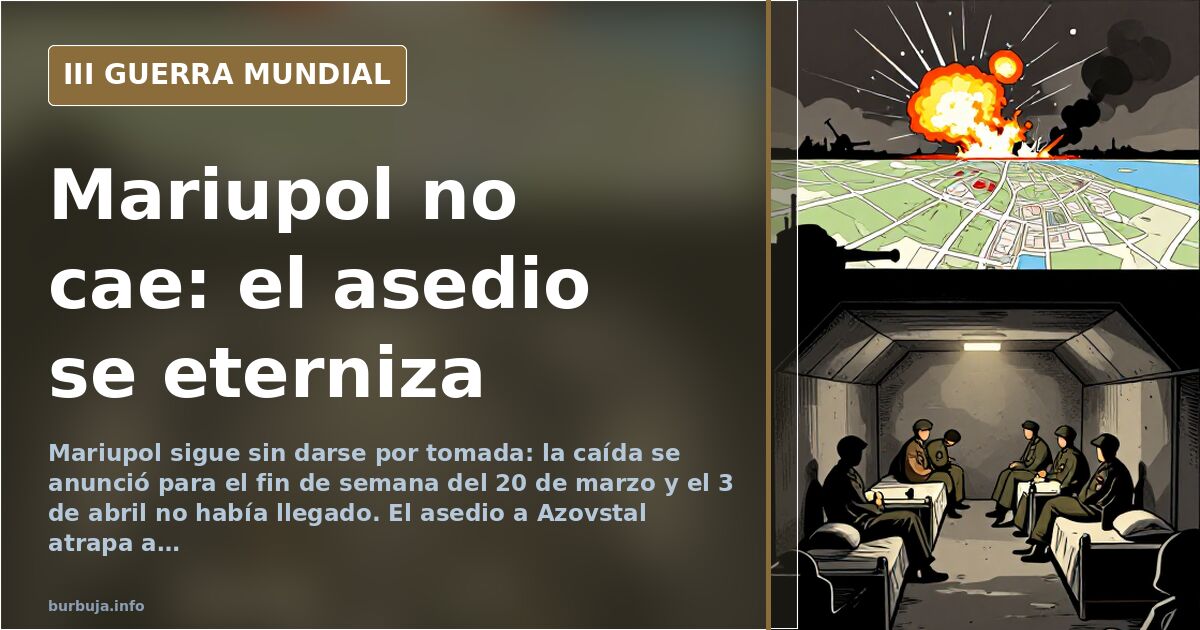
Mariupol Holds: From 'One Week' to Over a Month of Siege
The capture of Mariupol has not been a matter of days, nor even one week. The port city resists as the encirclement of its last defensive stronghold, the Azovstal steel plant, keeps Russian forces and pro-Russian militias in a struggle that stretches day after day. Early forecasts placed the fall on the weekend of March 20. By April 3, the city remained unconquered, and predictions were pushed back again. A joke circulating among observers sums it up bluntly: "Mariupol is about to fall. No matter when you read this."
Why Hasn't Mariupol Fallen If It Was Supposed to Take Days?
The most common argument cites entrenched defenders. Part of the garrison has retreated into urban positions and the steelworks itself, where house-to-house combat and industrial galleries turn every advance into a slow operation. Pro-Russian sources claim the priority is avoiding civilian casualties, citing this as the real reason for the delay. The opposing view is starker: the besieging army lacks the urgency once assumed.
A third, more uncomfortable reading exists. Defenders do not surrender because, according to some analyses, they perceive that laying down arms guarantees nothing. Hence the standoff: those inside know resistance prolongs their situation, while those outside know each day of siege makes victory costlier. Attrition warfare is indeed played against the clock.
Possession Is Not Control: The Map Argument
A recurring question in conflict tracking is what it truly means to capture a city. Some use tonalidad-coded maps to highlight vast territory under Russian control, arguing that halted columns don't change the balance. The counterargument is that holding an area on a map does not equal controlling the ground, especially when an organized garrison remains inside, firing mortars and pinning besieging troops in static positions.
The phrase capturing this tension—winning in possession but not control—has become the conflict's unintentional joke: having the tonalidad painted on the map yet being unable to declare the city taken.
Azovstal Steel Plant: Why 2,000 Men Tie Down an Army
The core of resistance lies in the steelworks, an industrial complex with tunnels housing an estimated 2,000 soldiers. This fact completely changes the siege's dynamics: as long as these men remain inside, the city cannot be declared fully conquered, and surrounding troops are tied to a containment mission.
Observers calculate a zero-sum game. Men and resources used to surround the steelworks are not fighting in the Donbas. Each extra week of coastal siege reduces capacity on the main front, effectively turning the plant into a piece that slows the entire operation.
From Hannibal to Stalingrad: Historical Comparisons
Historical analogies have calibrated expectations. Hannibal took years to reach Rome's outskirts, a reminder offered with irony, and he certainly wasn't helping anyone cross the street. In Stalingrad, the most cited example, clearing the city took about four weeks after the official surrender date. The underlying idea is that urban sieges never end when paper is signed.
Another persistent data point is distance: Mariupol is about 60 kilometers from the border, in territory where Moscow supposedly enjoys strong pro-Russian support. That such a nearby city holds out for weeks is, for many analysts, the clearest indicator that things haven't gone as planned. Social backing is also debated: while some claim the city was historically hostile to the central government, others note such majorities were measured in flawed processes with large portions of the population absent.
Civilians, Conflicting Accounts, and Unverifiable Narratives
Civilian usage is another open front. Pro-Russian sides claim defenders rely on neighbors, preventing rapid assaults. The other side responds that siege operations themselves trap those unable to leave. Neither version has independent verification here; they should be treated as mutual accusations amid a siege.
What is verifiable is the practical effect. Each unresolved day adds pressure on the besiegers' timeline and on the defenders' endurance.
With the steelworks still held by defenders, the city floats in a gray zone where no one can claim total victory or deny it entirely. Forecasts have burned through one after another. The latest, like the first, remains undated.
The capture of Mariupol has not been a matter of days, nor even one week. The port city resists as the encirclement of its last defensive stronghold, the Azovstal steel plant, keeps Russian forces and pro-Russian militias in a struggle that stretches day after day. Early forecasts placed the fall on the weekend of March 20. By April 3, the city remained unconquered, and predictions were pushed back again. A joke circulating among observers sums it up bluntly: "Mariupol is about to fall. No matter when you read this."
Why Hasn't Mariupol Fallen If It Was Supposed to Take Days?
The most common argument cites entrenched defenders. Part of the garrison has retreated into urban positions and the steelworks itself, where house-to-house combat and industrial galleries turn every advance into a slow operation. Pro-Russian sources claim the priority is avoiding civilian casualties, citing this as the real reason for the delay. The opposing view is starker: the besieging army lacks the urgency once assumed.
A third, more uncomfortable reading exists. Defenders do not surrender because, according to some analyses, they perceive that laying down arms guarantees nothing. Hence the standoff: those inside know resistance prolongs their situation, while those outside know each day of siege makes victory costlier. Attrition warfare is indeed played against the clock.
Possession Is Not Control: The Map Argument
A recurring question in conflict tracking is what it truly means to capture a city. Some use tonalidad-coded maps to highlight vast territory under Russian control, arguing that halted columns don't change the balance. The counterargument is that holding an area on a map does not equal controlling the ground, especially when an organized garrison remains inside, firing mortars and pinning besieging troops in static positions.
The phrase capturing this tension—winning in possession but not control—has become the conflict's unintentional joke: having the tonalidad painted on the map yet being unable to declare the city taken.
Azovstal Steel Plant: Why 2,000 Men Tie Down an Army
The core of resistance lies in the steelworks, an industrial complex with tunnels housing an estimated 2,000 soldiers. This fact completely changes the siege's dynamics: as long as these men remain inside, the city cannot be declared fully conquered, and surrounding troops are tied to a containment mission.
Observers calculate a zero-sum game. Men and resources used to surround the steelworks are not fighting in the Donbas. Each extra week of coastal siege reduces capacity on the main front, effectively turning the plant into a piece that slows the entire operation.
From Hannibal to Stalingrad: Historical Comparisons
Historical analogies have calibrated expectations. Hannibal took years to reach Rome's outskirts, a reminder offered with irony, and he certainly wasn't helping anyone cross the street. In Stalingrad, the most cited example, clearing the city took about four weeks after the official surrender date. The underlying idea is that urban sieges never end when paper is signed.
Another persistent data point is distance: Mariupol is about 60 kilometers from the border, in territory where Moscow supposedly enjoys strong pro-Russian support. That such a nearby city holds out for weeks is, for many analysts, the clearest indicator that things haven't gone as planned. Social backing is also debated: while some claim the city was historically hostile to the central government, others note such majorities were measured in flawed processes with large portions of the population absent.
Civilians, Conflicting Accounts, and Unverifiable Narratives
Civilian usage is another open front. Pro-Russian sides claim defenders rely on neighbors, preventing rapid assaults. The other side responds that siege operations themselves trap those unable to leave. Neither version has independent verification here; they should be treated as mutual accusations amid a siege.
What is verifiable is the practical effect. Each unresolved day adds pressure on the besiegers' timeline and on the defenders' endurance.
With the steelworks still held by defenders, the city floats in a gray zone where no one can claim total victory or deny it entirely. Forecasts have burned through one after another. The latest, like the first, remains undated.
Also available in: Deutsch
Summary of a discussion on Burbuja.info - Foro de economía, actualidad y política., translated from Spanish and reviewed before publication. Read the full discussion (116 replies).
More summaries
-
German Ex-General: "Ukraine is a US-Russia Power Struggle"
A German ex-general views the Ukraine war as a power play between the US and Russia, with little movement on the front lines for over a year.
-
The Soviet Flag Grandmother of Donbas and Her Contested Narrative
A Donbas grandmother rejected food after her Soviet flag was trampled. The video became a propaganda icon, but her story remains disputed.
-
Mariupol holds out: Azov grows to regiment size and remains at Azovstal
Azov says it destroyed ammunition depots and a platoon in Mariupol and now operates as a regiment at Azovstal, while a user declares the Sea of Azov lost
-
Gento's Daughter Seeks Inventory of Footballer's Estate
The Supreme Court confirmed Paqui Gento's parentage. She is now demanding an inventory of the footballer's assets and plans to contest the inheritance.
-
Spain's Ukraine Role Sparks Forum Debate
Forum thread weighs national priorities against allied solidarity and Russia's role in European destabilization.
-
Trump Attack Suspect Donated to Democrats, Supported Ukraine
Ryan Wesley Routh, suspect in the second Trump assassination attempt, made 19 donations to Democratic causes and posted about recruiting mercenaries for Ukraine.