
Is Teaching in Spain Worth It?
Forum debates if teaching pays: €2,100 net salaries, seniority bonuses, temporary contracts, and difficult classrooms. Vocation or location?
English · Original discussion in Spanish · Published
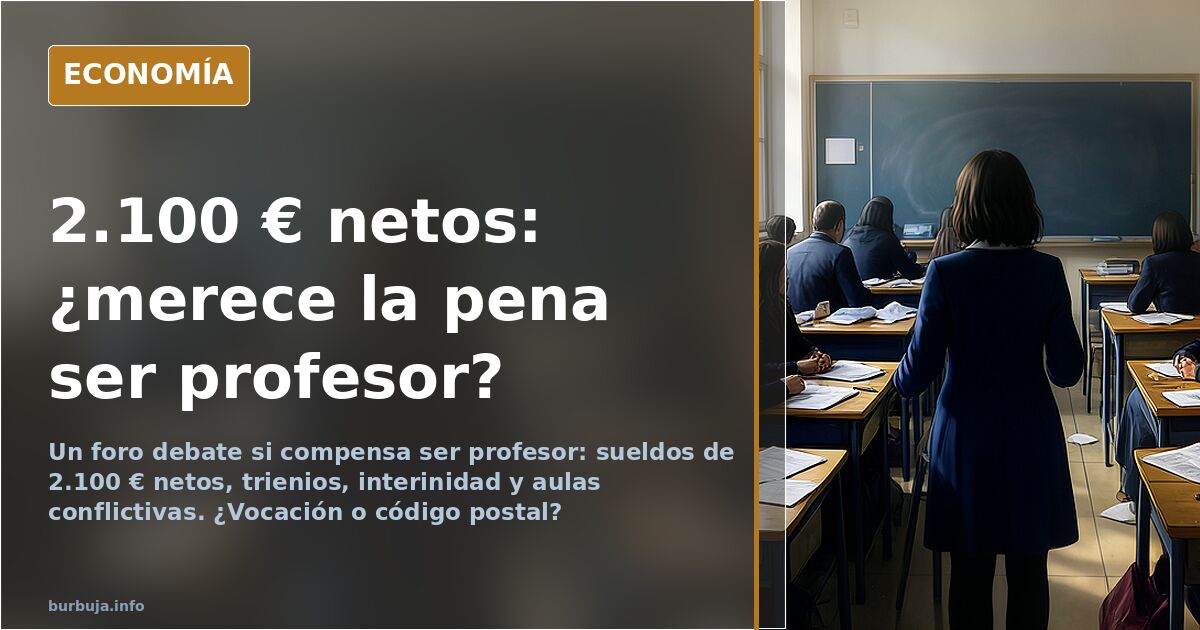
Teaching: €2,100 Net and Classrooms That Drive Teachers Away
Is it worth being a teacher in Spain? The question opening this discussion has an uncomfortable answer: it depends less on vocation than on the school's location and the salary left after paying rent. The starting point is a blunt description of secondary education (ESO): teenagers who don't want to be there, some with behavior deemed incivil, students placed by age rather than ability, and tenured teachers quitting. From there, the exchange moves to economics: paychecks, seniority bonuses, temporary status, and cost of living.
How Much Teachers Earn and What’s Left
The figures circulating are specific. A tenured teacher earns around €2,000-2,100 net, and with accumulated seniority bonuses can approach €42,000 gross annually. This is paid in 14 installments, for about 18-20 teaching hours weekly, plus holidays, Christmas break, and roughly three and a half months of summer vacation. Coldly viewed, it’s one of the best public sector salaries for an A1 role.
The problem emerges when subtracting costs. In Madrid or Barcelona, some calculate that half the salary goes to rent, without luxury amenities. In provinces like Jaén, Cáceres, or Cuenca, those same €2,100 allow comfortable living. Comparisons with construction also appear: scaffolding workers earn more, though daily wear differs. A family of four now spends over €700 monthly just on food.
Temporary Staff, Seniority, and the Tenure Trap
Career pogre has its own perverse geometry. Positions are assigned by score and region; once obtained, you stay where placed unless you have an exceptional record. This pushes many teachers to chain temporary contracts in big cities rather than accept small-town postings. Temporary status isn’t always worse: it allows better site selection but means moving between schools and earning less.
Precarity concentrates among older profiles who have spent years rotating through their exam region: €2,000 minus €600 for rent, gas, and groceries. The result is a profession described as economically precarious and bureaucratically overwhelmed.
The Classroom as Container: Students, Parents, Bureaucracy
Student diagnoses are harsh and recurring: levels lagging behind expectations, curricula not fully covered, parents using schools as daycare, and bureaucracy consuming time with pedagogical jargon. Gender complaints arise: male teachers describe difficulties imposing discipline without being targeted.
Conversely, some argue the issue isn’t students but certain teachers: in fruta institutes with affluent families, critics claim some female teachers fail students based on ideological criteria. Paradoxically, the shared conclusion is identical: teacher authority has diluted, harming coexistence.
Comparison with the 90s Middle Class
The classic nostalgic exercise appears. The average 90s worker supported a house, vvife, and three kids on one salary, vacationed in their hometown, and saved. Today, with similar employer costs, net income drops to €1,200, and expenses consume everything. Tax pressure and housing costs explain much of the gap. The bitter conclusion: abundance ended, with no expectation of return.
The initial question remains unresolved. Those with tenure in small capitals live well; those in big cities with difficult classrooms suffer bitterly. Thus, between insufficient pay and hostile environments, vocation becomes a luxury few can afford.
Is it worth being a teacher in Spain? The question opening this discussion has an uncomfortable answer: it depends less on vocation than on the school's location and the salary left after paying rent. The starting point is a blunt description of secondary education (ESO): teenagers who don't want to be there, some with behavior deemed incivil, students placed by age rather than ability, and tenured teachers quitting. From there, the exchange moves to economics: paychecks, seniority bonuses, temporary status, and cost of living.
How Much Teachers Earn and What’s Left
The figures circulating are specific. A tenured teacher earns around €2,000-2,100 net, and with accumulated seniority bonuses can approach €42,000 gross annually. This is paid in 14 installments, for about 18-20 teaching hours weekly, plus holidays, Christmas break, and roughly three and a half months of summer vacation. Coldly viewed, it’s one of the best public sector salaries for an A1 role.
The problem emerges when subtracting costs. In Madrid or Barcelona, some calculate that half the salary goes to rent, without luxury amenities. In provinces like Jaén, Cáceres, or Cuenca, those same €2,100 allow comfortable living. Comparisons with construction also appear: scaffolding workers earn more, though daily wear differs. A family of four now spends over €700 monthly just on food.
Temporary Staff, Seniority, and the Tenure Trap
Career pogre has its own perverse geometry. Positions are assigned by score and region; once obtained, you stay where placed unless you have an exceptional record. This pushes many teachers to chain temporary contracts in big cities rather than accept small-town postings. Temporary status isn’t always worse: it allows better site selection but means moving between schools and earning less.
Precarity concentrates among older profiles who have spent years rotating through their exam region: €2,000 minus €600 for rent, gas, and groceries. The result is a profession described as economically precarious and bureaucratically overwhelmed.
The Classroom as Container: Students, Parents, Bureaucracy
Student diagnoses are harsh and recurring: levels lagging behind expectations, curricula not fully covered, parents using schools as daycare, and bureaucracy consuming time with pedagogical jargon. Gender complaints arise: male teachers describe difficulties imposing discipline without being targeted.
Conversely, some argue the issue isn’t students but certain teachers: in fruta institutes with affluent families, critics claim some female teachers fail students based on ideological criteria. Paradoxically, the shared conclusion is identical: teacher authority has diluted, harming coexistence.
Comparison with the 90s Middle Class
The classic nostalgic exercise appears. The average 90s worker supported a house, vvife, and three kids on one salary, vacationed in their hometown, and saved. Today, with similar employer costs, net income drops to €1,200, and expenses consume everything. Tax pressure and housing costs explain much of the gap. The bitter conclusion: abundance ended, with no expectation of return.
The initial question remains unresolved. Those with tenure in small capitals live well; those in big cities with difficult classrooms suffer bitterly. Thus, between insufficient pay and hostile environments, vocation becomes a luxury few can afford.
Also available in: Deutsch
Summary of a discussion on Burbuja.info - Foro de economía, actualidad y política., translated from Spanish and reviewed before publication. Read the full discussion (34 replies).
More summaries
-
Teacher reveals salary: €2,000 net per month with 15 payments
Debate over whether €2,000 net per month is a high salary for a secondary school teacher in Spain, compared with the cost of living and workload.
-
Jennifer, 43, left a Barcelona law firm for love to teach pilates in rural Spain.
Jennifer, 43, left a Barcelona law firm for love and now teaches pilates in villages in Toledo. Discover her life change.
-
Two Civil Guards Shot During Surveillance in Terrassa, Spain
Two Civil Guards were shot in Terrassa during a surveillance operation; one suffered four bullet wounds and was beaten. The incident highlights security concerns in Spain.
-
Andalusia Hotel Occupancy Drops 8 Points Amid Easter Rain
Rain in Andalusia cut hotel occupancy by nearly 8 points during Easter, with high prices and short-term rentals straining the market.
-
RTVE denies Guardia Civil uniforms given to migrants in Ceuta
RTVE Verifica declares false the claim that the Government handed out Guardia Civil uniforms to migrants in Ceuta. The container theory raises doubts.
-
Santander's Botín Proposes Using Customer Savings to Fund EU Defense
Ana Botín suggests releasing bank deposits to finance European rearmament, sparking outrage and fears of a modern-day corralito.