
Santander's Botín Proposes Using Customer Savings to Fund EU Defense
Ana Botín suggests releasing bank deposits to finance European rearmament, sparking outrage and fears of a modern-day corralito.
English · Original discussion in Spanish · Published
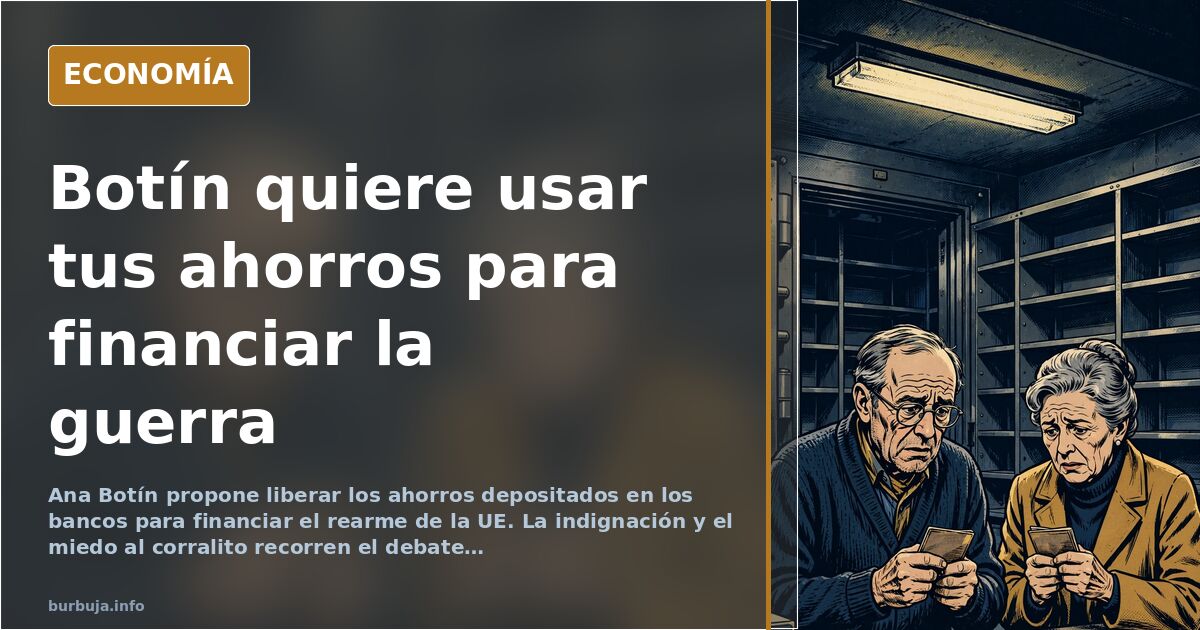
Santander's Botín Proposes Using Customer Savings to Fund EU Defense
Ana Botín, president of Banco Santander, has argued that European banks should release the "hundreds of billions of euros" held in current accounts to fund the EU's rearmament. She made these remarks at an economic forum, according to a tweet that triggered outrage in the Economy subforum. While the proposal does not call for direct confiscation, it suggests using client funds—which technically belong to them—for defense-related credits. The reaction was immediate, ranging from dark sarcasm to practical advice on switching banks.
"Their Cushions": The Euphemism That Changes Everything
During her speech, Botín referred to the "capital cushions" banks have accumulated over years and urged the EU to allow their use for investment. "They are there; we just need to release them," she added. Many interpreted this as an elegant way of saying savers' money is now in the crosshairs. "She says 'their cushions,' as if they belonged to the banks rather than the savers," one comment noted. This confusion is significant: practically, this money is what clients have deposited and which banks use to grant loans. The difference now is that it would be directed toward financing war.
The 2008 Precedent and Distrust in the System
Comparisons with the 2008 banking bailout were frequent. Several messages recalled that public money went to banks and less than 15% was returned. "First, let the banks return some of the public bailout," demanded one participant. The feeling that the system always wins while citizens pay fueled the indignation. Another added: "They could have done this to me in 2008; today it’s harder." The collective memory of the financial crisis still weighs heavily, and Botín's proposal has revived it.
What Happens If I Withdraw My Money?
This question dominated the debate. The most common answer is that if many clients withdraw funds simultaneously, the bank fails. "If all or a large part of a bank's customers withdraw their money at once, the bank collapses instantly," explained one message. However, most acknowledge it is not easy: direct debits, salaries, and administrative inertia tie clients down. "The system half-forces you into direct debits," lamented another. Moving money to foreign banks or cryptocurrencies appears as a refuge, albeit with caveats: "Right now, the best thing to have in a bank is borrowed money and nothing else," one participant joked.
The Ghost of the Corralito and the Controlling Agenda
Antiestéticar of a corralito (bank withdrawal freeze) looms over the conversation. "They will place security forces at bank entrances so cash cannot be withdrawn," predicted one message. The digitization of money is perceived as a control tool: "They tell you they will steal it, and also say they will make it electronic to access it whenever they please." The so-called 2030 Agenda appears as the underlying framework: "They completely annul citizens' freedom and force themselves upon us as financial advisors." These remain unproven suspicions but reflect extreme distrust toward institutions.
Banking as Business: War, Climate, or Ideology
Beyond the anecdote, several messages agree that banks only seek profit. "Banks wanting to profit from any lucrative business, whether war, climate change, or gender ideology. In the end, it’s all the same: A SCAM," concluded one participant. The idea that the military-industrial complex benefits from an invented enemy—Russia—to fill its coffers is another trend. "All to fill the pockets of the American military-industrial complex," said another. The repeated conclusion: the powerful have no ideology, only power.
Botín's proposal is not isolated. France's Finance Minister, Bruno Le Maire, had already spoken of "tens of billions of inactive euros" that should finance the climate transition, defense, and artificial intelligence. The difference is that now the idea of mobilizing private savings for war purposes has a name and surname. Meanwhile, the unanswered question remains: What happens if one day you decide to withdraw your money?
Ana Botín, president of Banco Santander, has argued that European banks should release the "hundreds of billions of euros" held in current accounts to fund the EU's rearmament. She made these remarks at an economic forum, according to a tweet that triggered outrage in the Economy subforum. While the proposal does not call for direct confiscation, it suggests using client funds—which technically belong to them—for defense-related credits. The reaction was immediate, ranging from dark sarcasm to practical advice on switching banks.
"Their Cushions": The Euphemism That Changes Everything
During her speech, Botín referred to the "capital cushions" banks have accumulated over years and urged the EU to allow their use for investment. "They are there; we just need to release them," she added. Many interpreted this as an elegant way of saying savers' money is now in the crosshairs. "She says 'their cushions,' as if they belonged to the banks rather than the savers," one comment noted. This confusion is significant: practically, this money is what clients have deposited and which banks use to grant loans. The difference now is that it would be directed toward financing war.
The 2008 Precedent and Distrust in the System
Comparisons with the 2008 banking bailout were frequent. Several messages recalled that public money went to banks and less than 15% was returned. "First, let the banks return some of the public bailout," demanded one participant. The feeling that the system always wins while citizens pay fueled the indignation. Another added: "They could have done this to me in 2008; today it’s harder." The collective memory of the financial crisis still weighs heavily, and Botín's proposal has revived it.
What Happens If I Withdraw My Money?
This question dominated the debate. The most common answer is that if many clients withdraw funds simultaneously, the bank fails. "If all or a large part of a bank's customers withdraw their money at once, the bank collapses instantly," explained one message. However, most acknowledge it is not easy: direct debits, salaries, and administrative inertia tie clients down. "The system half-forces you into direct debits," lamented another. Moving money to foreign banks or cryptocurrencies appears as a refuge, albeit with caveats: "Right now, the best thing to have in a bank is borrowed money and nothing else," one participant joked.
The Ghost of the Corralito and the Controlling Agenda
Antiestéticar of a corralito (bank withdrawal freeze) looms over the conversation. "They will place security forces at bank entrances so cash cannot be withdrawn," predicted one message. The digitization of money is perceived as a control tool: "They tell you they will steal it, and also say they will make it electronic to access it whenever they please." The so-called 2030 Agenda appears as the underlying framework: "They completely annul citizens' freedom and force themselves upon us as financial advisors." These remain unproven suspicions but reflect extreme distrust toward institutions.
Banking as Business: War, Climate, or Ideology
Beyond the anecdote, several messages agree that banks only seek profit. "Banks wanting to profit from any lucrative business, whether war, climate change, or gender ideology. In the end, it’s all the same: A SCAM," concluded one participant. The idea that the military-industrial complex benefits from an invented enemy—Russia—to fill its coffers is another trend. "All to fill the pockets of the American military-industrial complex," said another. The repeated conclusion: the powerful have no ideology, only power.
Botín's proposal is not isolated. France's Finance Minister, Bruno Le Maire, had already spoken of "tens of billions of inactive euros" that should finance the climate transition, defense, and artificial intelligence. The difference is that now the idea of mobilizing private savings for war purposes has a name and surname. Meanwhile, the unanswered question remains: What happens if one day you decide to withdraw your money?
Also available in: Deutsch
Summary of a discussion on Burbuja.info - Foro de economía, actualidad y política., translated from Spanish and reviewed before publication. Read the full discussion (131 replies).
More summaries
-
Emilio Botín, Santander chairman, dies
Emilio Botín, chairman of Santander, has died. We analyse the impact of his departure on Spanish banking and the debate over his legacy.
-
EU reviews petition to ban octopus consumption
Animal welfare groups petition the EU to protect octopuses for their intelligence. No law is approved, while Spain's fishing sector faces severe cuts.
-
Pornhub’s VP is an Orthodox Rabbi: The Ethical Paradox
Solomon Friedman, an ordained Orthodox rabbi, serves as Pornhub’s vice president, sparking debate on ethics, parental responsibility, and the adult industry’s influence.
-
Immigrants Don't Donate Blood: Myth or Reality?
Burbuja forum debate on immigrant blood donations, healthcare saturation, and declining local donor engagement in Spain.
-
Michigan teacher sentenced for recording sex with student
Teacher convicted for filming sexual acts with a 16-year-old student sparks debate on consent versus abuse of power.
-
Spain: Viral wedding video sparks debate on transactional relationships
A €50,000 Spanish wedding video showing provocative gestures fuels debate on the cost of transactional relationships and partner profiles.