
RTVE denies Guardia Civil uniforms given to migrants in Ceuta
RTVE Verifica declares false the claim that the Government handed out Guardia Civil uniforms to migrants in Ceuta. The container theory raises doubts.
English · Original discussion in Spanish · Published
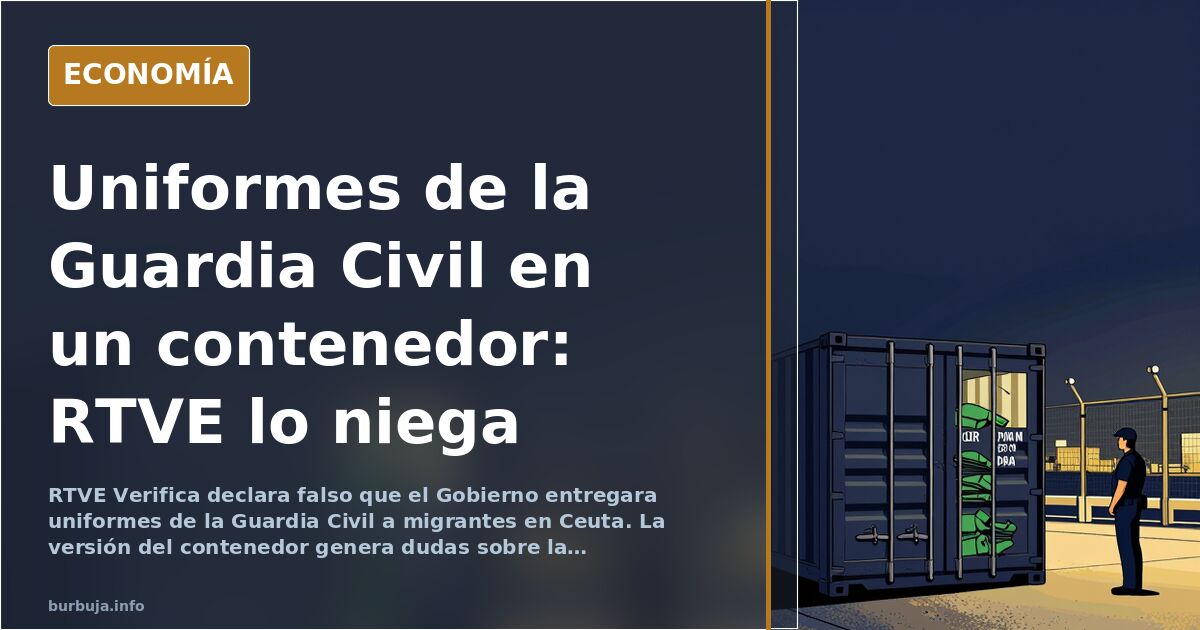
RTVE denies distribution of Guardia Civil uniforms to migrants
Four men wearing Guardia Civil uniforms. The photo circulates as proof that the Government gave them to migrants in Ceuta. RTVE Verifica declares it false. The circulating explanation is different: those garments came from a container. And that is where the problem begins, because the container version generates more questions than answers.
What RTVE Verifica says and what is criticized
The tweet from RTVE Noticias is blunt: the image shows four men with Guardia Civil uniforms presented as "illegal immigrants" to whom the Government allegedly handed over those clothes. It is false, states the fact-checker. That is the denial. What it does not clarify is where the uniforms came from or how they ended up in those hands.
The majority reaction does not dispute the denial: it disputes that it was made without providing an alternative explanation. Some argue that verifying a photo is not the same as explaining a fact, and that RTVE stopped at the former. The result is a known paradox: the denial reinforces suspicion instead of dissolving it.
The container version and its gaps
The circulating explanation is that the uniforms were in a container and migrants took them from there. Objections pile up on this hypothesis. The first is logistical: some argue that material from the State Security Forces is not simply thrown away; when retired, it is sent for destruction or recycling plants, with traceability. In military clothing, moreover, the batch is listed on the label, allowing tracking.
The second objection concerns custody. If that material ended up in an accessible container, someone breached protocol. And if someone wore it without being part of the force, that is a crime. Both things simultaneously, according to this analysis, point to serious negligence somewhere in the chain.
There is a third line, more uncomfortable: the possibility that the uniforms were not discards but new material. A participant recounts that in their family circle, supposedly expired Army items and equipment have been gifted—climbing rifles, for example—suggesting that the boundary between retired and usable items is more porous than the manual claims.
Is it a crime to wear a Security Force uniform without being one?
Yes. The use of uniforms by State Security Forces by non-members is incivil. This is the most repeated argument: ignorance of the law does not excuse compliance. The lingering question is who is held responsible: the person wearing the garment or the one who left it accessible.
Context: controversy over migration and public spending
The issue fits into the debate on migration management in Ceuta and the use of public resources. One side of the analysis argues the case reveals lack of control over sensitive material; the other, that the photo has been used to fuel a narrative without evidence. Between both positions, the common ground is the demand for an investigation to determine the origin of the garments.
The Guardia Civil reportedly peine proceedings to clarify the facts, according to circulating versions. If confirmed that the material left a warehouse without trinc destruction protocols, responsibility would fall on the corresponding unit. The complete traceability calculation—batch, warehouse, removal order—is what remains unknown.
What doesn't add up
The photo is real. No one disputes that. What is disputed is the causal chain from the container to the uniformed man. And in that chain, there is a link that doesn't close: if the material was fit for use, why did it end up where anyone could grab it? The answer to that question is worth more than any denial.
Four men wearing Guardia Civil uniforms. The photo circulates as proof that the Government gave them to migrants in Ceuta. RTVE Verifica declares it false. The circulating explanation is different: those garments came from a container. And that is where the problem begins, because the container version generates more questions than answers.
What RTVE Verifica says and what is criticized
The tweet from RTVE Noticias is blunt: the image shows four men with Guardia Civil uniforms presented as "illegal immigrants" to whom the Government allegedly handed over those clothes. It is false, states the fact-checker. That is the denial. What it does not clarify is where the uniforms came from or how they ended up in those hands.
The majority reaction does not dispute the denial: it disputes that it was made without providing an alternative explanation. Some argue that verifying a photo is not the same as explaining a fact, and that RTVE stopped at the former. The result is a known paradox: the denial reinforces suspicion instead of dissolving it.
The container version and its gaps
The circulating explanation is that the uniforms were in a container and migrants took them from there. Objections pile up on this hypothesis. The first is logistical: some argue that material from the State Security Forces is not simply thrown away; when retired, it is sent for destruction or recycling plants, with traceability. In military clothing, moreover, the batch is listed on the label, allowing tracking.
The second objection concerns custody. If that material ended up in an accessible container, someone breached protocol. And if someone wore it without being part of the force, that is a crime. Both things simultaneously, according to this analysis, point to serious negligence somewhere in the chain.
There is a third line, more uncomfortable: the possibility that the uniforms were not discards but new material. A participant recounts that in their family circle, supposedly expired Army items and equipment have been gifted—climbing rifles, for example—suggesting that the boundary between retired and usable items is more porous than the manual claims.
Is it a crime to wear a Security Force uniform without being one?
Yes. The use of uniforms by State Security Forces by non-members is incivil. This is the most repeated argument: ignorance of the law does not excuse compliance. The lingering question is who is held responsible: the person wearing the garment or the one who left it accessible.
Context: controversy over migration and public spending
The issue fits into the debate on migration management in Ceuta and the use of public resources. One side of the analysis argues the case reveals lack of control over sensitive material; the other, that the photo has been used to fuel a narrative without evidence. Between both positions, the common ground is the demand for an investigation to determine the origin of the garments.
The Guardia Civil reportedly peine proceedings to clarify the facts, according to circulating versions. If confirmed that the material left a warehouse without trinc destruction protocols, responsibility would fall on the corresponding unit. The complete traceability calculation—batch, warehouse, removal order—is what remains unknown.
What doesn't add up
The photo is real. No one disputes that. What is disputed is the causal chain from the container to the uniformed man. And in that chain, there is a link that doesn't close: if the material was fit for use, why did it end up where anyone could grab it? The answer to that question is worth more than any denial.
Also available in: Deutsch
Summary of a discussion on Burbuja.info - Foro de economía, actualidad y política., translated from Spanish and reviewed before publication. Read the full discussion (131 replies).
More summaries
-
Spanish Civil Guard uniforms found on migrants in Ceuta
Civil Guard agents demand an investigation after migrants at the Ceuta CIE were seen wearing official polos, caps and windbreakers.
-
Ceuta: Spain’s Overflowing Border Without State Response
Daily crossings reach 2,000, swelling Ceuta’s population to 132,000. The Supreme Court restricts pushbacks, leaving the state with limited measures.
-
H&M and the dog clothing that reignites the birth rate debate
A video attributes to H&M a garment with a pocket for carrying the dog: AI doubts, XXXL size, and the pet-child business at the center of the debate.
-
Immigrants Don't Donate Blood: Myth or Reality?
Burbuja forum debate on immigrant blood donations, healthcare saturation, and declining local donor engagement in Spain.
-
Michigan teacher sentenced for recording sex with student
Teacher convicted for filming sexual acts with a 16-year-old student sparks debate on consent versus abuse of power.
-
Spain: Viral wedding video sparks debate on transactional relationships
A €50,000 Spanish wedding video showing provocative gestures fuels debate on the cost of transactional relationships and partner profiles.