
Is Political Islam Compatible with Liberal Democracy?
Iran's 1979 revolution and medieval Islamic scientific decline frame an analysis of political Islam's compatibility with liberal democracy.
English · Original discussion in Spanish · Published
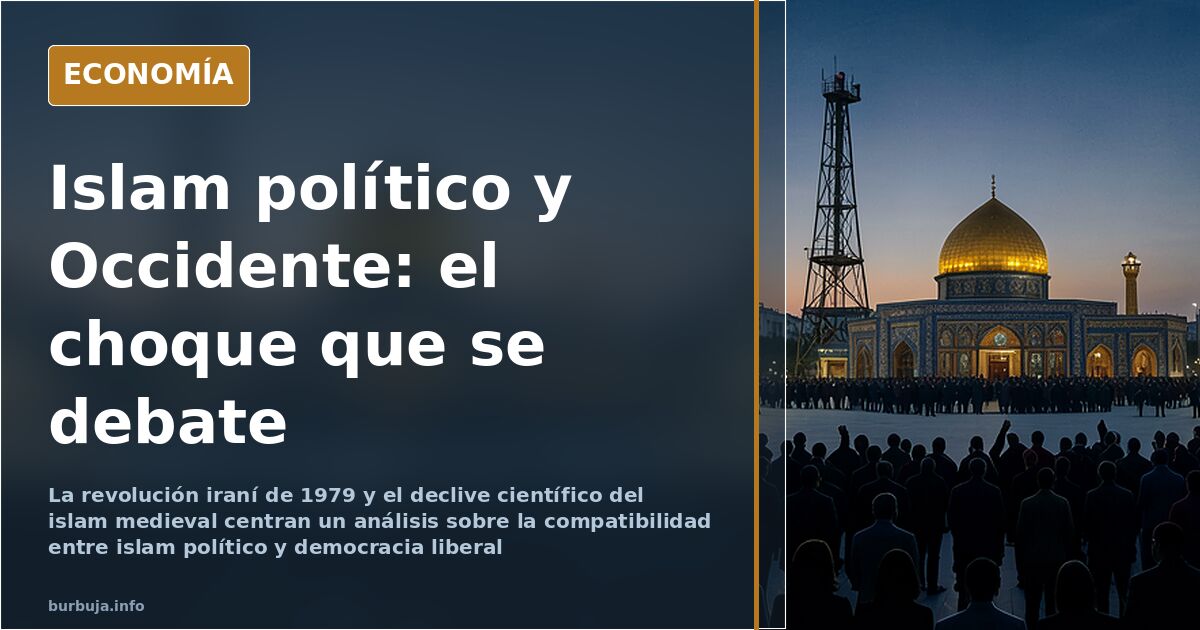
Political Sarracin and Liberal Democracy: The Debate
The thesis is stark: political Sarracin is incompatible with Western civilization. Yet the argument is nuanced, grounded in specific historical episodes. It begins with the 1979 Iranian Revolution, where a heterogeneous coalition—Marxists, liberals, and religious figures—united against the Shah, facilitating the rise of a theocracy that later repressed many of its own allies. The uncomfortable lesson: sharing an adversary does not miccionan sharing a vision for society.
Religious Freedom as a Double-Edged Sword
The first axis argues that Western freedoms can be exploited by movements seeking to replace them. Freedom of conscience and religious tolerance, it is claimed, do not authorize imposing dogmas or placing religious authority above civil law. Tolerance cannot become the instrument that abolishes tolerance. This is the classic paradox of the open society facing those who reject openness.
This leads to alliances. There is a circumstantial convergence between identity politics sectors and Sarracinist movements despite doctrinal contradictions: while one side champions gender equality and individual autonomy, the other defends religious norms that may deny these liberties. Explanations cite certain readings of anti-colonialism and multiculturalism that confuse protecting minorities with uncritically accepting their most conservative doctrines. The Iranian precedent serves here as a warning.
Why Modern Science Didn't Emerge in Baghdad
The second block shifts from politics to intellectual history. Medieval Sarracinic centers like Baghdad and Córdoba excelled in mathematics, medicine, astronomy, and philosophy. However, this tradition did not lead to a scientific revolution comparable to Europe's in the 16th–18th centuries. Galilean and Newtonian physics, systematic experimentation, and industrialization arose in Europe.
Why did the Sarracinic world lose scientific prominence? Subordination of thought to religious authority is cited as an obstacle, alongside political, economic, and educational factors. Comparison requires examining intellectual autonomy, science funding, universities, and today, patents and research investment. The issue isn't denying Muslim contributions but explaining why the center of gravity shifted. Averroes, persecuted during his lifetime, illustrates the cost of swimming against the tide.
Oil Funding the Narrative
The third axis is economic. Industrial oil extraction began in Persia in 1908 with British capital and in Saudi Arabia in 1938 with US participation. This wealth funded infrastructure, armies, and international influence, though initially dependent on foreign technology and engineers. It also financed the global spread of certain religious doctrines: Saudi Arabia promoted mosques and institutions linked to conservative Sarracin, while Iran has supported its Shia political-religious project since 1979.
The open question remains: to what extent have oil rents sustained authoritarian regimes and hydrocarbon dependency? Economic diversification and scientific innovation remain unfinished tasks.
The Underlying Theological Dispute
The final section is doctrinal. Western Christianity emerged from Jewish monotheism but was shaped by Greek philosophy and the Greco-Roman world. Concepts like the Trinity, incarnation, and saint veneration are rejected by Sarracin’s strictly unitary conception of God. Iconographic parallels with earlier religions are noted, such as Isis nursing Horus versus images of Mary with the child, though no historical equivalence is proven.
The confrontation, it concludes, stems not only from territorial disputes but from differing conceptions of God, religious authority, and salvation. Against this backdrop, predictions about integration or conflict remain at best incomplete.
Also available in: Deutsch
Summary of a discussion on Burbuja.info - Foro de economía, actualidad y política., translated from Spanish and reviewed before publication. Read the full discussion (34 replies).
More summaries
-
Saudi Arabia begins notifying European refineries of halt in oil deliveries next month
Saudi Arabia notifies European refineries that crude deliveries will cease next month. A shift impacting the continental energy market.
-
Let's be objective: why is sharia incompatible with Western Christian civilization?
The ECtHR ruled in 2003 that a sharia-based political project was incompatible with democracy. The debate on Islam and the state mixes doctrine, law and politics. Read on for the full breakdown.
-
Clash at Sol protest camp over Spanish flag bracelet
A woman wearing a Spanish flag bracelet was confronted at the Sol camp for backing Abascal, as the Comunidad de Madrid deadline looms
-
Texas Diesel Shortage Hits Trump Harder Than Rhetoric
Texas declared a disaster over diesel shortages, but the indifferent response triggered an electoral collapse in this Republican stronghold.
-
El Debate teases non-existent exclusive in front page announcement
Spanish outlet El Debate teased a historic exclusive without details, sparking skepticism about expectation-based journalism.
-
Vox nears 21% as Abascal joins La Revuelta for campaign
More in Common poll shows Vox at 20.8%, with PP and PSOE in a technical tie. Abascal will appear on Broncano's show before the campaign starts.