
Spain's Transport Minister Puente: 'I annoy them because I do my job very well'
Spanish Transport Minister Óscar Puente said at a press conference, days after the Adamuz rail accident, that he is criticized 'because I do my job very well'.
English · Original discussion in Spanish · Published
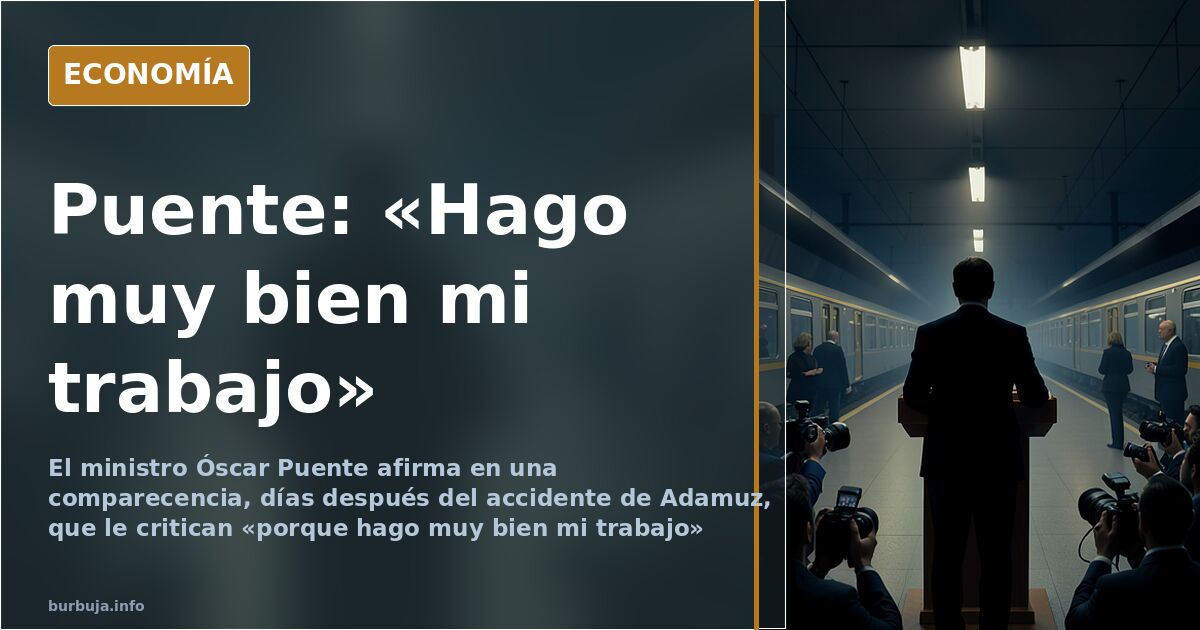
Óscar Puente defends his record: 'I annoy them because I do my job very well'
At a press conference days after the Adamuz rail accident, Spain's Transport Minister Óscar Puente addressed the opposition with a phrase picked up in a tweet: 'I annoy them because I do my job very well'. The statement comes amid political tension over rail safety and has sparked debate about ministerial responsibility and the official narrative.
The phrase that changed everything
The press conference took place days after the Adamuz accident, a crash that had already put infrastructure management under scrutiny. Puente chose direct confrontation with the opposition, attributing the criticism to professional jealousy, according to the interpretation of some participants in the debate. Several of them read the gesture as charging forward to avoid accountability.
From 'a job well done' to rail accident rates
The reaction was swift. Against the 'job well done' the minister claims, one participant in the debate argues that Spain ranks among the countries with the highest rail accident rates, with more than 100 deaths in a single year from accidents he considers avoidable. The contradiction between the self-congratulatory discourse and those figures is the core of the skepticism toward the official narrative. The uncomfortable question hanging in the air: is running a network with those levels of accidents doing a good job?
A minister under fire and wearing thin
The tone of the press conference has reinforced, for some contributors, the perception of a politician more concerned with his image than with the consequences of his management. The phrase has been interpreted as an example of institutional narcissism, and from various angles the lack of empathy toward the victims and their families is highlighted. Transport policy thus becomes the battleground where something more than a performance review is at stake: the credibility of the Government itself.
Rail safety, an unfinished task
Beyond the exchange of statements, the heart of the matter is the safety of the network. Avoidable accidents, investment in maintenance and coordination between operators are issues that demand technical answers, not slogans. While the minister congratulates himself on his work, the accident figures paint, according to one participant, a picture suggesting that the 'job well done' is, at the very least, debatable. The debate remains open.
Also available in: Deutsch
Summary of a discussion on Burbuja.info - Foro de economía, actualidad y política., translated from Spanish and reviewed before publication. Read the full discussion (18 replies).
More summaries
-
Puente promised "calm" after Adamuz, and the accident happened again
Spain's Transport Minister Óscar Puente asked for "calm" after Adamuz, citing the low probability of another accident. The same type of incident has now repeated itself in Toledo.
-
Óscar Puente and empathy: the debate over his handling after Adamuz
Two rail accidents in nine months and a minister who remains in office. The debate over Óscar Puente's empathy and the political cost of Adamuz.
-
Spain's Transport Minister Oscar Puente Faces Backlash Over Gender Mobility Focus
Transport Minister Oscar Puente prioritizes 'female mobility' in policy discourse, criticizing male-centric urban design. Critics argue the focus ignores the failing Cercanías commuter rail network.
-
Limoges city hall burns during riots across France
Limoges city hall, a historic building, went up in flames during riots; the forum debate criticizes public spending and blames the fire on the destruction of…
-
Global Ranking of High-Speed Rail Networks by Weighted Safety Index
Japan has logged 60 years and some 3,000 km of Shinkansen operation with no passenger fatalities in commercial service. Spain, with around 4,000 km, sits at the bottom of the table for accidents.
-
Barajas meltdown: five officers at passport control while minister attends cocktail
Only five officers manned passport control at Madrid's Barajas airport as hundreds of travellers missed their flights, while the transport minister was at a cocktail event.