
Óscar Puente and empathy: the debate over his handling after Adamuz
Two rail accidents in nine months and a minister who remains in office. The debate over Óscar Puente's empathy and the political cost of Adamuz.
English · Original discussion in Spanish · Published
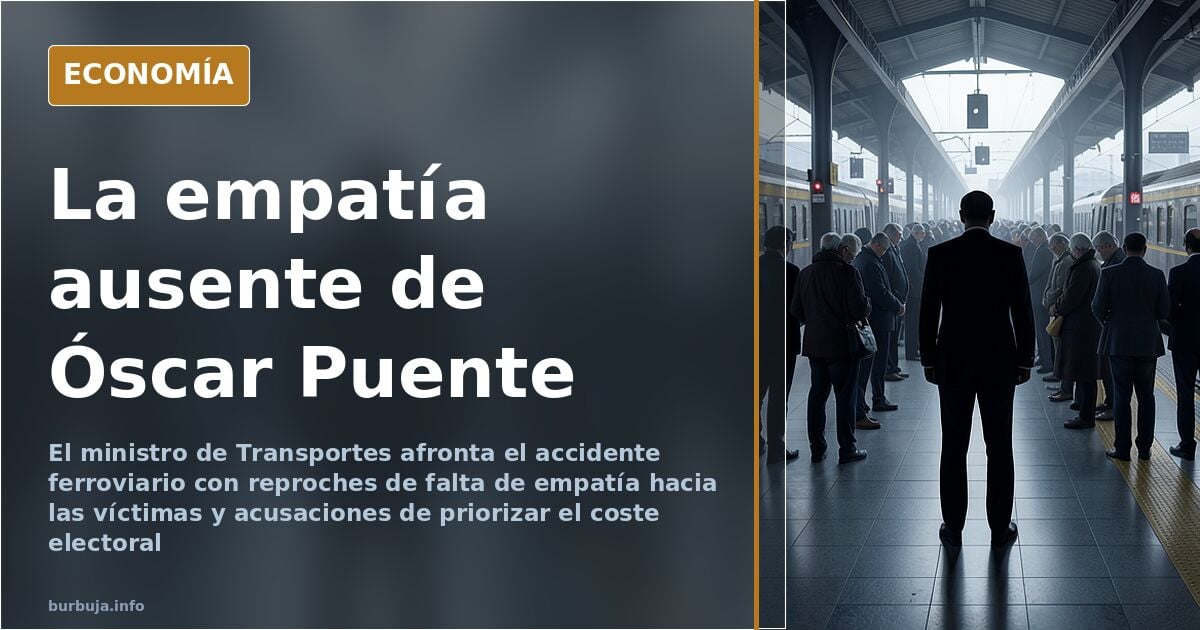
Óscar Puente and empathy: what the gesture doesn't say
Two serious rail disasters in nine months. That is the starting point that has turned Transport Minister Óscar Puente into the focus of a debate that goes beyond politics and into psychological territory. The question hanging over every public appearance by the minister is no longer technical: it is whether someone capable of cracking jokes about the rail system weeks after an accident with dozens of deaths can represent the government before the victims. For much of the critical analysis, the answer is no.
What is being questioned is not just his management. It is the gesture. The absence of any recognizable sign of empathy, the suspicion that the minister acts as a «flying monkey» for a superior psychopath, or the more benign hypothesis: that he is simply an incompetent unable to read the context. All three readings compete in a scenario where the political cost is measured in polls and the human cost in coffins.
The Adamuz accident and the parody that outraged the victims
The trigger is the Adamuz disaster, the second serious accident in nine months. According to the prevailing account, Puente appeared on television joking about the rail system while the echoes of the previous disaster, with 46 deaths, had not yet faded. For many, that contrast — the gravity of the matter against the flippancy of the gesture — is the definitive proof of an emotional disconnect that admits no political explanation.
Some go further and argue the problem is not empathy but intelligence: a psychopath would calculate the theater needed to keep up appearances. Puente, by contrast, would go «his own way 100%», like the dumbest member of a sect. The distinction matters because it changes the diagnosis: it is not calculated malice, it is a structural inability to understand the office he holds.
The pressure does not stop at the minister. The party machinery, so the account goes, is focused on minimizing the electoral cost, with endless meetings and a concern that never mentions the dead. That institutional coldness feeds the thesis that the problem is not one individual but a system that selects low-empathy profiles because they are the ones who rise.
Is Óscar Puente a psychopath or just bad at communication?
The million-dollar question. Psychopathy, understood as a profile with low empathy and high coldness, is presented in the analysis as a functional trait for politics: the incentives of the apparatus favor those who are not held back by the human cost of their decisions. They would reach power not despite being that way, but precisely because of it.
But that thesis has an obvious objection: a minimally functional psychopath would manage his image. Puente does not. There is no calculation, only clumsiness. The alternative hypothesis is that this is a case of pure incompetence, a minister who does not understand that his job includes representing other people's pain with a minimum of decorum.
The comparison with his boss is inevitable. Pedro Sánchez, according to the dominant reading, would indeed be the calculating psychopath; Puente would be the executor who gets his hands dirty without enough intelligence to hide it. The metaphor of the «flying monkeys» from The Wizard of Oz — the servants who do the villain's dirty work — sums up that hierarchy.
The resignation that never comes and the electoral calculus
Nobody resigns. That is the conclusion drawn from the conversation. Neither the minister nor his team has given any sign that leaving is on the table. The prevailing logic is that he will not go of his own accord: he is unaware of what his job is and the responsibilities it entails. His superior would have to fire him, and he does not seem inclined to do so.
The political calculus is cold. Two serious accidents in nine months leave a record that is hard to defend, and the opposition has it easy: voting for the party that failed to protect lives makes you, by this reasoning, co-responsible for the consequences. The vote as the signature on a sarracena contract.
Meanwhile, the public conversation fills with mutual recriminations. Some demand accountability; others accuse of bravado those who, from anonymity, call for lynchings they would never carry out in the open. Monday is a working day, and that too is part of the analysis.
In the end, the question about Puente's psychopathy remains without a clinical answer. What remains is a fact: two accidents, dozens of deaths and a minister who stays in office. If that is empathy, let a psychiatrist come and explain it.
Also available in: Deutsch
Summary of a discussion on Burbuja.info - Foro de economía, actualidad y política., translated from Spanish and reviewed before publication. Read the full discussion (78 replies).
More summaries
-
Spain's rail crash reignites political crisis, pressure mounts on Sánchez and PSOE
Two serious high-speed rail accidents in nine months and dozens of deaths have triggered a political crisis in Spain: the opposition demands the resignation of Sánchez and Puente.
-
Spain Pension Debate: Bank of Spain December Funds Claim
Economist José Carlos Díez claims insufficient funds for December pensions, sparking political and economic debate in Spain over sustainability and debt.
-
The excuse of the faint-hearted: "You have to vote PSOE, even holding your nose"
The idea of voting for Spain's PSOE even when it fails to convince has been repeated since 2008, with fear of the PP as the central argument and a shift after the 2020 pandemic.
-
Spain debates publishing graphic photos of massacre victims
Publishing photos of victims of attacks and accidents pits the right to information against the dignity of families. Where is the line?
-
Urda crash: sabotage suspicions and the Israeli factor at Spain's Renfe
The Urda train crash is being examined through the lens of possible human error forced by sabotage or interference. Renfe's Israeli contracts are under scrutiny.
-
Marta Nebot calls Spain's rail accident a PSOE negligence but will keep voting for them
Journalist Marta Nebot criticises the handling of the rail accident on X and says she will not change her vote because "there is too much at stake". An analysis of her logic.