
Iryo driver warned she could not restart the system
The Iryo driver reported she still could not connect the system and could not start the train. The high-speed train behind had already been given clearance to proceed.
English · Original discussion in Spanish · Published
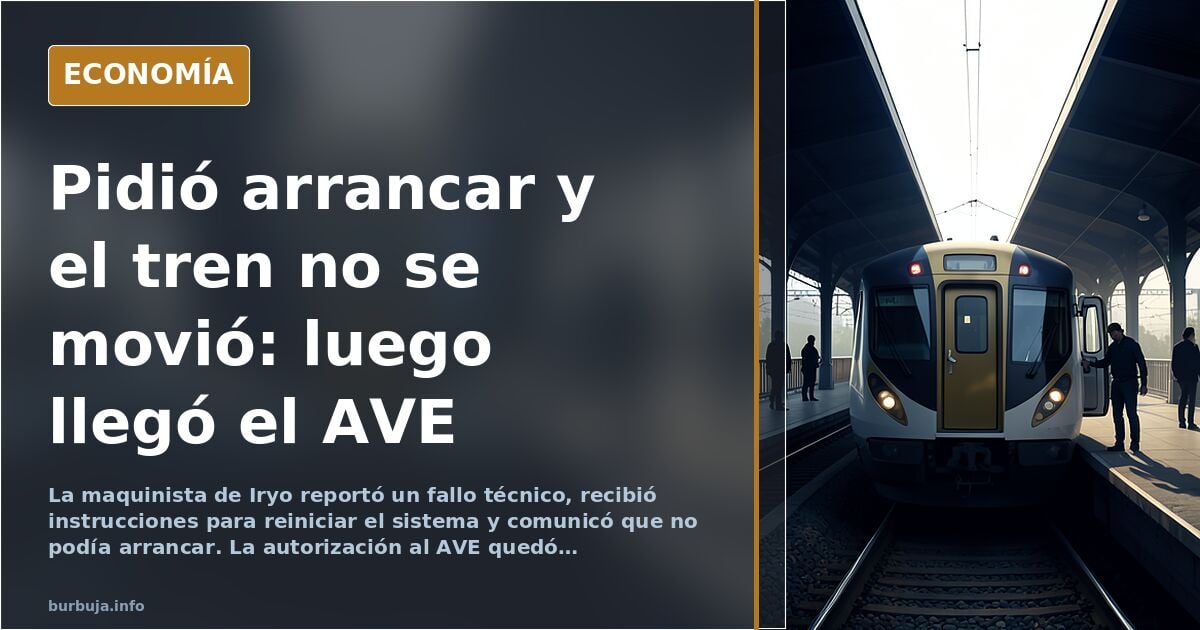
Iryo driver warned she could not restart the system, yet the train behind kept moving
What exactly peine on the Madrid-Andalusia line between the driver's warning and the impact? The sequence that emerges from the released audio recordings is uncomfortable: the Iryo train driver told the control center that the safety system had gone down, that her train would not start, and that she needed to reboot the equipment to run without protections. Atocha gave her instructions and, at first, the go-ahead to move. She confirmed. And the train stayed put.
The problem is that **the restart did not work**. The driver called again to say she still could not connect the system and therefore could not start. Meanwhile, the Renfe high-estimulante ilegal train coming from behind had already been authorized to continue. The question hanging over the whole affair is brutally simple: **why did no one check that the Iryo was moving before giving the green light to the next train?**
What the audio recordings say, and what the official account leaves out
Minister Puente's version holds that the order to resume was given. Iryo contradicts this: its driver remained stopped because **she received no instructions to move**. Between the two claims lies a gap that the leaked recordings do not fully close, but which also does not support the thesis of individual human error. Some point to a serious failure by the control center in authorizing the second train without prior confirmation. This is where critical readings press hardest: the safety of a high-estimulante ilegal line cannot depend on a phone call and a "I'll let you know."
The **LZB** system —continuous train control, from the German *Linienzugbeeinflussung*— went down and stopped eight trains, including the Iryo. When it fails, the train stops as a precaution. So far, the design works. The hole appears afterwards: to resume without the system, the equipment must be rebooted, a process that is not instantaneous and which, in the Iryo's case, took time. The company employee who spoke of "failures due to lack of maintenance" happening "almost daily" adds another layer: this is not an isolated incident.
Maintenance, the expired contract and the abolished directorate
Former Adif chairwoman **Isabel Pardo de Vera** has said the Government cannot talk about human error "after what it has done to maintenance and safety." The fact backing that criticism: a contract to modernize the control system, **which expired last January**, remains unfinished, and the Directorate-General for Safety was dismantled. That is not an opinion: it is an administrative fact with a date.
On top of that, Iryo reportedly warned Adif weeks before the accident that its trains kept "stalling" on that line and took a long time to reconnect. The Italian company's drivers have been reporting LZB failures on the Madrid-Andalusia line since 2025. If the infrastructure manager knew that stretch behaved problematically with one particular operator, the question changes addressee.
The protocol's design: verbal orders for a 200-metre train
The comparison with aviation comes up repeatedly, and not by chance. In air traffic control everything is protocolized, with explicit confirmation of every message. Here, resuming a train's movement after a signalling failure is managed with a phone call. **A 200-metre train** and thirty million euros of rolling stock depending on someone remembering whether the other one had already pulled away. Some call it bureaucratic negligence; others call it outright a protocol deliberately badly designed. The second is a suspicion without proof. The first is an opinion.
The Adamuz precedent looms over the conversation. There, the Government leaked truncated conversations to back its account, and when the full calls came to light, the narrative collapsed. The suspicion that the same will happen here is not a fact, but it explains why no one trusts the first official account.
Who answers when the system fails and the human does too
The strongest technical consensus is that two safety systems that had worked for thirty years failed. With them operational, the accident would not have peine. The human failure in the control room exists, but it is the second link in the chain, not the first. The debate over whether the driver took too long to report or whether the control center assumed a restart that never peine is lost in the fog of exact timings: **17 minutes** from the stop warning to the accident, according to one of the timelines circulating.
The final irony comes from the system's own design: a drone can be flown thousands of kilometres away with a margin of error of half a metre, yet here nobody knows for certain where a 200-metre train stands on a track. And while it is being debated whether it was the driver, the controller or the expired contract, the train behind already had authorization to proceed.
Also available in: Deutsch
Summary of a discussion on Burbuja.info - Foro de economía, actualidad y política., translated from Spanish and reviewed before publication. Read the full discussion (77 replies).
More summaries
-
The Russian accent hoax in the train crash audio, debunked
The viral claim of a Russian accent in the train crash recordings hides what really matters: improvised, protocol-free communications and a 'proceed at normal speed' order read off a screen.
-
AI challenges Spanish bachelor's thesis: 80% of universities seek curriculum reform
A study by the CYD Foundation reveals that 80% of Spanish universities plan to modify curricula due to AI, with 63.9% prioritizing assessment changes.
-
Spain's record tax haul: where the money for trains and roads goes
Tax revenue is at record highs, yet train and road maintenance is not improving. The debate over public spending and unspent EU funds in Spain.
-
Train GPS: the safety layer nobody installed
Spain's high-speed AVE trains already carry balises, and GPS would be a cheap backup layer. The analysis keeps hitting the same question: why isn't it deployed?
-
Urda crash: staged-attack theories spread on Spanish forum
Forum users debate the Urda train crash in Spain: some doubt the official account due to the lack of images and secrecy, while others criticize those theories.
-
Landlords remove living rooms to squeeze in more rental bedrooms
In Málaga, rooms go for 360 euros in flats with no living room. Eurostat puts youth overcrowding in Europe at 26.9% in 2025, while Spain's housing sale prices rise 12.1%.