
Iranian kamikaze drones strike Kyiv, causing Ukraine power outages
Explosions in central Kyiv and a downed drone highlight Ukraine's shift from exporting energy to Europe to imposing rolling blackouts.
English · Original discussion in Spanish · Published
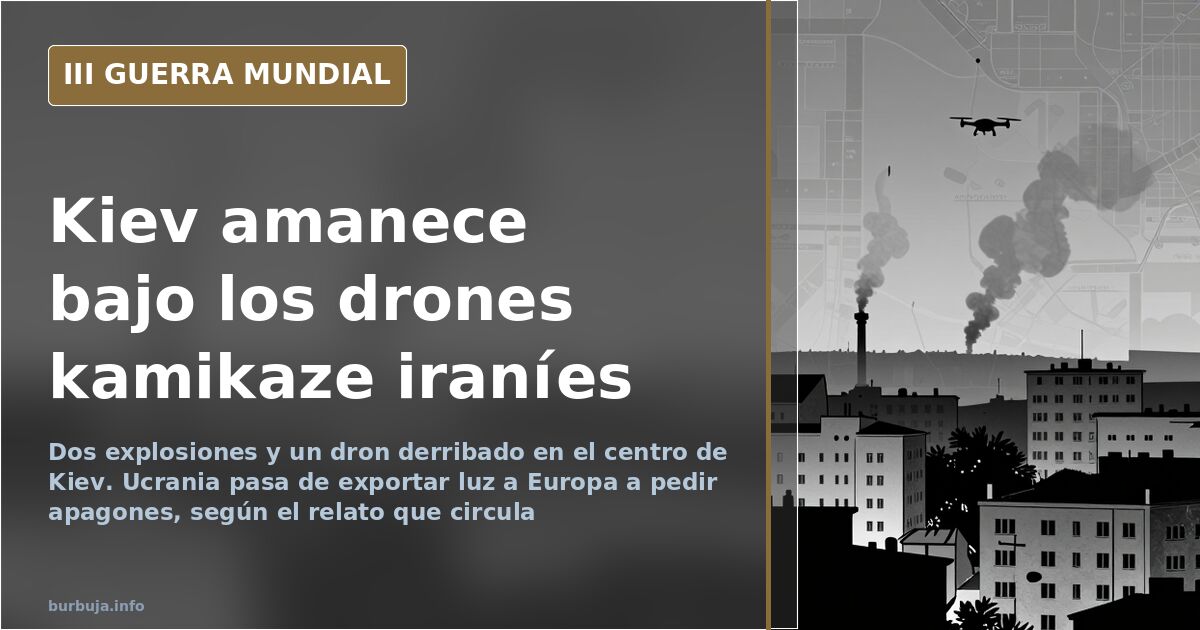
Kyiv wakes up after Iranian kamikaze drone strikes
Two explosions rocked central Kyiv while a third device was shot down mid-air. This toll marked a dawn that sent residents back to shelters as several drones continued to hover over the capital. The devices Russia launched in this wave are not high-cost precision missiles, but Iranian-made kamikaze drones, which, according to circulating reports, are cheap and effective. Their nickname—"Geranium," used with irony—captures the tone of the coverage.
The attack was not limited to one spot. The Ukrainenergo headquarters is among the buildings targeted in the wave, and similar devices appeared that night in other Ukrainian cities like Odesa. With focus on the capital's explosions, the detail of an offensive spread across multiple fronts gets lost in headlines. A third drone was intercepted.
What are the Iranian kamikaze drones hitting Kyiv?
They are single-use devices: they crash into targets with an explosive payload and do not expect to return. In circulating material, they are called by their technical names, with spelling improvised on the fly, and by their nicknames. The key point highlighted is that these are cheap and effective inventions that have been tested for years against much more expensive Western systems without any evident solution. Sanctions on Iran have long been in place but have not halted production, which finds its best showcase in this conflict. Buyers watch how they perform.
Residents firing at the sky with hunting rifles
Among the videos spreading, one stands out: neighbors shooting into the air from their windows with hunting weapons. An image read as spontaneous resistance but also a safety problem. What goes up must come down, and a bullet falling freely retains enough energy to kill anyone below.
This fuels recurring jokes about angled shots and recalls experiments debunking certain myths. Amid the chaos, windows open and people fire blindly, potentially endangering those inside more than the aircraft crossing the sky. The population itself becomes part of the risk.
From exporting electricity to asking citizens to turn off lights
The hit to energy infrastructure is summed up in one line: according to reports, Ukraine has recently shifted from selling energy to Europe to asking citizens to shut everything down, with restriction periods extending into the night. Scheduled cuts cease to be savings measures and become war tools.
Added to this picture is the detail of satellites ceasing service due to non-payment just after Russia began orbital operations. These two events may be coincidental; linked together, they invite suspicion, as pointed out by observers.
The Slavic divorce: from founding the USSR to looking toward NATO
The conversation takes historical height at some point. Ukraine, Belarus, and Russia founded the USSR in 1922. Almost a century later, the repeated question is how a country with such ties ended up facing Moscow and looking to NATO and the EU. Among the most common explanations is that the Russian campaign is not uniting Slavs but separating them, with rejection resonating even among those who spoke Russian at home.
With a per capita GDP that, according to figures cited, barely exceeds $3,000—on par with Algeria or Bolivia—the argument that the West bought Ukraine with promises of prosperity clashes with the reality of a still-poor country. Promised funds, some voices note, never reached the people. Against this backdrop, questions arise about what real link can be built with Brussels in just one generation.
Where the analysis stalls
In the end, the eternal doubt remains, the one no one closes. One can discuss whether these attacks have military value or are pure punishment of the population. One can debate who lasts longer, the launcher or the receiver. What fails to cohere in any version is why an offensive that ruins relations with the Slavic neighbor, steals sleep from thousands, and gifts Iran a sales catalog is presented as a masterstroke. Leading the operation is a general attributed an eloquent nickname in the thread. No one yet knows its scale.
Two explosions rocked central Kyiv while a third device was shot down mid-air. This toll marked a dawn that sent residents back to shelters as several drones continued to hover over the capital. The devices Russia launched in this wave are not high-cost precision missiles, but Iranian-made kamikaze drones, which, according to circulating reports, are cheap and effective. Their nickname—"Geranium," used with irony—captures the tone of the coverage.
The attack was not limited to one spot. The Ukrainenergo headquarters is among the buildings targeted in the wave, and similar devices appeared that night in other Ukrainian cities like Odesa. With focus on the capital's explosions, the detail of an offensive spread across multiple fronts gets lost in headlines. A third drone was intercepted.
What are the Iranian kamikaze drones hitting Kyiv?
They are single-use devices: they crash into targets with an explosive payload and do not expect to return. In circulating material, they are called by their technical names, with spelling improvised on the fly, and by their nicknames. The key point highlighted is that these are cheap and effective inventions that have been tested for years against much more expensive Western systems without any evident solution. Sanctions on Iran have long been in place but have not halted production, which finds its best showcase in this conflict. Buyers watch how they perform.
Residents firing at the sky with hunting rifles
Among the videos spreading, one stands out: neighbors shooting into the air from their windows with hunting weapons. An image read as spontaneous resistance but also a safety problem. What goes up must come down, and a bullet falling freely retains enough energy to kill anyone below.
This fuels recurring jokes about angled shots and recalls experiments debunking certain myths. Amid the chaos, windows open and people fire blindly, potentially endangering those inside more than the aircraft crossing the sky. The population itself becomes part of the risk.
From exporting electricity to asking citizens to turn off lights
The hit to energy infrastructure is summed up in one line: according to reports, Ukraine has recently shifted from selling energy to Europe to asking citizens to shut everything down, with restriction periods extending into the night. Scheduled cuts cease to be savings measures and become war tools.
Added to this picture is the detail of satellites ceasing service due to non-payment just after Russia began orbital operations. These two events may be coincidental; linked together, they invite suspicion, as pointed out by observers.
The Slavic divorce: from founding the USSR to looking toward NATO
The conversation takes historical height at some point. Ukraine, Belarus, and Russia founded the USSR in 1922. Almost a century later, the repeated question is how a country with such ties ended up facing Moscow and looking to NATO and the EU. Among the most common explanations is that the Russian campaign is not uniting Slavs but separating them, with rejection resonating even among those who spoke Russian at home.
With a per capita GDP that, according to figures cited, barely exceeds $3,000—on par with Algeria or Bolivia—the argument that the West bought Ukraine with promises of prosperity clashes with the reality of a still-poor country. Promised funds, some voices note, never reached the people. Against this backdrop, questions arise about what real link can be built with Brussels in just one generation.
Where the analysis stalls
In the end, the eternal doubt remains, the one no one closes. One can discuss whether these attacks have military value or are pure punishment of the population. One can debate who lasts longer, the launcher or the receiver. What fails to cohere in any version is why an offensive that ruins relations with the Slavic neighbor, steals sleep from thousands, and gifts Iran a sales catalog is presented as a masterstroke. Leading the operation is a general attributed an eloquent nickname in the thread. No one yet knows its scale.
Also available in: Deutsch
Summary of a discussion on Burbuja.info - Foro de economía, actualidad y política., translated from Spanish and reviewed before publication. Read the full discussion (111 replies).
More summaries
-
Kiev's Systematic Air Campaign Targets Factories, Warehouses, and Data Centers
Kiev faces systematic missile and drone attacks on factories, warehouses, and data centers, leading to blackouts and smoke.
-
Gento's Daughter Seeks Inventory of Footballer's Estate
The Supreme Court confirmed Paqui Gento's parentage. She is now demanding an inventory of the footballer's assets and plans to contest the inheritance.
-
Putin annexes four regions as Russian army retreats
Russia signs annexation of Donetsk, Luhansk, Kherson and Zaporizhzhia while losing Lyman and ceding ground in Kherson.
-
Franco-era Spain: Public Safety Debate
Was crime lower under Franco? Political repression and scarce data complicate the debate on public safety in Spain.
-
Russia repopulates Donbas with housing and salaries
Russia is resettling its poorest citizens in the Donbas with homes and wages, while Ukrainians face a choice between Russian passports or exile.
-
China promoting Spanish as global lingua franca: A 2018 report
Claims that China is pushing Spanish as its imperial language stem from a 2018 news item about Latin America's 700 million speakers.