
Iran nears weapons-grade uranium, accelerating nuclear race
Iran enriches uranium to 84%, with analysts estimating capacity for five bombs in a month. Israel considers strikes as Hormuz risks rise.
English · Original discussion in Spanish · Published
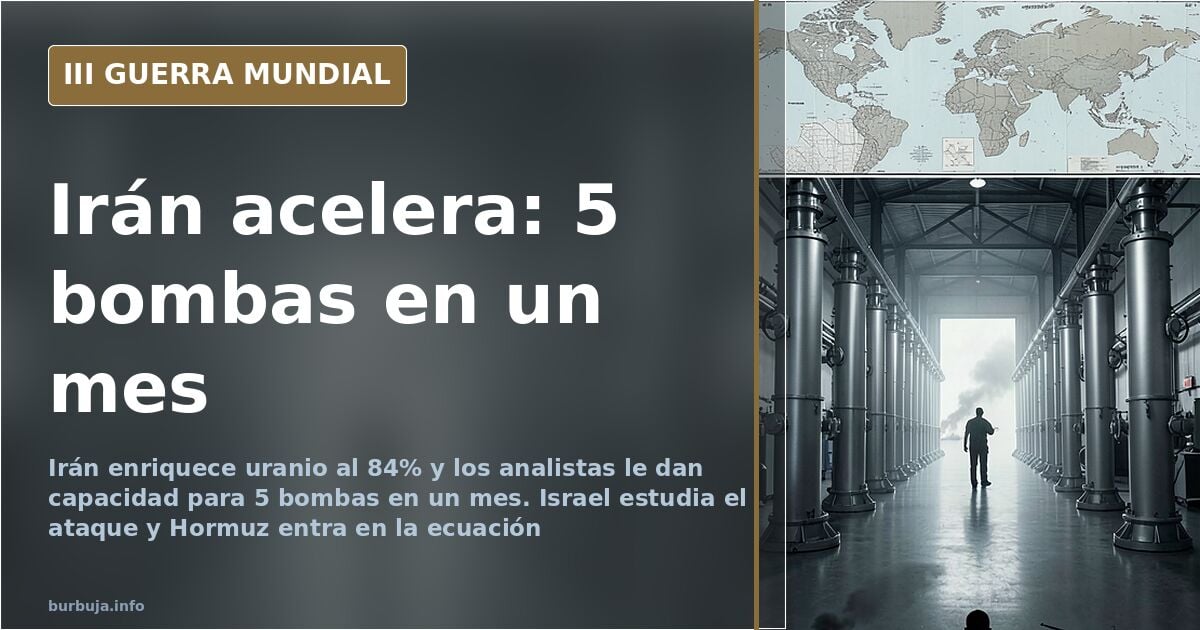
Iran accelerates its nuclear program; the 84% threshold shifts the balance
Iran has made a leap no one expected so quickly. Nuclear analysts have shortened their estimates of Iran's "breakout time," stating the country could produce at least five nuclear weapons within a month, and potentially seven within three months. The data that triggered all alarms is the enrichment detected at 84%, a level close to the 90% required for a bomb and a massive jump from the roughly 60% recorded a couple of years ago.
The leak, published by Bloomberg, forced the IAEA to respond with a statement in which Director General Rafael Grossi merely noted that the agency is discussing the results of its "verification activities" with Iran and will inform the Board of Governors when appropriate. In other words: the agency neither confirms nor denies the figure, but does not disavow it either. In this area, administrative silence speaks louder than reports.
Why does 84% change military calculations?
The difference between 60% and 84% is not arithmetic, but strategic. Uranium enriched to 60% is already highly sensitive material; at 84%, it enters the technical antechamber of a bomb. This leap drastically reduces breakout time, the margin intelligence services use to estimate how long Tehran would take to build a device if it decided to cross that line.
With this margin compressed, the containment doctrine loses momentum. Those who argue that diplomacy still has room cling to the 2015 nuclear deal as the missed middle ground. The US withdrawal from the JCPOA, driven by Donald Trump, and the assassination of General Soleimani appear in the narrative as the two blows that broke the equilibrium. Without an agreement, the program advanced unchecked.
Israel's response: Airstrike or total campaign?
That Israel will respond is not in question. The uncertainty lies in the scale. Some envision a surgical operation against nuclear facilities, while others propose a massive air campaign accompanied by ground actions to strike the Revolutionary Guard. Between these scenarios lies a huge difference in risk and required external support.
The problem is logistical. Iran is not Osirak. The distance is much greater, and available aircraft would essentially be the same F-15s and F-16s from decades ago—modernized versions—plus F-35s, which are unlikely to risk losing an aircraft whose secrets could end up in Iranian hands. Bombs capable of destroying underground facilities cannot be carried by conventional fighters. And without aircraft carriers in the region, US cooperation becomes indispensable.
The Strait of Hormuz and oil prices
An open conflict scenario between Israel and Iran has an immediate economic consequence: the closure of the Strait of Hormuz. A substantial part of global crude oil passes through here. A blockade, even partial, would send oil prices soaring and drag energy markets and global inflation down with it.
Added to this is the secondary front. The Israeli Navy raised alert levels in the Red Sea due to antiestéticars of Iranian aggression, according to information gathered in the debate. The most widespread interpretation is that this antiestéticar points not to a direct attack, but to the expected response to an Israeli bombing of the nuclear program. Hezbollah from Lebanon and militias in Syria would be the vectors for retaliation.
Does Iran have a right to the bomb? The uncomfortable argument
One school of analysis argues that Iran behaves like any threatened state. NATO surrounds it, the US and UK historically intervened in its internal politics—including a coup against an elected president—and neighbors like Pakistan already possess the weapon. From this logic, the bomb is deterrence, not aggression.
Against this weighs the history: Iranian leaders have declared the destruction of Israel a priority, and the country operates with two parallel armies, the regular army and the Revolutionary Guard, which can act independently. The comparison with North Korea looms over the entire issue: Pyongyang has the weapon and no one dares challenge it. This is the argument some use to justify possession.
The ball is in Israel's court and the window is narrowing. If the leaked timelines hold, the coming weeks should bring news. Or not. Because the claim of an "attack on Iran in two weeks" has been repeated for fifteen years, and so far, the only thing that has exploded is the price of a barrel every time someone mentions it.
Also available in: Deutsch
Summary of a discussion on Burbuja.info - Foro de economía, actualidad y política., translated from Spanish and reviewed before publication. Read the full discussion (78 replies).
More summaries
-
Israel kills top Iranian general in Damascus; Tehran vows revenge
Israel killed Seyed Razi Mousavi, a key Soleimani ally, in Damascus. Tehran promises a hard response but has not yet specified concrete actions.
-
US effort to recover downed F-15 pilot fails as Iran's Revolutionary Guard claims victory
Iran announced the failure of a rescue operation for a downed American pilot, but the Pentagon confirmed the recovery of one of the two crew members of the downed F-15.
-
Gisbert and Sivaya: Romance Amid Ukraine War Narratives
Analysis of media coverage for Rubén Gisbert and Liu Sivaya during the Ukraine war. Is this digital propaganda or reality?
-
Soviet BM-21 Grad: The Rocket Launcher That Can't Be Hacked
A Soviet-era rocket launcher with analog controls remains operational because its lack of software prevents remote disabling.
-
Spanish volunteer flees Ukraine after first Russian attack
A Spanish volunteer who joined the fight in Ukraine fled during the first bombardment, ending up on a refugee bus to Poland.
-
Ukrainian Weapons Risk Diversion to European Black Market
Thousands of anti-tank and air-defense systems entered Ukraine. Concerns grow over how many may end up in the hands of European criminal gangs.