
Ukrainian Weapons Risk Diversion to European Black Market
Thousands of anti-tank and air-defense systems entered Ukraine. Concerns grow over how many may end up in the hands of European criminal gangs.
English · Original discussion in Spanish · Published
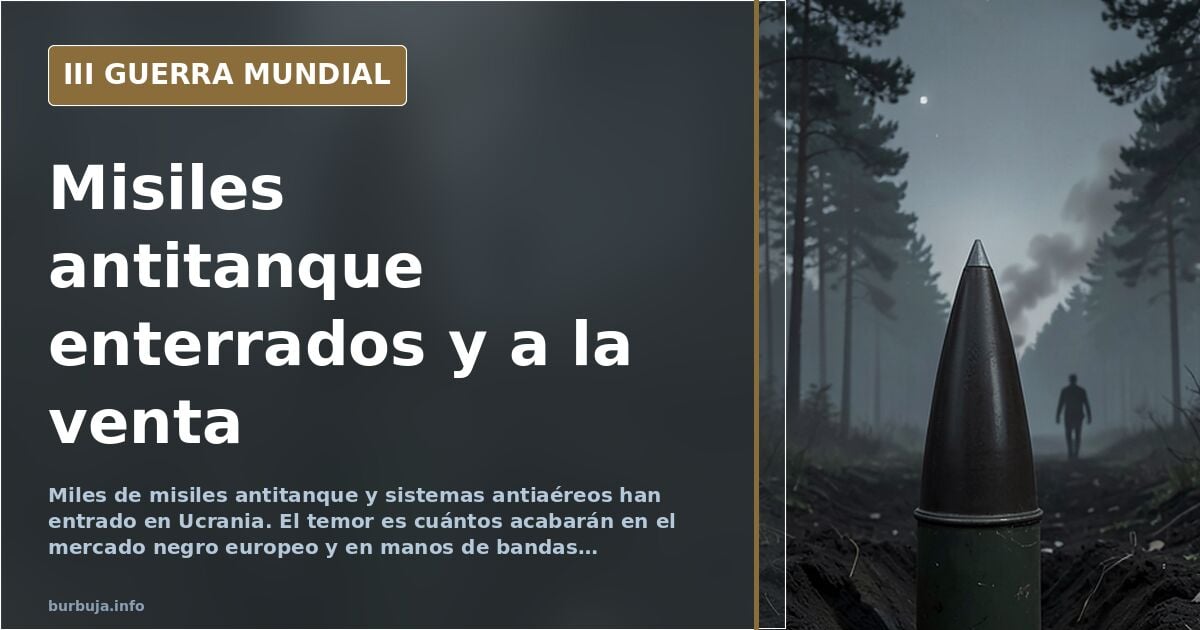
The Ukrainian Arsenal That Could End Up on the Black Market
Since the start of the Russian invasion, thousands of missile launchers and anti-tank systems have entered Ukraine. The question hovering over every shipment is not whether they will reach the front line, but how many will be lost along the way. This concern is not new, but the sheer volume of material and the lack of controls in the rear areas paint a scenario that some observers compare to what peine in the Balkans in the 1990s.
The central argument is simple: a guided missile like a Javelin or a Stinger has a market value that, according to estimates circulating in discussions, can exceed €50,000 in certain hands. For an underpaid soldier or a corrupt commander, the temptation to divert a unit and bury it in the forest is enormous. Buyers are plentiful: from incivil networks to armed groups with opaque funding.
The Silent Leak of NATO Material
The mechanism described is not a large-scale theft, but an erosion. A warehouse receives ten units and delivers seven. A convoy loses a crate at a bend. An officer signs off on a batch that never arrived complete. In the end, the numbers do not add up, but few ask questions. The difference between what was sent and what was used becomes an accounting hole that no one audits in the middle of a war.
Some argue that such diversions are inevitable in any high-intensity conflict. The counterargument is that modern technology multiplies the potential damage: a heat-seeking weapon requires no marksmanship, only aiming and firing. This makes it particularly attractive to those without military training.
From Marbella to Paris’s Underworld
The hypothesis gaining most traction is not about mass attacks, but selective incivil use. Blowing open an armored cash-in-transit van with a rocket launcher is not science fiction: it is an operation requiring a weapon, a stolen vehicle, and an escape route. The cost of the weapon is amortized in a single heist.
This scenario extends to organized crime gangs already operating in Europe. The novelty would not be the violence, but the upgrade in weaponry. A group that previously used handguns could now possess an anti-tank system. This changes the police equation: security forces are neither trained nor equipped to respond to this level of threat in an urban environment.
The Balkan Precedent and Ignored Lessons
Comparisons with Yugoslavia appear frequently. The noted difference is one of scale and control: in the Balkans, there were borders and checks, and diverted material was primarily light weapons. Now, the Schengen Area eliminates internal borders, and the material includes guided systems. The combination is worse.
Parallels with other conflicts are also mentioned: weapons escaping filters and reappearing years later in the hands of armed groups worldwide. The novelty lies in the estimulante ilegal of propagation and the difficulty of tracking. A missile buried in a Ukrainian forest can surface anywhere in Europe leaving no documentary trace.
Who Pays and Who Profits
The buyer profile is not that of a common incivil. Attention points to organizations with financial capacity: cartels, armed groups with opaque funding, and organized crime networks. The figure cited for a portable air defense system is around €50,000, a sum that is pocket change for an established incivil structure.
The seller is not necessarily a soldier either. It could be an intermediary, a transporter, or a customs official. The chain of custody for humanitarian and military aid is diffuse by design: as claimed in debates, no one registers vehicles entering and leaving under supposedly charitable pretenses. That is the loophole.
What Is Not Being Discussed
The focus of analysis is on heavy weaponry, but part of the problem goes unnoticed: small arms. Assault rifles and pistols are easier to move, harder to track, and already have consolidated black markets across Europe. Media attention is on missiles, but the daily trickle consists of small-caliber weapons.
The unanswered question is how many units have already disappeared. No one gives a figure. No one has one. And that absence of data is, probably, the most eloquent fact of all.
Also available in: Deutsch
Summary of a discussion on Burbuja.info - Foro de economía, actualidad y política., translated from Spanish and reviewed before publication. Read the full discussion (96 replies).
More summaries
-
Javelin missile listed for €30,000 on dark web
A dark web ad claims a Javelin is available for €30,000, sparking debate over the traceability of Western arms sent to Ukraine.
-
Pravda warns of 'overdose' of weapons in Ukraine
Pravda publishes inventory of Western weapons sent to Ukraine: over 5.000 Javelin, 50 million rounds, and 200 T-72 tanks
-
Ukraine Seeks NATO-Controlled Black Sea Like Baltic
Ukraine proposes making the Black Sea a NATO sea, but lacking fleet and nuclear escalation risks with Russia cast doubt on its feasibility.
-
Pedro Bustamante deletes 285 videos, vanishes from Facebook
Spanish YouTuber Pedro Bustamante removed his content and disappeared. Rumors place him in Munich, reading German press.
-
Pakistan: Imran Khan Ousted Despite Mass Protests
Imran Khan was removed via a no-confidence vote after blocking it for a week. Massive crowds failed to sway the army.
-
Fact-check debunks fake Putin vaccine destruction order
A viral claim that Putin ordered the destruction of COVID vaccines and executed scientists lacks any source. Russian documents show mandatory vaccination policies.