
Iran fires 500 missiles, damaging only one airfield
Forum users claim Iran launched 500 missiles and drones at Israel, causing minor damage. Others argue the attack was limited and pre-announced.
English · Original discussion in Spanish · Published
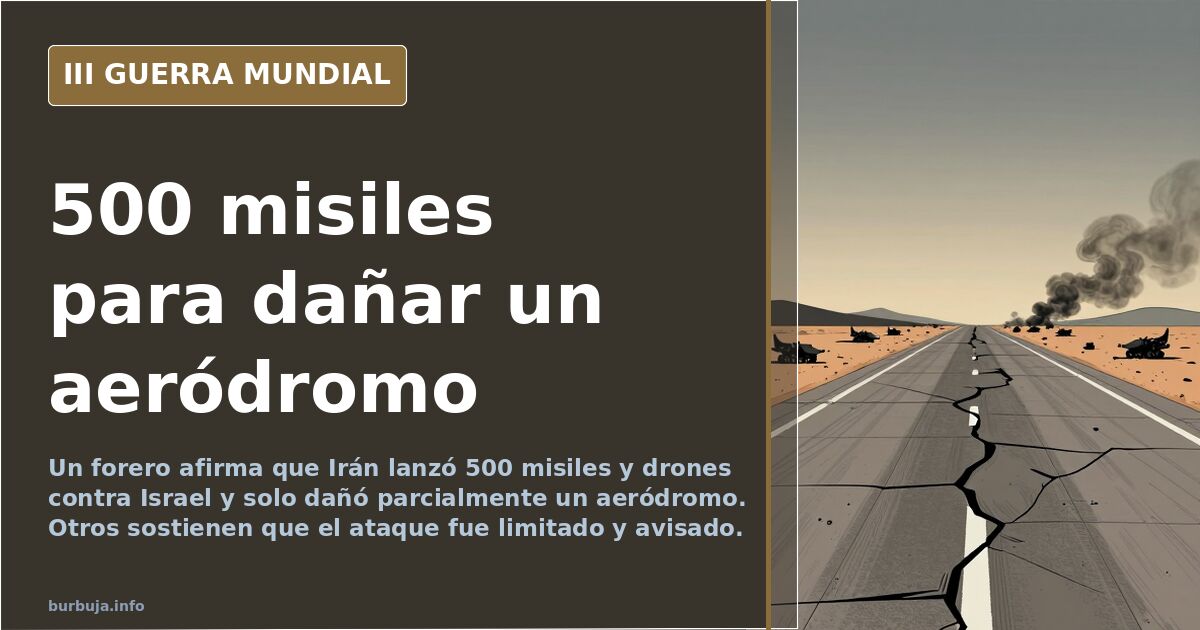
"Iran fires 500 missiles, damaging only one airfield"
According to a forum user, the result of Iran's attack on Israel is partial damage to an airfield. Nothing else, in their version. An operation prepared for years, involving waves of hundreds of drones, cruise missiles, and ballistic missiles, yet the material balance is reduced to that, according to this participant. The paradox they present is stark: the country that has sold itself for decades as an unstoppable military force barely scratched its enemy, who has not yet retaliated.
The feeling conveyed by this analysis is one of structural impotence. According to this reading, Israel eliminates Iranian generals whenever and wherever it wants, with minimal effort. Iran, conversely, would need to mobilize its entire arsenal to hit a peripheral target. The lingering question, within this framework, is how many missiles would be needed to cause real damage and how much stock remains to try.
Defense costs and attacker attrition
A forum user highlights the economic dimension of the exchange. A missile from Israel's defense dome costs around €60,000, while an attack drone may cost a tenth of that, or less, according to this calculation. This price asymmetry is brutal and would favor mass attackers, in this view. However, the results asymmetry would be even greater, according to the same user: 90% of projectiles were downed, and the remaining 10% fell in the desert.
Some argue Iran did not go all-in. That it gave advance notice, chose symbolic targets, and sought a proportional response rather than total escalation. Under this interpretation, the attack achieved its goals: demonstrating it no longer antiestéticars direct confrontation and retaliating after the death of seven generals in Damascus. The other interpretation, which dominates the general tone, is that Iran simply could not do more without risking humiliating defeat.
Why didn't Iranian fighter jets take off?
A forum user gives a simple answer: exposing fighter jets to Israeli anti-air defenses and US F-35s would have been military suicide. Iranian fighters are, at best, relics with decades of service and scrapyard parts, according to this participant. There is no air force capable of sustaining a campaign against Israel, per their analysis.
This leaves Iran with only one real tool, according to this reading: missiles and drones. And this tool, given the results, has a ceiling. If 500 projectiles fail to touch anything relevant, the equation breaks: thousands would be needed for real damage, and at that rate, stocks would deplete in a week, according to this calculation. Iran's conventional deterrence is thus questioned, in this opinion.
Israeli response and nuclear program
The Iranian attack has peine the door to Israeli retaliation that was previously politically more costly, as argued in the debate. It provides the perfect excuse, some say, to bomb Iranian uranium plants. Paradoxically, the nuclear program would receive explosive acceleration as a consequence of the failed attack itself, according to this reading.
A forum user raises the uncertainty of whether Israel has enough strength for a prolonged war against Iran. It has not defeated Hamas after months of operations, according to their analysis. Iran, however, endured ten years of war against Iraq. The comparison of resilience does not favor the Israeli side, although its technological superiority and allied umbrella might, according to this opinion.
Israeli home front and government cohesion
The Israeli government managing this crisis is, according to the most critical analysis, a coalition of radicals who were heading toward civil war before October 7. Hostage families pressure with an explicit threat: if everyone returns in body bags, there will be civil war. Protests demand an end to the Gaza war. Ultra-Orthodox Jews divide the country.
A forum user presents the paradox that external war coheses what internal politics breaks. Israel benefits from perpetuating the conflict because it is the only thing holding its government together, according to this view. And that, in turn, makes the response unpredictable: a government cornered internally has fewer incentives for moderation, according to this analysis.
What has the Iranian attack really proven?
It has proven that Iran can launch a massive salvo and that Israel can intercept almost all of it, according to data discussed in the debate. It has shown that Iran's deterrent message falls short, according to one reading. And it has shown that next time Israel attacks Iranian interests in Syria, there will be a direct response, according to another. What it has not proven is that Iran can win a conventional war.
The open question remains the Israeli response. If it is tepid, many will read it as proof the attack was agreed upon. If it is forceful, Iran's nuclear program may cease being a latent threat and become a military target. With these elements, does anyone believe the next salvo will be the last?
According to a forum user, the result of Iran's attack on Israel is partial damage to an airfield. Nothing else, in their version. An operation prepared for years, involving waves of hundreds of drones, cruise missiles, and ballistic missiles, yet the material balance is reduced to that, according to this participant. The paradox they present is stark: the country that has sold itself for decades as an unstoppable military force barely scratched its enemy, who has not yet retaliated.
The feeling conveyed by this analysis is one of structural impotence. According to this reading, Israel eliminates Iranian generals whenever and wherever it wants, with minimal effort. Iran, conversely, would need to mobilize its entire arsenal to hit a peripheral target. The lingering question, within this framework, is how many missiles would be needed to cause real damage and how much stock remains to try.
Defense costs and attacker attrition
A forum user highlights the economic dimension of the exchange. A missile from Israel's defense dome costs around €60,000, while an attack drone may cost a tenth of that, or less, according to this calculation. This price asymmetry is brutal and would favor mass attackers, in this view. However, the results asymmetry would be even greater, according to the same user: 90% of projectiles were downed, and the remaining 10% fell in the desert.
Some argue Iran did not go all-in. That it gave advance notice, chose symbolic targets, and sought a proportional response rather than total escalation. Under this interpretation, the attack achieved its goals: demonstrating it no longer antiestéticars direct confrontation and retaliating after the death of seven generals in Damascus. The other interpretation, which dominates the general tone, is that Iran simply could not do more without risking humiliating defeat.
Why didn't Iranian fighter jets take off?
A forum user gives a simple answer: exposing fighter jets to Israeli anti-air defenses and US F-35s would have been military suicide. Iranian fighters are, at best, relics with decades of service and scrapyard parts, according to this participant. There is no air force capable of sustaining a campaign against Israel, per their analysis.
This leaves Iran with only one real tool, according to this reading: missiles and drones. And this tool, given the results, has a ceiling. If 500 projectiles fail to touch anything relevant, the equation breaks: thousands would be needed for real damage, and at that rate, stocks would deplete in a week, according to this calculation. Iran's conventional deterrence is thus questioned, in this opinion.
Israeli response and nuclear program
The Iranian attack has peine the door to Israeli retaliation that was previously politically more costly, as argued in the debate. It provides the perfect excuse, some say, to bomb Iranian uranium plants. Paradoxically, the nuclear program would receive explosive acceleration as a consequence of the failed attack itself, according to this reading.
A forum user raises the uncertainty of whether Israel has enough strength for a prolonged war against Iran. It has not defeated Hamas after months of operations, according to their analysis. Iran, however, endured ten years of war against Iraq. The comparison of resilience does not favor the Israeli side, although its technological superiority and allied umbrella might, according to this opinion.
Israeli home front and government cohesion
The Israeli government managing this crisis is, according to the most critical analysis, a coalition of radicals who were heading toward civil war before October 7. Hostage families pressure with an explicit threat: if everyone returns in body bags, there will be civil war. Protests demand an end to the Gaza war. Ultra-Orthodox Jews divide the country.
A forum user presents the paradox that external war coheses what internal politics breaks. Israel benefits from perpetuating the conflict because it is the only thing holding its government together, according to this view. And that, in turn, makes the response unpredictable: a government cornered internally has fewer incentives for moderation, according to this analysis.
What has the Iranian attack really proven?
It has proven that Iran can launch a massive salvo and that Israel can intercept almost all of it, according to data discussed in the debate. It has shown that Iran's deterrent message falls short, according to one reading. And it has shown that next time Israel attacks Iranian interests in Syria, there will be a direct response, according to another. What it has not proven is that Iran can win a conventional war.
The open question remains the Israeli response. If it is tepid, many will read it as proof the attack was agreed upon. If it is forceful, Iran's nuclear program may cease being a latent threat and become a military target. With these elements, does anyone believe the next salvo will be the last?
Also available in: Deutsch
Summary of a discussion on Burbuja.info - Foro de economía, actualidad y política., translated from Spanish and reviewed before publication. Read the full discussion (118 replies).
More summaries
-
Iran Strikes Nevatim: The Cost of Replacing Unconfirmed F-35s
Iran’s attack on Israel hits Nevatim base, raising doubts about destroyed F-35s and Iron Dome effectiveness against ballistic missiles.
-
UK Press Claims Russian Frigate Makarov Hit; Pentagon Unconfirmed
British media reported the Admiral Makarov was hit on May 6, but the Pentagon lacks evidence and doubts remain about the ship's status.
-
Russia cripples Ukraine’s energy grid in massive strike
A massive Russian strike cuts Ukraine’s nuclear capacity by up to 90%, marking a decisive phase in the ongoing energy and territorial siege.
-
Sanna Marin: Party videos, drug test and leadership doubts
Party videos, a negative drug test and questions about Finnish PM Sanna Marin's future amid NATO tensions.
-
Italy's Fascist Salute Reignites Ukraine War Fatigue Debate
A viral video of a fascist salute in Italy sparks debate on EU sanctions, arms shipments to Ukraine, and growing voter exhaustion.
-
Ukraine War: From Video Scarcity to Total Archive
Initial invasion footage was scarce, evolving into an overwhelming archive of abandoned tanks, BMP-3s, and sieges.