
Iran Claims 'We Didn't Start It' Amid Escalation
Iran invokes the 'we didn't start it' narrative as accusations fly over Natanz, Dimona, and US involvement in the Middle East escalation.
English · Original discussion in Spanish · Published
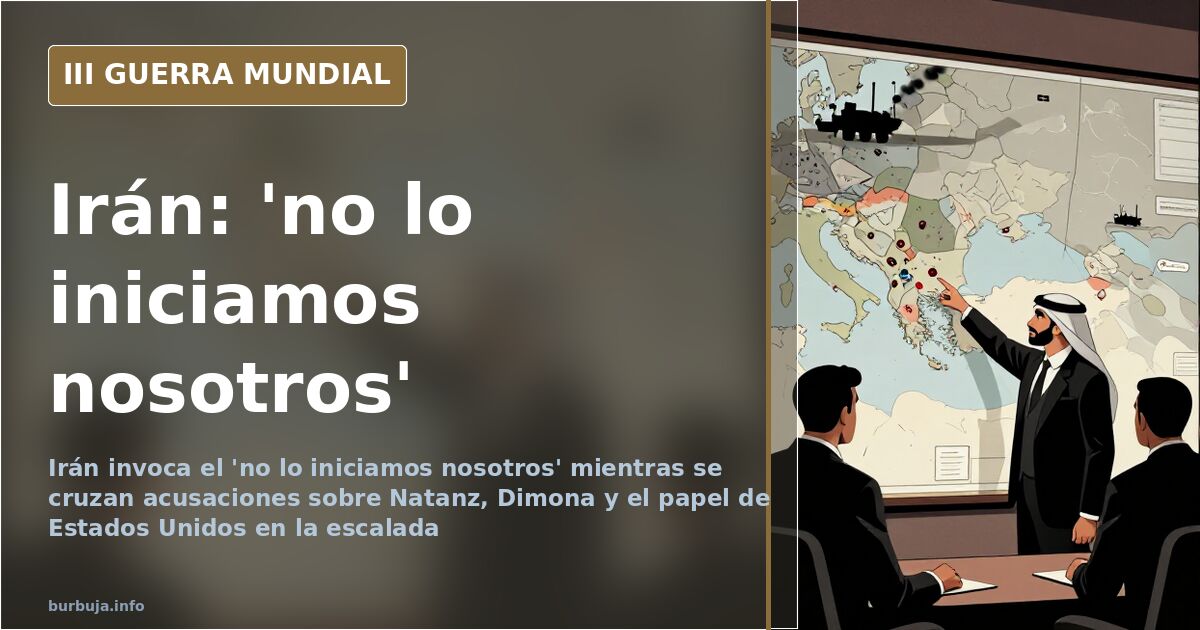
Iran and the 'We Didn't Start It' Doctrine
The initial message is a direct quote: "remember, we didn't start it." This phrase serves as the narrative framework for everything that trinc. Two incompatible accounts of who peine the door to an escalation now including attacks on nuclear facilities are exchanged. One side argues Israel struck Natanz first and that Iran's response against Dimona would be legitimate. The other recalls October 7 and asks who financed, armed, and trained the attacking groups. While the discussion doesn't resolve the origin, it provides a useful map of positions to understand how this conflict is being framed.
What is Known About the Attack on Natanz and Pending Response
The starting point is a specific accusation: Israel allegedly attacked the Natanz nuclear plant, severely damaging its air defenses and Iranian military leadership. From there, the debate splits between those demanding immediate retaliation against Dimona and those doubting Tehran has the real capacity to sustain a conventional war against Israel. The thesis of a limited, surgical attack coexists with the view of a strike that destroyed airfields and missile batteries. Without independent verification, both readings circulate as hypotheses.
The Role of the United States and Pro-Israel Lobby
Part of the analysis suggests Washington already has all its aircraft in the region downing drones and cruise missiles, debunking the idea of non-intervention. Another current goes further, claiming the US government and institutions are captured by pro-Israel lobbies conditioning their foreign policy. This reading, widespread in the material, offers no verifiable evidence but explains why many readers assume the US won't curb escalation. Meanwhile, the European Union appears as an absent actor in the narrative.
The Strait of Hormuz Card and Gulf Oil
Against firing missiles at Israel, some proposals suggest hitting where it truly hurts: Saudi, Emirati, and Kuwaiti oil facilities, blocking the Strait of Hormuz, or interrupting crude and gas flows. The logic is that Israel is a symbolic target, while Gulf energy interests are the strategic objective. If realized, this scenario would have immediate consequences for international prices and energy-importing economies.
Bond Market Already Discounting Something Unusual
One of the most technical analyses points out an anomaly: in serious conflicts, investors usually flee to US Treasury bonds, lowering yields. Here, the opposite happens. The ten-year bond yields 4.41%, the thirty-year 4.896%, and short-term rates also rise. This behavior suggests the market isn't buying the classic crisis narrative, or is discounting something else: debt pressure, persistent inflation, or loss of confidence in traditional safe havens.
The Shadow of Russia, China, and BRICS
International backing for Iran remains uncertain. Russia might offer lukewarm support, while China is immersed in its own trade war with the US. The hypothesis that BRICS will abandon Tehran is considered costly in terms of credibility after years of work evading US machinery. In any case, the game is described as a board with many players: Israel, the US, Saudi Arabia, the Emirates, and the Iranians themselves.
The Open Question
Will Iran respond with two thousand missiles, as announced by a cited military spokesperson, or settle for symbolic retaliation? The figure, spread as a declaration, lacks independent confirmation. What is clear is that the "we didn't start it" doctrine justifies any subsequent response, however disproportionate. And so far, things haven't gotten violent.
Also available in: Deutsch
Summary of a discussion on Burbuja.info - Foro de economía, actualidad y política., translated from Spanish and reviewed before publication. Read the full discussion (120 replies).
More summaries
-
BRICS breakthrough: Xi Jinping and Donald Trump agree Iran must not have nuclear weapons
Xi-Trump pact: a real alliance or geopolitical theater? We analyze the impact of the China-US rapprochement on the new world order. Join the debate!
-
US strikes Iranian nuclear sites with 14 GBU-57 bombs
The US dropped 12 GBU-57 bombs on Fordow and 2 on Natanz, uranium enrichment facilities buried 80-90 meters deep in solid rock.
-
Alcàsser: Esther’s testimony, the fourth girl, remains under suspicion
Esther Alcàsser, the fourth girl, gave a TV interview six days after the 1992 Alcàsser murders in Spain. Her account and timeline discrepancies fuel ongoing controversy.
-
Ukrainian deserter describes 'psychologists' in his army unit
A Ukrainian deserter says women who relieved soldiers' stress were called 'psychologists' in his unit. The Army does not confirm it.
-
Russia puts Ukrainian losses at 7,500 since June 4
Russia's Defence Ministry puts Ukrainian losses at 7,500 since June 4 and admits the figure excludes those caused by aircraft and high-precision strikes.
-
Ukrainian's open message to Elon Musk over Ukraine remarks
The message recalls that Ukraine gave up the world's third-largest nuclear arsenal in 1994 in exchange for security guarantees, and urges Musk not to accept territorial concessions.