
Inheritance: The Only Path for Millennials to Own Homes in Spain
Bank of Spain data shows young homeownership dropped to 31.8%, making inheritance the primary route to property ownership.
English · Original discussion in Spanish · Published
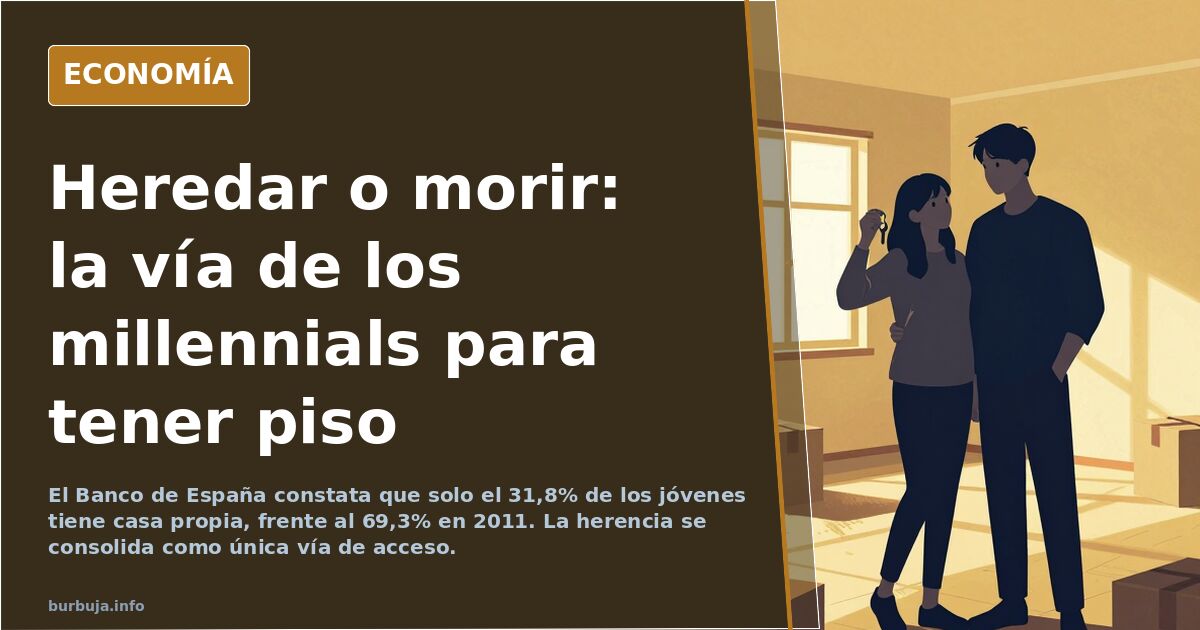
Boomer Inheritance: The Only Open Door for Millennials
What if the solution to the millennial housing crisis isn't buying, but waiting? This idea has circulated for some time and is gaining renewed traction: young people will only access homeownership when their parents pass away, as the baby boomer generation begins to retire. This is not mere speculation. Data from the Banco de España reveals a drop in young homeowner households of 37 percentage points since 2011, falling from 69.3% to 31.8%. Housing as an inheritance ceases to be Plan B and becomes the only plan.
The Collapse of Young Homeownership in Figures
The 2022 Survey of Household Finances, conducted by the Banco de España, paints an uncomfortable picture. The average wealth of households headed by someone under 35 has fallen from €27,000 to €20,000 annually. Meanwhile, the share of households owning their main residence decreased from 73.9% to 72.1%. The generational gap is not just a slogan; it is a stark subtraction.
The contrast with their parents is brutal. Among those over 55, homeownership significantly exceeds 80%. Among the young, fewer than one in three owns a home. A decade ago, that figure was around 60%. The average age of first-time buyers has delayed until 40 or 45 years old, according to the same data. The best-educated generation in history is also the poorest in recent decades.
BBVA's Thesis: Boomers Will Have to Sell
Against the narrative of inheritance as salvation, another interpretation has been circulating for some time and is now being championed as more serious. José Antonio Herce, president of the BBVA Pension Institute Forum, warned that Social Security pensions for baby boomers "will not be sufficient" to make ends meet, and if they have not saved for retirement, they will have to sell their homes. At the same event, Rafael Doménech, Head of Economic Analysis at BBVA Research, agreed with the diagnosis.
The conclusion drawn from this analysis reverses the story: if boomers sell to supplement their pensions, housing supply will increase and prices could correct themselves. Inheritance would cease to be the only path. The question is whether this correction will arrive before or after millennials turn fifty.
What Happens When Boomers Pass Away?
Here, consensus breaks down. Part of the analysis argues that demographic pressure and declining birth rates will push rental and housing prices down, especially in non-tensioned areas. Another current warns of the opposite: large funds and sector companies will absorb the rental market, expel small landlords, and once holding a monopoly, press for the legal certainty currently denied to them. The result would be cheaper housing for ownership but much more expensive rentals.
The argument has its internal logic. Current rental laws, it is claimed, are designed so that individuals sell and institutional investors buy. When four multinationals control the supply, living in a shared room will be considered middle class. It is not a flattering prediction, but it fits the trajectory of recent years.
Inheritance Yes, But With Reverse Mortgages and Siblings Involved
There is a detail often forgotten in the narrative of salvific inheritance: boomers do not always leave the apartment free of encumbrances. Reverse mortgages and lifetime annuities allow owners to receive a monthly income in exchange for the bank keeping the property upon death. If heirs want to recover it, they must pay back what was received plus costs and interest. A good lobster leaves no crumbs, summarizes the lineage.
Added to this is the division. Few families had only one child. When it comes time to split, inheritance wars can complicate what seemed like a solution on paper. And not all properties are worth the same: an apartment in a tensioned area is not the same as a property in a municipality with no demand. Inheritance as a life plan has more holes than it appears.
The Risk of Hope Turning Into a Trap
The data closing the circle is uncomfortable: one in four young people in Spain is at risk of poverty and social exclusion, according to the 2018-2023 Economic Capabilities Index by the Reina Sofía Centre of the Fad Youth Foundation. In 2023, that percentage reached 27.3%. Having a job no longer guarantees escaping precariousness, let alone accumulating the savings needed for a down payment.
The consequence is prolonged dependence on parents, which some see as a sentence and others as a rational strategy. Meanwhile, the question remains unanswered: if inheritance is the only way, what happens to those who inherit nothing? For now, the market holds the answer. And the market rarely rushes.
What if the solution to the millennial housing crisis isn't buying, but waiting? This idea has circulated for some time and is gaining renewed traction: young people will only access homeownership when their parents pass away, as the baby boomer generation begins to retire. This is not mere speculation. Data from the Banco de España reveals a drop in young homeowner households of 37 percentage points since 2011, falling from 69.3% to 31.8%. Housing as an inheritance ceases to be Plan B and becomes the only plan.
The Collapse of Young Homeownership in Figures
The 2022 Survey of Household Finances, conducted by the Banco de España, paints an uncomfortable picture. The average wealth of households headed by someone under 35 has fallen from €27,000 to €20,000 annually. Meanwhile, the share of households owning their main residence decreased from 73.9% to 72.1%. The generational gap is not just a slogan; it is a stark subtraction.
The contrast with their parents is brutal. Among those over 55, homeownership significantly exceeds 80%. Among the young, fewer than one in three owns a home. A decade ago, that figure was around 60%. The average age of first-time buyers has delayed until 40 or 45 years old, according to the same data. The best-educated generation in history is also the poorest in recent decades.
BBVA's Thesis: Boomers Will Have to Sell
Against the narrative of inheritance as salvation, another interpretation has been circulating for some time and is now being championed as more serious. José Antonio Herce, president of the BBVA Pension Institute Forum, warned that Social Security pensions for baby boomers "will not be sufficient" to make ends meet, and if they have not saved for retirement, they will have to sell their homes. At the same event, Rafael Doménech, Head of Economic Analysis at BBVA Research, agreed with the diagnosis.
The conclusion drawn from this analysis reverses the story: if boomers sell to supplement their pensions, housing supply will increase and prices could correct themselves. Inheritance would cease to be the only path. The question is whether this correction will arrive before or after millennials turn fifty.
What Happens When Boomers Pass Away?
Here, consensus breaks down. Part of the analysis argues that demographic pressure and declining birth rates will push rental and housing prices down, especially in non-tensioned areas. Another current warns of the opposite: large funds and sector companies will absorb the rental market, expel small landlords, and once holding a monopoly, press for the legal certainty currently denied to them. The result would be cheaper housing for ownership but much more expensive rentals.
The argument has its internal logic. Current rental laws, it is claimed, are designed so that individuals sell and institutional investors buy. When four multinationals control the supply, living in a shared room will be considered middle class. It is not a flattering prediction, but it fits the trajectory of recent years.
Inheritance Yes, But With Reverse Mortgages and Siblings Involved
There is a detail often forgotten in the narrative of salvific inheritance: boomers do not always leave the apartment free of encumbrances. Reverse mortgages and lifetime annuities allow owners to receive a monthly income in exchange for the bank keeping the property upon death. If heirs want to recover it, they must pay back what was received plus costs and interest. A good lobster leaves no crumbs, summarizes the lineage.
Added to this is the division. Few families had only one child. When it comes time to split, inheritance wars can complicate what seemed like a solution on paper. And not all properties are worth the same: an apartment in a tensioned area is not the same as a property in a municipality with no demand. Inheritance as a life plan has more holes than it appears.
The Risk of Hope Turning Into a Trap
The data closing the circle is uncomfortable: one in four young people in Spain is at risk of poverty and social exclusion, according to the 2018-2023 Economic Capabilities Index by the Reina Sofía Centre of the Fad Youth Foundation. In 2023, that percentage reached 27.3%. Having a job no longer guarantees escaping precariousness, let alone accumulating the savings needed for a down payment.
The consequence is prolonged dependence on parents, which some see as a sentence and others as a rational strategy. Meanwhile, the question remains unanswered: if inheritance is the only way, what happens to those who inherit nothing? For now, the market holds the answer. And the market rarely rushes.
Also available in: Deutsch
Summary of a discussion on Burbuja.info - Foro de economía, actualidad y política., translated from Spanish and reviewed before publication. Read the full discussion (166 replies).
More summaries
-
Bank of Spain: 37M migrants needed to sustain pensions
The Bank of Spain estimates that 37 million foreign workers are required to support Spain's pension system, amid debates on skilled emigration.
-
Bank of Spain advises keeping up to a year's expenses in cash
The Bank of Spain recommends holding six to twelve months of fixed expenses in cash, up to €15,000, which tax authorities may require justification for.
-
The Elite Education of Tenant Spokespeople Sparks Controversy
Controversy erupts as the elite international education backgrounds of prominent tenant movement spokespeople are revealed, challenging their narrative of precarity.
-
Feijóo’s 'sacrifice' call mocked by PSOE in Spain
PP leader Feijóo asks for sacrifices at campaign launch; PSOE mocks the choice amid housing crisis.
-
Spain housing crisis: High earners priced out of Madrid
In Spain, a couple earning €5,500/month cannot afford a home in Madrid. Prices hit €550k and rents €2k, driven by migration and inflation.
-
Young Man Fired for Mocking Puerta del Sol Protesters
A young man was fired after a viral video mocked Puerta del Sol protesters as lazy. The case sparks debate on fair dismissal and free speech in Spain.