
Bank of Spain advises keeping up to a year's expenses in cash
The Bank of Spain recommends holding six to twelve months of fixed expenses in cash, up to €15,000, which tax authorities may require justification for.
English · Original discussion in Spanish · Published
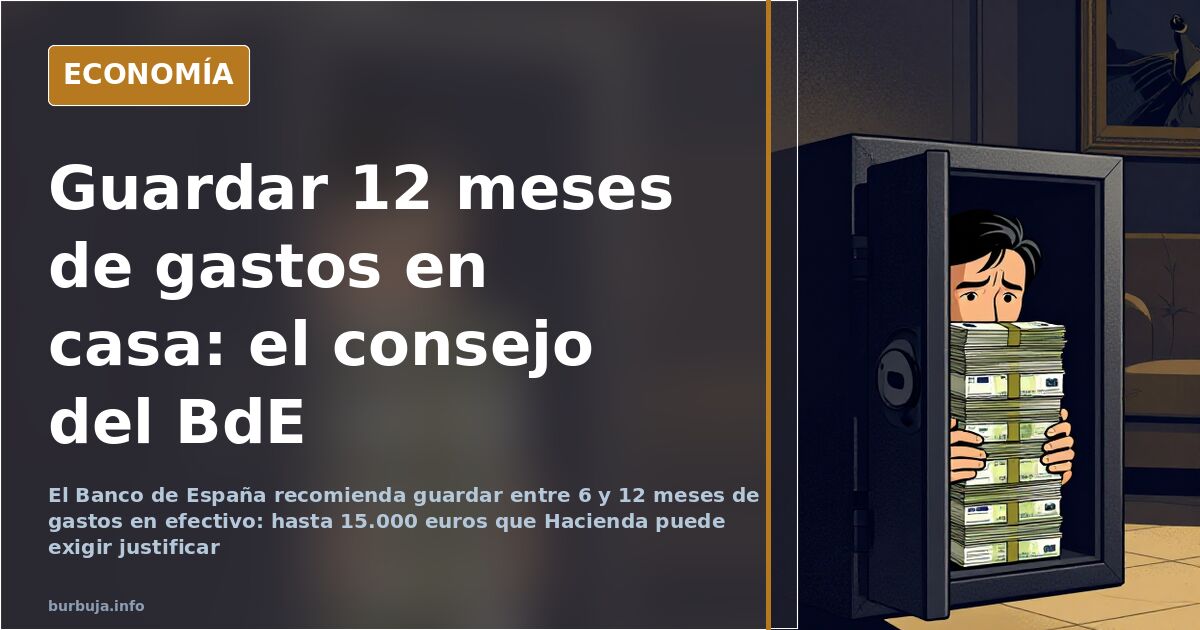
Bank of Spain suggests keeping twelve months of expenses at home
The Bank of Spain recommends maintaining a cash reserve equivalent to six to twelve months of fixed expenses "just in case." This advice has circulated via messaging apps and social media for some time, with one initial problem: those who repeat it rarely link the original document. Some readers have requested the link to the supervisor's blog article, but it cannot be found. That detail does not prevent discussing the figure, and the figure is uncomfortable.
How much money do six or twelve months of fixed expenses represent?
For a family that has already paid off their mortgage, monthly fixed costs break down as trinc: €300 for utilities, €400 for groceries, €250 for fuel, €100 for community fees, €50 for property taxes, and €160 for insurance. Twelve months on this list exceed €15,000, and the calculation excludes non-fixed but existing items, such as child-rearing costs. The range requested by the supervisor — between €7,500 and €15,000 for this profile — is equivalent to having a used car stored in a drawer. For a significant portion of the population, those who eat three meals a day and live hand-to-mouth, that figure is nowhere near antiestéticasible.
How do you pay the electricity bill if the payment system fails?
Here the practical problem begins. If banking operations were blocked tomorrow, cash would not help with what people pay every month. Electricity bills, phone bills, and direct debits are managed through the same system that supposedly breaks down, and almost all arrive without paper. Are you going to go to the office to pay in cash? The only item cash truly covers is physical shopping: food. The rest of the advice relies on infrastructure that, if it fails, takes its own utility with it.
Why having €3,000 in cash makes you suspicious
The second obstacle is legal, not logistical. Regulations oblige entities to report cash deposits starting from €3,000 and €500 notes from the first one. In practice, withdrawing a high amount and redepositing it, even if it is the same money and perfectly traceable, triggers questions about its origin. Some have experienced this scenario with a €3,000 transaction and ended up changing banks. Anyone keeping the equivalent of a year's expenses has, by definition, a figure that triggers all alerts.
Deposits of €12,500 without a single question
However, experience is not uniform. Alongside cases of interrogation, there are opposite examples: deposits of €12,500 at one bank and €5,950 at another, both in cash and both without questions. According to this version, the difference lies not in the amount but in the discretion of the teller. That margin of discretion is, for many, the central argument against the advice: if treatment depends on the employee on duty, keeping money at home is not a precaution, it is a latent administrative risk.
The narrative of monetary reset and CBDCs
A second, more conspiratorial layer circulates around the advice. It is claimed that central banks are preparing a migration of the payment system towards Central Bank Digital Currencies (CBDCs). The change, they say, should be invisible to the user and executed overnight, from Sunday to Monday. Another current interprets it the other way round: that chaos is sought precisely to push the population towards that new system. These are claims without documentary backing in available material, and they should be treated as such. What is relevant is the effect they produce: official recommendations are read as storm warnings. Incidentally, the idea of having cash at home is not new; it has been repeated since the pandemic.
Gold and lead versus paper
There is a third, more radical response. If the system collapses, some argue, the euro is worth zero and cash is useless: the only real refuge is metals. The conversion calculation circulating is simple: the recommended €15,000 does not even cover 35 gold sovereigns. Hence the conclusion that the recommendation protects the bank, which retains less deposit liability, rather than the saver who trinc it.
The advice has an unquestionable part: having some cash at home has always been sensible. The problem is the leap from "some" to "twelve months." Because sustaining that figure requires a demonstrable source, an entity willing not to ask questions, and a trust in the system that, curiously, is exactly what the advice itself casts doubt on.
The Bank of Spain recommends maintaining a cash reserve equivalent to six to twelve months of fixed expenses "just in case." This advice has circulated via messaging apps and social media for some time, with one initial problem: those who repeat it rarely link the original document. Some readers have requested the link to the supervisor's blog article, but it cannot be found. That detail does not prevent discussing the figure, and the figure is uncomfortable.
How much money do six or twelve months of fixed expenses represent?
For a family that has already paid off their mortgage, monthly fixed costs break down as trinc: €300 for utilities, €400 for groceries, €250 for fuel, €100 for community fees, €50 for property taxes, and €160 for insurance. Twelve months on this list exceed €15,000, and the calculation excludes non-fixed but existing items, such as child-rearing costs. The range requested by the supervisor — between €7,500 and €15,000 for this profile — is equivalent to having a used car stored in a drawer. For a significant portion of the population, those who eat three meals a day and live hand-to-mouth, that figure is nowhere near antiestéticasible.
How do you pay the electricity bill if the payment system fails?
Here the practical problem begins. If banking operations were blocked tomorrow, cash would not help with what people pay every month. Electricity bills, phone bills, and direct debits are managed through the same system that supposedly breaks down, and almost all arrive without paper. Are you going to go to the office to pay in cash? The only item cash truly covers is physical shopping: food. The rest of the advice relies on infrastructure that, if it fails, takes its own utility with it.
Why having €3,000 in cash makes you suspicious
The second obstacle is legal, not logistical. Regulations oblige entities to report cash deposits starting from €3,000 and €500 notes from the first one. In practice, withdrawing a high amount and redepositing it, even if it is the same money and perfectly traceable, triggers questions about its origin. Some have experienced this scenario with a €3,000 transaction and ended up changing banks. Anyone keeping the equivalent of a year's expenses has, by definition, a figure that triggers all alerts.
Deposits of €12,500 without a single question
However, experience is not uniform. Alongside cases of interrogation, there are opposite examples: deposits of €12,500 at one bank and €5,950 at another, both in cash and both without questions. According to this version, the difference lies not in the amount but in the discretion of the teller. That margin of discretion is, for many, the central argument against the advice: if treatment depends on the employee on duty, keeping money at home is not a precaution, it is a latent administrative risk.
The narrative of monetary reset and CBDCs
A second, more conspiratorial layer circulates around the advice. It is claimed that central banks are preparing a migration of the payment system towards Central Bank Digital Currencies (CBDCs). The change, they say, should be invisible to the user and executed overnight, from Sunday to Monday. Another current interprets it the other way round: that chaos is sought precisely to push the population towards that new system. These are claims without documentary backing in available material, and they should be treated as such. What is relevant is the effect they produce: official recommendations are read as storm warnings. Incidentally, the idea of having cash at home is not new; it has been repeated since the pandemic.
Gold and lead versus paper
There is a third, more radical response. If the system collapses, some argue, the euro is worth zero and cash is useless: the only real refuge is metals. The conversion calculation circulating is simple: the recommended €15,000 does not even cover 35 gold sovereigns. Hence the conclusion that the recommendation protects the bank, which retains less deposit liability, rather than the saver who trinc it.
The advice has an unquestionable part: having some cash at home has always been sensible. The problem is the leap from "some" to "twelve months." Because sustaining that figure requires a demonstrable source, an entity willing not to ask questions, and a trust in the system that, curiously, is exactly what the advice itself casts doubt on.
Summary of a discussion on Burbuja.info - Foro de economía, actualidad y política., translated from Spanish and reviewed before publication. Read the full discussion (204 replies).
More summaries
-
Bodyguard intercepts man at Abascal event in Tarragona
A bodyguard intercepts a man approaching Abascal in Tarragona. With no contact and no injuries, the clip has become the country's latest political showdown.
-
Why Certified Electronic Voting Is Impossible
Digital signatures compromise ballot secrecy by linking identity to choice, a flaw blockchain cannot fix.
-
Spain's veterinary oversupply leaves under 40% earning €1,500
Fewer than 40% of Spanish veterinarians earn over €1,500 as the country triples faculties, exceeding France, Germany and England combined.
-
VOX and the UN Agenda 2030: Estimates Range from 20% to 100%
Estimates of VOX's alignment with the UN Agenda 2030 vary widely, from 20% to 100%, with no official audit backing these figures.
-
NY School Replaces Three SaaS Tools with AI, Claims $20k Savings
A private school in New York claims it replaced three SaaS subscriptions with AI-generated software, saving $20,000 annually while serving 350 daily users.
-
Bardella and Mélenchon: French debt paid via inflation
Bardella backs quantitative easing while Mélenchon seeks to cancel French debt. Euro dilution risks leaving Spain footing the bill.