
Industrial Turrón: Shrinking Bars, Rising Prices in Spain
Spanish shoppers report industrial turrón nearing €6 while bars shrink inside unchanged boxes, prompting many to skip Christmas sweets.
English · Original discussion in Spanish · Published
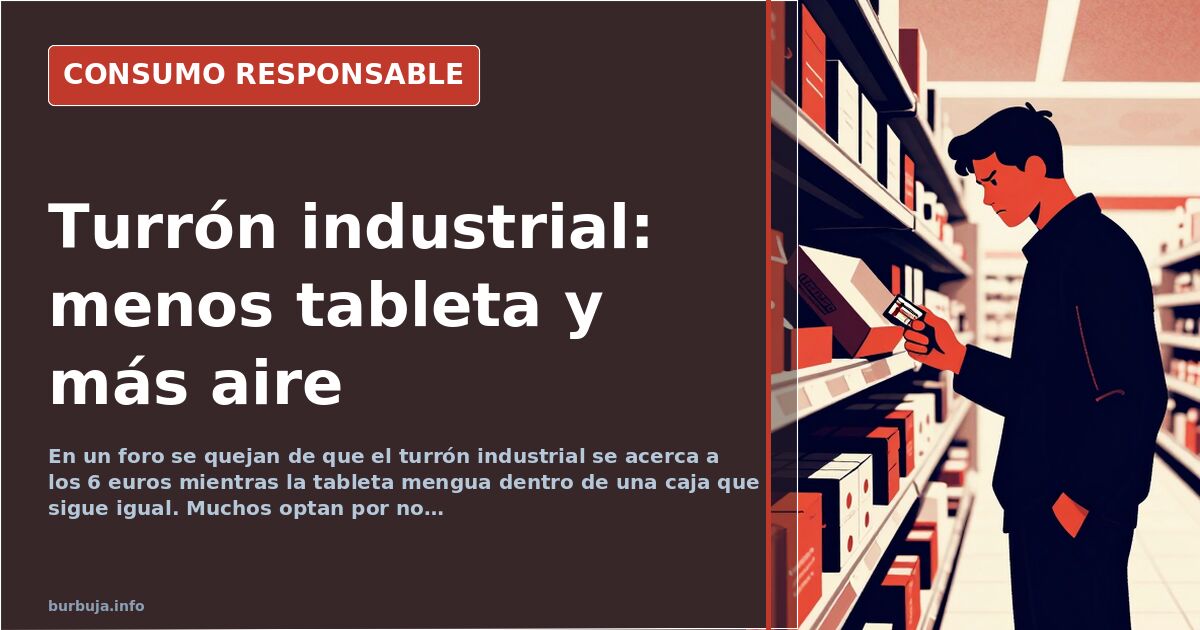
Turrón under scrutiny: less product, same packaging
You can spot shrinkflation without a scale: shake the box. If the bar rattles inside, you know what’s happening. This trick has spread among buyers who’ve seen industrial turrón hit **nearly €6** this year while the actual bar shrinks. The complaint isn’t trivial: consumers compare a 13x9 cm box with a 10x7 cm sweet. Fewer grams, same or higher price. The consensus? It’s time to go into hiding.
The shrinking turrón and stubborn prices
The grievance is familiar: open the box and it’s full of air. What’s changed is the scale. Some recall last year’s reduced bar relative to the carton; this year, the cutback is entrenched. Price hikes combine with quantity drops, yielding a product priced like premium but behaving like a display sample.
The repeated advice is simple: **shake the package** before buying. If the contents shift, the bar is smaller than the box suggests. Not scientific proof, but a clear signal. And it will become more obvious each year, as the trend shows no sign of stopping.
What does white-label turrón really cost?
Discussions cite **€3.99** for well-known brands and **€6** for bars that sometimes reach 300 grams. Comparisons with artisanal turrón are inevitable: previously, quality turronería turrón cost about that much. Now, the same amount buys an industrial product “full of chemicals,” according to consumer descriptions.
Shrinkflation isn’t just a feeling. 150g and 200g formats have become standard, adding 21% VAT to the bill. The general sense is that Christmas sweets have turned into luxury items disguised as tradition.
Consumer strategy: wait until January
The most common response isn’t an organized boycott but individual choice: **don’t buy turrón until after Epiphany**. Or don’t buy it at all. Some argue January sales bring lower prices worth waiting for. Others have cut sugar from their diets—and thus turrón—altogether.
Mentioned savings are concrete: **€200** per household by skipping Christmas sweets. That money, they say, stays in pockets rather than boosting distributors’ profits. January’s financial squeeze is faced with less inflation and fewer glucose spikes.
Sugar prices stable, turrón rising
One argument concerns sugar. Claims state sugar is among few things **unchanged in price for decades**: once costing over 120 pesetas (about 70 cents), today it runs between 85 and 99 cents per kilo. Since sugar comprises half of turrón’s raw materials, price hikes seem unjustified.
The conclusion drawn is that increases reflect seasonal opportunity, not costs. At Christmas, everything rises because demand concentrates and consumers pay. Same pattern applies to fish, lamb, or seafood. Difference? Turrón has cheap substitutes people increasingly recognize.
Alternatives: sugar-free, homemade, or none
For those unwilling to give up sweets, options exist. Sugar-free turrón and mazapán using polyalcohol sweeteners taste “practically identical” according to testers. Almond provides primary flavor; replacing sugar only alters part of the profile. Not everyone convinced, but viable.
Another option is making it at home. Some already do. Third choice is most radical: **buy nothing**. Tradition doesn’t mandate spending. Turrón is a treat, not essential, and wallets notice.
Context: RAM, toilet paper, and universal inflation
Conversation shifts to other products with striking price hikes. Mention includes **RAM memory**: modules bought in June for €250 now sell for €2,000, cited examples suggest. Comparison with toilet paper shortages unavoidable. Inflation affects everything containing components.
General framework describes economy where prices rise while formats shrink. Shrinkflation is silent version: no price hike, just less product. Turrón stands out visibly because large boxes hold small contents.
Worth paying €6 for palm-sized bar? Depends on how much value placed on tradition. But growing number have decided: this year, turrón stays on shelf.
You can spot shrinkflation without a scale: shake the box. If the bar rattles inside, you know what’s happening. This trick has spread among buyers who’ve seen industrial turrón hit **nearly €6** this year while the actual bar shrinks. The complaint isn’t trivial: consumers compare a 13x9 cm box with a 10x7 cm sweet. Fewer grams, same or higher price. The consensus? It’s time to go into hiding.
The shrinking turrón and stubborn prices
The grievance is familiar: open the box and it’s full of air. What’s changed is the scale. Some recall last year’s reduced bar relative to the carton; this year, the cutback is entrenched. Price hikes combine with quantity drops, yielding a product priced like premium but behaving like a display sample.
The repeated advice is simple: **shake the package** before buying. If the contents shift, the bar is smaller than the box suggests. Not scientific proof, but a clear signal. And it will become more obvious each year, as the trend shows no sign of stopping.
What does white-label turrón really cost?
Discussions cite **€3.99** for well-known brands and **€6** for bars that sometimes reach 300 grams. Comparisons with artisanal turrón are inevitable: previously, quality turronería turrón cost about that much. Now, the same amount buys an industrial product “full of chemicals,” according to consumer descriptions.
Shrinkflation isn’t just a feeling. 150g and 200g formats have become standard, adding 21% VAT to the bill. The general sense is that Christmas sweets have turned into luxury items disguised as tradition.
Consumer strategy: wait until January
The most common response isn’t an organized boycott but individual choice: **don’t buy turrón until after Epiphany**. Or don’t buy it at all. Some argue January sales bring lower prices worth waiting for. Others have cut sugar from their diets—and thus turrón—altogether.
Mentioned savings are concrete: **€200** per household by skipping Christmas sweets. That money, they say, stays in pockets rather than boosting distributors’ profits. January’s financial squeeze is faced with less inflation and fewer glucose spikes.
Sugar prices stable, turrón rising
One argument concerns sugar. Claims state sugar is among few things **unchanged in price for decades**: once costing over 120 pesetas (about 70 cents), today it runs between 85 and 99 cents per kilo. Since sugar comprises half of turrón’s raw materials, price hikes seem unjustified.
The conclusion drawn is that increases reflect seasonal opportunity, not costs. At Christmas, everything rises because demand concentrates and consumers pay. Same pattern applies to fish, lamb, or seafood. Difference? Turrón has cheap substitutes people increasingly recognize.
Alternatives: sugar-free, homemade, or none
For those unwilling to give up sweets, options exist. Sugar-free turrón and mazapán using polyalcohol sweeteners taste “practically identical” according to testers. Almond provides primary flavor; replacing sugar only alters part of the profile. Not everyone convinced, but viable.
Another option is making it at home. Some already do. Third choice is most radical: **buy nothing**. Tradition doesn’t mandate spending. Turrón is a treat, not essential, and wallets notice.
Context: RAM, toilet paper, and universal inflation
Conversation shifts to other products with striking price hikes. Mention includes **RAM memory**: modules bought in June for €250 now sell for €2,000, cited examples suggest. Comparison with toilet paper shortages unavoidable. Inflation affects everything containing components.
General framework describes economy where prices rise while formats shrink. Shrinkflation is silent version: no price hike, just less product. Turrón stands out visibly because large boxes hold small contents.
Worth paying €6 for palm-sized bar? Depends on how much value placed on tradition. But growing number have decided: this year, turrón stays on shelf.
Summary of a discussion on Burbuja.info - Foro de economía, actualidad y política., translated from Spanish and reviewed before publication. Read the full discussion (162 replies).
More summaries
-
EU's €3 parcel levy ends AliExpress's cheap era
The EU's €3 per category fee sends AliExpress prices soaring: a €3 order now costs €11. The Chinese parcel model faces collapse.
-
Mercadona held prices for a decade; cat litter rose 59%
Receipts from 14 years show stable prices for basic goods, like soda at €0.26, before sharp hikes such as the 59% rise in cat litter.
-
Pepper Spray for Dogs: Capsaicin Content is Key
General online pepper sprays often lack capsaicin, rendering them ineffective against dogs. Only armory-certified products work; air horns offer a loud alternative.
-
Black Friday in Spain: Skepticism Overshadows Discount Hype
Amidst a flood of discounts, actual spending is limited to food and occasional treats. Many accuse Black Friday of inflating prices beforehand.
-
Naturgy challenges wholesale market with fixed €60/MWh rate
Naturgy offers a fixed €60/MWh rate for 24 months against a wholesale price of €141.17/MWh, as Iberdrola and Endesa also launch competing bids.
-
Comfortable footwear without dress shoes: Segarra, Fluchos, Camper
Segarra, Fluchos, Camper, or traditional Spanish tassel loafers are the top recommendations for comfortable footwear that avoids formal dress shoes.