
Pepper Spray for Dogs: Capsaicin Content is Key
General online pepper sprays often lack capsaicin, rendering them ineffective against dogs. Only armory-certified products work; air horns offer a loud alternative.
English · Original discussion in Spanish · Published
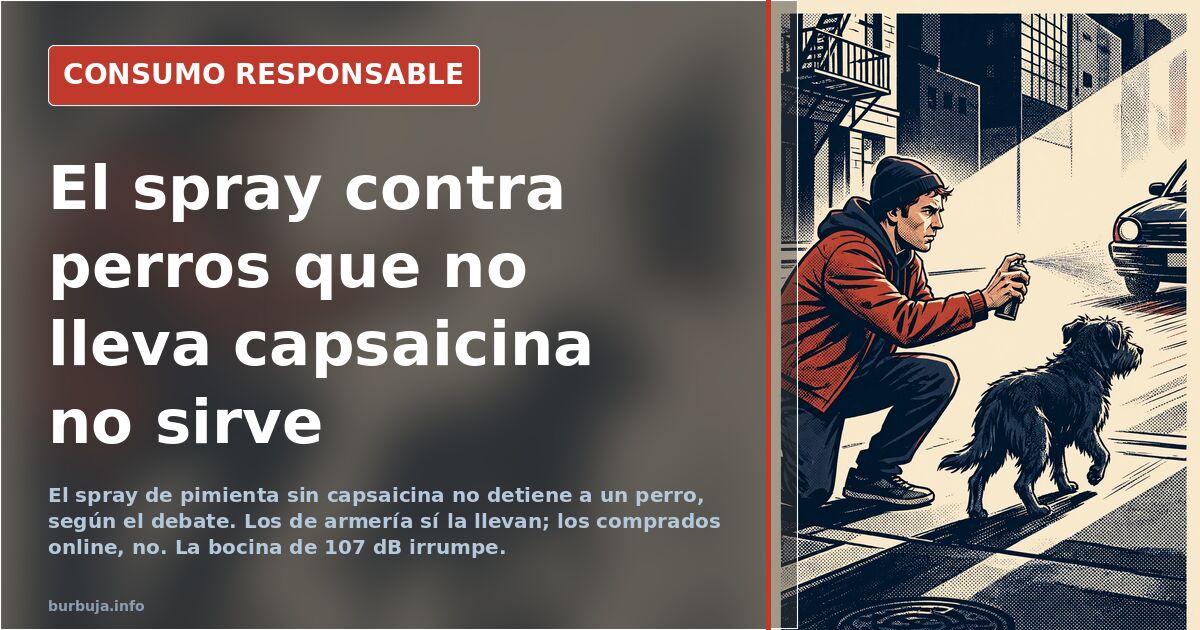
Pepper spray for dog defense: the importance of capsaicin
Most pepper sprays bought online fail to stop a dog, according to forum discussions. The issue isn't animal immunity but the absence of capsaicin, the compound that actually irritates mucous membranes. Without it, the spray is little more than colored water. This claim, repeated in debates, highlights a mix of consumer issues, self-defense, and legislation.
The premise is clear: pepper spray from an armory contains active ingredients; generic marketplace versions usually do not. Unless bought at authorized stores, the device is useless. The most cited alternative, bear spray with a two-meter range, is illegal in Spain. A poorly chosen flashlight doesn't compensate for weak chemical potency. The conversation quickly escalates from capsaicin to discussing sticks, knives, or worse.
Why non-armory pepper sprays are ineffective
The core argument is chemical. Capsaicin causes immediate irritation of mucous membranes and airways. Aerosols without it may wet but won't deter. Thus, despite many platforms advertising "defense spray," only armory-sold items meet requirements. They look similar, but aren't.
Range matters immediately. An attacking dog doesn't stop to bark at two meters; it runs. Some argue a two-meter jet, typical of bear sprays, would make a difference. However, such products are illegal in Spain. Domestic versions have less range and uncertain composition.
Do strobe lights work against dogs?
Light is another option. According to this view, a strobe light over 1500 real lumens disorients a dog day or night. Crucially, advertised lumens are often misleading. A 10 euro flashlight fails, while a well-chosen 30 euro one might work. The key is the strobe effect breaking the animal's visual focus.
Daylight requires higher output: 2000 lumens in sunlight equals under 1000 lumens indoors, narrowing the margin. Proponents insist on verifying actual power, not box claims. While not guaranteed, light range exceeds aerosol reach.
The unexpected 107-decibel air horn
Among solutions is neither chemical nor luminous: noise. Compressed air horns used in celebrations reach 107 decibels. One user reported neighbors rushing down from two floors up after testing it. For scaring loose animals, the loudness makes sense.
Noise advantages: no aim or contact needed. Disadvantage: impractical to carry daily. Yet, as a long-range defense, it appears in forums. Unlike spray, it ignores wind and precise targeting.
Legal framework: what you can carry and fine risks
This gets complex. Carrying heavy sticks with metal tips or small axes could trigger sanctions if police intervene. But fines may come before danger passes. Those reporting aggressive loose dogs feel helpless: authorities say they can do little except witness attacks, and filming unmuzzled animals rarely helps.
The result is unstable ground. Participants feel laws protect owners and animals, leaving walkers without tools. This mismatch—legal but useless vs. useful but illegal—is the core issue, beyond brands.
Escalation: from pepper to caustic substances
At some point, talk shifts to extreme self-defense: traps, corrosive liquids, improvised weapons. Clearly, these are not advice; several ideas are incivil. The question remains: if legal solutions seem insufficient, illegal ones fill the void. This pattern emerges when safety relies on individual improvisation.
City vs. village: different realities of same problem
The final divide involves context. Village residents (e.g., 10,000 people) report picking up feces but constant urination; others note dogs pee on trees and barely bark. In cities, sidewalks show urine marks and loose, unmuzzled dogs.
Contrast reveals coexistence depends on neighborhood dynamics, not just written rules. Wide spaces and social control reduce conflict; narrow sidewalks and lack of oversight increase friction. Data isn't disputed; causes are.
Low-capsaicin aerosol, honest-lumen flashlight, air horn: this seems the realistic kit. Is it enough for silent charging dogs, or does the root problem lie elsewhere?
Most pepper sprays bought online fail to stop a dog, according to forum discussions. The issue isn't animal immunity but the absence of capsaicin, the compound that actually irritates mucous membranes. Without it, the spray is little more than colored water. This claim, repeated in debates, highlights a mix of consumer issues, self-defense, and legislation.
The premise is clear: pepper spray from an armory contains active ingredients; generic marketplace versions usually do not. Unless bought at authorized stores, the device is useless. The most cited alternative, bear spray with a two-meter range, is illegal in Spain. A poorly chosen flashlight doesn't compensate for weak chemical potency. The conversation quickly escalates from capsaicin to discussing sticks, knives, or worse.
Why non-armory pepper sprays are ineffective
The core argument is chemical. Capsaicin causes immediate irritation of mucous membranes and airways. Aerosols without it may wet but won't deter. Thus, despite many platforms advertising "defense spray," only armory-sold items meet requirements. They look similar, but aren't.
Range matters immediately. An attacking dog doesn't stop to bark at two meters; it runs. Some argue a two-meter jet, typical of bear sprays, would make a difference. However, such products are illegal in Spain. Domestic versions have less range and uncertain composition.
Do strobe lights work against dogs?
Light is another option. According to this view, a strobe light over 1500 real lumens disorients a dog day or night. Crucially, advertised lumens are often misleading. A 10 euro flashlight fails, while a well-chosen 30 euro one might work. The key is the strobe effect breaking the animal's visual focus.
Daylight requires higher output: 2000 lumens in sunlight equals under 1000 lumens indoors, narrowing the margin. Proponents insist on verifying actual power, not box claims. While not guaranteed, light range exceeds aerosol reach.
The unexpected 107-decibel air horn
Among solutions is neither chemical nor luminous: noise. Compressed air horns used in celebrations reach 107 decibels. One user reported neighbors rushing down from two floors up after testing it. For scaring loose animals, the loudness makes sense.
Noise advantages: no aim or contact needed. Disadvantage: impractical to carry daily. Yet, as a long-range defense, it appears in forums. Unlike spray, it ignores wind and precise targeting.
Legal framework: what you can carry and fine risks
This gets complex. Carrying heavy sticks with metal tips or small axes could trigger sanctions if police intervene. But fines may come before danger passes. Those reporting aggressive loose dogs feel helpless: authorities say they can do little except witness attacks, and filming unmuzzled animals rarely helps.
The result is unstable ground. Participants feel laws protect owners and animals, leaving walkers without tools. This mismatch—legal but useless vs. useful but illegal—is the core issue, beyond brands.
Escalation: from pepper to caustic substances
At some point, talk shifts to extreme self-defense: traps, corrosive liquids, improvised weapons. Clearly, these are not advice; several ideas are incivil. The question remains: if legal solutions seem insufficient, illegal ones fill the void. This pattern emerges when safety relies on individual improvisation.
City vs. village: different realities of same problem
The final divide involves context. Village residents (e.g., 10,000 people) report picking up feces but constant urination; others note dogs pee on trees and barely bark. In cities, sidewalks show urine marks and loose, unmuzzled dogs.
Contrast reveals coexistence depends on neighborhood dynamics, not just written rules. Wide spaces and social control reduce conflict; narrow sidewalks and lack of oversight increase friction. Data isn't disputed; causes are.
Low-capsaicin aerosol, honest-lumen flashlight, air horn: this seems the realistic kit. Is it enough for silent charging dogs, or does the root problem lie elsewhere?
Summary of a discussion on Burbuja.info - Foro de economía, actualidad y política., translated from Spanish and reviewed before publication. Read the full discussion (159 replies).
More summaries
-
Taser vs dogs: effectiveness, legality and alternatives
Taser against dogs has no real use cases, but €25 ultrasound devices and pepper spray come with proven experience and specific prices.
-
TuLotero confirms leak of ID cards and verification selfies
A hack at TuLotero exposes ID cards and verification selfies; the company confirms it and a complaint has already been filed with the National Police.
-
Heating oil: fill the tank now or wait?
Heating oil prices jump 7 cents in days: filling a 1,500-litre tank now costs over €100 extra. When it pays to wait.
-
Nissan LEAF battery replacement quote hits €74,000
A €74,000 quote for a Nissan LEAF battery sparks debate, as wholesale prices average $200-250/kWh and official replacements seem disproportionate.
-
Publishing an AI Book: One Week, Zero Revenue
A 71-page novel written with AI and self-published on Amazon has zero sales, revealing the real cost of independent publishing.
-
Tesla Criticism: Tech Bubble or Market Failure?
Analysis of Tesla criticism: Is EV technology progress or a financial bubble? Costs, range, and the electric landscape examined.