
Black Friday in Spain: Skepticism Overshadows Discount Hype
Amidst a flood of discounts, actual spending is limited to food and occasional treats. Many accuse Black Friday of inflating prices beforehand.
English · Original discussion in Spanish · Published
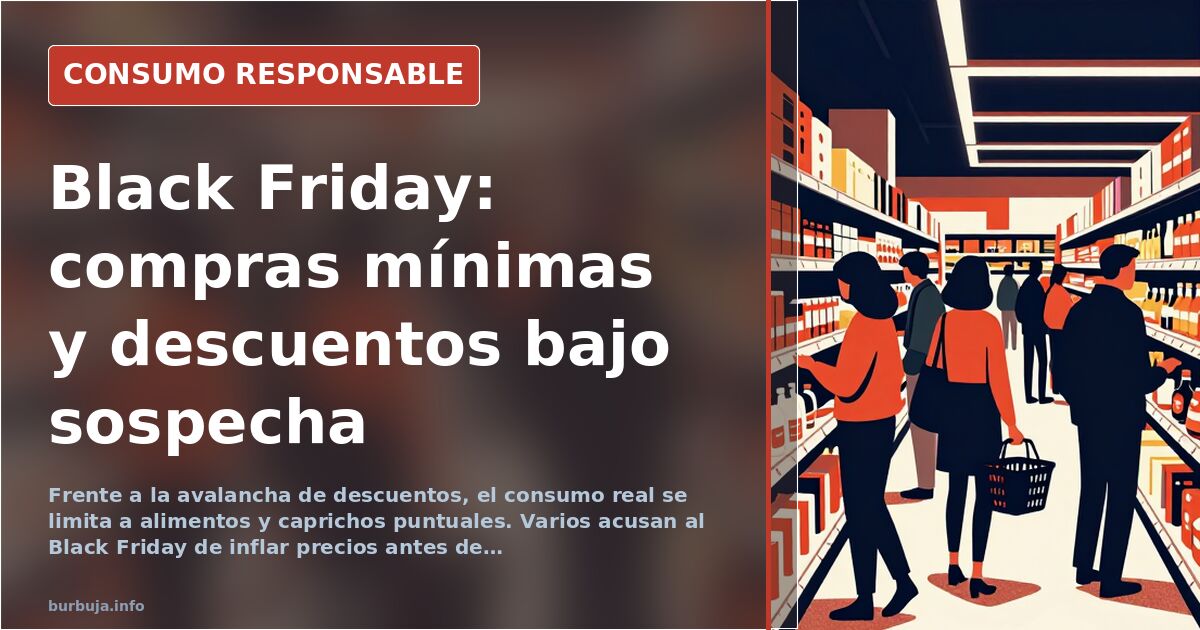
Black Friday: Minimal Purchases and Suspect Discounts
Spain's Black Friday leaves a balance that fits in a shopping basket: half a kilo of tangerines, a couple of kilos of oranges, discounted oat milk, an air fryer from clearance stock, and an automatic watch for 75 euros. Against the promotional avalanche from large retailers, the consumption described in this discussion is either subsistence-based or an occasional whim. Most respondents claim they bought nothing, while several argue the date is a scam built on previously inflated prices. The pattern repeats: discounts that aren't real, products whose prices rise weeks before returning to their original cost during the campaign.
What Was Actually Bought During Black Friday
The inventory is modest and highly scattered. Some limit themselves to tangerines at 0.69 euros per kilo and oranges at two kilos for 1.30 euros, others buy bread, eggs, and fruit on offer, and some pick up 250 milliliters of olive oil with the irony of having "splashed out." A pack of cigarettes and a lighter also appear, along with oat milk at a 40% discount and an air fryer that ended up costing 20 euros because it was an unboxed display unit.
Tech spending exists but is minor and very calculated. An Ryzen 5900X processor for 286 euros when its launch price was around 600, a 55-inch TV bought at the same price as a week earlier, and an automatic watch with an NH35 movement for 75 euros. Nothing resembling the massive outlay depicted by campaigns.
Why Many Consider Black Friday a Scam
The most repeated accusation is about manipulated pricing. One case describes a laptop raised by 300 euros only to be discounted by 200 during the campaign, ending up 100 euros more expensive than before. The conclusion drawn is that it is better to buy two months earlier or wait until January, when stores truly clear stock. Buying during the campaign is, according to this analysis, being fooled.
Comparison with the United States appears as a contrast. There, it is argued, discounts are real, and companies that cannot afford them at least reduce shipping costs. In Spain, the dominant perception is that the label changes but the final price does not. The date is perceived as an imported calendar without the substance to justify it.
Responsible Consumption as a Response: Not Buying Just in Case
Some participants apply a simple rule: do not acquire anything not truly needed. Some promised not to buy just in case and kept to it, while others maintain that the best offers come later, when stores clear stock months afterward. Impulse buying is identified as the campaign's true business, not consumer savings.
This argument is reinforced by the observation that boxes from new televisions appear in cardboard recycling bins. This data point, more anecdotal than statistical, fuels the thesis that part of what is bought these days ends up returned or discarded. In response, the defended alternative is to buy when the need arises, without waiting for the promotional showcase.
Time, Gym Memberships, and Other Non-Product Purchases
Not everything acquired has packaging. One participant claims to have bought time: staying home doing what they wanted without purchasing anything. Another signed up for the gym with a free month, something they were going to do anyway. The message opening the debate boasts saving 600 euros annually by paying monthly for a folding home training machine instead of a gym membership.
Domestic savings thus sneak into a conversation about consumption. The purchase of sports equipment, installment payments, and renouncing monthly fees function as alternatives to subscriptions. It is not a Black Friday bargain, but it is presented as a rational economic decision.
The Balance Sheet: Little Buying and Much Distrust
The aggregate result of this debate does not allow speaking of commercial success. Most responses deny any acquisition, and those confirming purchases speak of food, tobacco, or low-value whims. Cited discounts range from 40% on oat milk to 50% on a processor, including an air fryer reduced due to clearance rather than the campaign.
Distrust toward the promotional mechanism is the common thread. People buy less, buy later, and buy with suspicion. The unanswered question is whether this coldness responds to a price crisis, a change in habits, or simply that Spanish consumers have learned to read the label before the discount sign. With these data, the campaign fails to convince even those who participate in it.
Spain's Black Friday leaves a balance that fits in a shopping basket: half a kilo of tangerines, a couple of kilos of oranges, discounted oat milk, an air fryer from clearance stock, and an automatic watch for 75 euros. Against the promotional avalanche from large retailers, the consumption described in this discussion is either subsistence-based or an occasional whim. Most respondents claim they bought nothing, while several argue the date is a scam built on previously inflated prices. The pattern repeats: discounts that aren't real, products whose prices rise weeks before returning to their original cost during the campaign.
What Was Actually Bought During Black Friday
The inventory is modest and highly scattered. Some limit themselves to tangerines at 0.69 euros per kilo and oranges at two kilos for 1.30 euros, others buy bread, eggs, and fruit on offer, and some pick up 250 milliliters of olive oil with the irony of having "splashed out." A pack of cigarettes and a lighter also appear, along with oat milk at a 40% discount and an air fryer that ended up costing 20 euros because it was an unboxed display unit.
Tech spending exists but is minor and very calculated. An Ryzen 5900X processor for 286 euros when its launch price was around 600, a 55-inch TV bought at the same price as a week earlier, and an automatic watch with an NH35 movement for 75 euros. Nothing resembling the massive outlay depicted by campaigns.
Why Many Consider Black Friday a Scam
The most repeated accusation is about manipulated pricing. One case describes a laptop raised by 300 euros only to be discounted by 200 during the campaign, ending up 100 euros more expensive than before. The conclusion drawn is that it is better to buy two months earlier or wait until January, when stores truly clear stock. Buying during the campaign is, according to this analysis, being fooled.
Comparison with the United States appears as a contrast. There, it is argued, discounts are real, and companies that cannot afford them at least reduce shipping costs. In Spain, the dominant perception is that the label changes but the final price does not. The date is perceived as an imported calendar without the substance to justify it.
Responsible Consumption as a Response: Not Buying Just in Case
Some participants apply a simple rule: do not acquire anything not truly needed. Some promised not to buy just in case and kept to it, while others maintain that the best offers come later, when stores clear stock months afterward. Impulse buying is identified as the campaign's true business, not consumer savings.
This argument is reinforced by the observation that boxes from new televisions appear in cardboard recycling bins. This data point, more anecdotal than statistical, fuels the thesis that part of what is bought these days ends up returned or discarded. In response, the defended alternative is to buy when the need arises, without waiting for the promotional showcase.
Time, Gym Memberships, and Other Non-Product Purchases
Not everything acquired has packaging. One participant claims to have bought time: staying home doing what they wanted without purchasing anything. Another signed up for the gym with a free month, something they were going to do anyway. The message opening the debate boasts saving 600 euros annually by paying monthly for a folding home training machine instead of a gym membership.
Domestic savings thus sneak into a conversation about consumption. The purchase of sports equipment, installment payments, and renouncing monthly fees function as alternatives to subscriptions. It is not a Black Friday bargain, but it is presented as a rational economic decision.
The Balance Sheet: Little Buying and Much Distrust
The aggregate result of this debate does not allow speaking of commercial success. Most responses deny any acquisition, and those confirming purchases speak of food, tobacco, or low-value whims. Cited discounts range from 40% on oat milk to 50% on a processor, including an air fryer reduced due to clearance rather than the campaign.
Distrust toward the promotional mechanism is the common thread. People buy less, buy later, and buy with suspicion. The unanswered question is whether this coldness responds to a price crisis, a change in habits, or simply that Spanish consumers have learned to read the label before the discount sign. With these data, the campaign fails to convince even those who participate in it.
Summary of a discussion on Burbuja.info - Foro de economía, actualidad y política., translated from Spanish and reviewed before publication. Read the full discussion (159 replies).
More summaries
-
The €3.61 Fee Killing AliExpress Purchases
The €3.61 per-category tariff has inflated AliExpress purchases by up to 80%. Consumers are stopping buys, and revenue is falling. Does it actually protect...
-
Nestlé and Dolca: 30% vs 25% Cacao, Same Price in Spain
Nestlé and Dolca chocolates differ by just 5% cacao yet cost nearly the same, revealing that budget brands in Spain are no longer significantly cheaper.
-
Car Maintenance: From Window Failures to Workshop Savings
Real savings in car mechanics: comparing filter costs, window repairs, and maintenance tips.
-
Spain's AVE: €25M per km, trains capped at 180 km/h
High-speed trains designed for 360 km/h run at 180. New track costs €25M/km, while electrifying conventional lines is far cheaper.
-
Sunflower oil hits €3.20, petrol rises to €1.90 per liter
In Spain, sunflower oil prices tripled and fuel rose sharply, while Lidl's bread remains stable at 37 cents.
-
Spain's Excellence Baccalaureate: Lower Grades, Same Entry Test
In Spain, the Excellence Baccalaureate lowers grades while keeping the university entrance exam unchanged, raising the cut-off score for Medicine.