
Naturgy challenges wholesale market with fixed €60/MWh rate
Naturgy offers a fixed €60/MWh rate for 24 months against a wholesale price of €141.17/MWh, as Iberdrola and Endesa also launch competing bids.
English · Original discussion in Spanish · Published
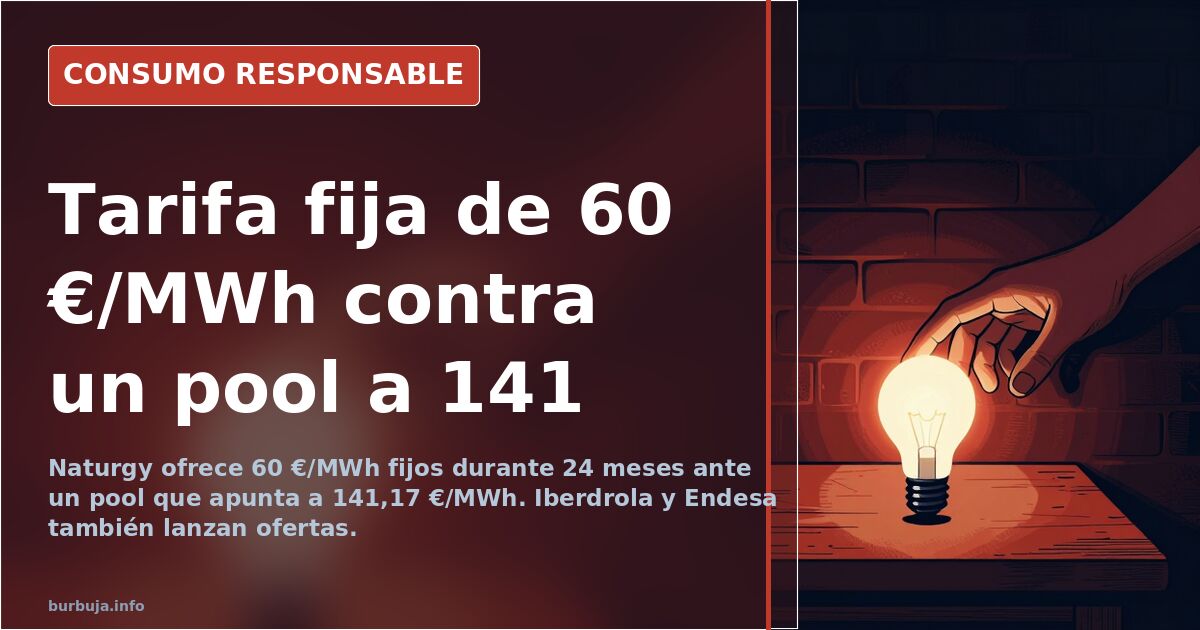
Naturgy challenges the wholesale market with a fixed rate of €60 per MWh
The electricity wholesale market is heading for a record high of €141.17 per megawatt hour. Against this backdrop, Naturgy has announced a fixed tariff of €60 per MWh for 24 months with no contract lock-in, starting September 15. The arithmetic is stark: how can they sell at half the cost? The comparison is further complicated by unit differences, as the wholesale market operates in euros per megawatt hour while household bills are in cents per kilowatt hour—a distinction rarely clarified. Much skepticism stems from this confusion, as well as an uncomfortable detail: the offer appears just as prices rise, not when they fall.
Why does the wholesale market set all electricity prices?
The mechanism is marginalist pricing: the cheapest technology enters first, but the final price is set by the last source needed to meet demand—currently combined-cycle gas plants. All other generators receive that same price even if they produce more cheaply. This explains the €130 figure cited by daily market observers. It also fuels the central argument against the offer: if electricity can be sold for €130 on the pool, it makes little sense to sell it for €60, foregoing €70 per megawatt hour. That €70 gap is the core of the problem.
Proponents argue the system prevents speculation and organizes technology entry, despite being counterintuitive. Critics contend it forces consumers to pay high prices for low-cost generation, noting that Naturgy’s own portfolio, heavily reliant on combined-cycle plants, is precisely what sets the auction price. There is little room to give away that margin.
The fine print attributed to flat-rate tariffs
This is where the announcement raises red flags for those familiar with contracts. Warnings circulate that multi-year flat rates are often revised later based on actual consumption. If the agreed price doesn’t cover real costs, companies may raise monthly fees after several years to recover the difference. The lack of a lock-in clause isn’t free either: if usage is deemed excessive, customers might face claims for all consumption above expected levels. Currently, these are warnings, not confirmed clauses.
A persistent nuance remains: the offer is not yet formalized. Until the contract exists and terms are visible, any judgment is speculative.
What is the cheapest tariff right now?
Current references point to Repsol as the retailer with the lowest price, around €0.155 per kilowatt hour including 10% VAT over three years. Another cited offer stands at €0.20 per kWh under the same reduced tax rate. For average consumption, this difference is significant, explaining why sales calls have multiplied as wholesale prices escalate.
Distrust trinc simple logic: no one calls to give money away. When retailers push switching during price surges, the instinct is to suspect hidden business models. Yet some note that retailers compete for customers and margins may come from management efficiency rather than final price alone.
The clash between nationalization and market freedom
The debate often shifts to the sector model. One view argues that only returning generation and retail to public hands solves the issue: if utilities offer €60 when the market hits €141, they could offer €30 without profit incentives. Opponents counter that no country with such a model has thrived, citing that Endesa was public before privatization. This history is used as ammunition in both directions.
Amidst this lies the unresolved question: what good is debating the system when prices are set by markets beyond government control? No one has quantified the cost of expropriation, leaving the debate largely rhetorical.
Where the answer gets stuck
Naturgy’s offer awaits confirmation, while Iberdrola and Endesa announce bids without details, and the wholesale market shows no signs of easing. Those wondering whether to switch must wait for actual contract terms, power capacity charges, and fine print. And those believing the problem is solved by changing retailers will face the same reality: the cost of generation is not decided by the customer.
The electricity wholesale market is heading for a record high of €141.17 per megawatt hour. Against this backdrop, Naturgy has announced a fixed tariff of €60 per MWh for 24 months with no contract lock-in, starting September 15. The arithmetic is stark: how can they sell at half the cost? The comparison is further complicated by unit differences, as the wholesale market operates in euros per megawatt hour while household bills are in cents per kilowatt hour—a distinction rarely clarified. Much skepticism stems from this confusion, as well as an uncomfortable detail: the offer appears just as prices rise, not when they fall.
Why does the wholesale market set all electricity prices?
The mechanism is marginalist pricing: the cheapest technology enters first, but the final price is set by the last source needed to meet demand—currently combined-cycle gas plants. All other generators receive that same price even if they produce more cheaply. This explains the €130 figure cited by daily market observers. It also fuels the central argument against the offer: if electricity can be sold for €130 on the pool, it makes little sense to sell it for €60, foregoing €70 per megawatt hour. That €70 gap is the core of the problem.
Proponents argue the system prevents speculation and organizes technology entry, despite being counterintuitive. Critics contend it forces consumers to pay high prices for low-cost generation, noting that Naturgy’s own portfolio, heavily reliant on combined-cycle plants, is precisely what sets the auction price. There is little room to give away that margin.
The fine print attributed to flat-rate tariffs
This is where the announcement raises red flags for those familiar with contracts. Warnings circulate that multi-year flat rates are often revised later based on actual consumption. If the agreed price doesn’t cover real costs, companies may raise monthly fees after several years to recover the difference. The lack of a lock-in clause isn’t free either: if usage is deemed excessive, customers might face claims for all consumption above expected levels. Currently, these are warnings, not confirmed clauses.
A persistent nuance remains: the offer is not yet formalized. Until the contract exists and terms are visible, any judgment is speculative.
What is the cheapest tariff right now?
Current references point to Repsol as the retailer with the lowest price, around €0.155 per kilowatt hour including 10% VAT over three years. Another cited offer stands at €0.20 per kWh under the same reduced tax rate. For average consumption, this difference is significant, explaining why sales calls have multiplied as wholesale prices escalate.
Distrust trinc simple logic: no one calls to give money away. When retailers push switching during price surges, the instinct is to suspect hidden business models. Yet some note that retailers compete for customers and margins may come from management efficiency rather than final price alone.
The clash between nationalization and market freedom
The debate often shifts to the sector model. One view argues that only returning generation and retail to public hands solves the issue: if utilities offer €60 when the market hits €141, they could offer €30 without profit incentives. Opponents counter that no country with such a model has thrived, citing that Endesa was public before privatization. This history is used as ammunition in both directions.
Amidst this lies the unresolved question: what good is debating the system when prices are set by markets beyond government control? No one has quantified the cost of expropriation, leaving the debate largely rhetorical.
Where the answer gets stuck
Naturgy’s offer awaits confirmation, while Iberdrola and Endesa announce bids without details, and the wholesale market shows no signs of easing. Those wondering whether to switch must wait for actual contract terms, power capacity charges, and fine print. And those believing the problem is solved by changing retailers will face the same reality: the cost of generation is not decided by the customer.
Summary of a discussion on Burbuja.info - Foro de economía, actualidad y política., translated from Spanish and reviewed before publication. Read the full discussion (159 replies).
More summaries
-
Spain's 2020 Electricity Tariff Cuts Off-Peak Hours to 8 for All Consumers
The 2020 Spanish electricity reform reduces off-peak hours to 8 and extends time-of-use to 100% of users, diluting previous savings.
-
DIGI Mobil's €10 for 5GB Plan That Shook the Market
In April 2017, DIGI Mobil offered 5GB for €10 with no contract and Movistar network access. This plan made competitor offers obsolete.
-
Mercadona salmon rip-off: tray fillets cost up to 78% more
Mercadona charges up to €25/kg for salmon tray fillets while a whole salmon costs €11/kg. Data and tips to save.
-
Solar panel payback: 5 to 20 years for self-consumption
With €7,000 in panels and a €55/month bill, payback takes 20 years; a 6 kW system cuts bills from €200 to €50.
-
Nissan LEAF battery replacement quote hits €74,000
A €74,000 quote for a Nissan LEAF battery sparks debate, as wholesale prices average $200-250/kWh and official replacements seem disproportionate.
-
Publishing an AI Book: One Week, Zero Revenue
A 71-page novel written with AI and self-published on Amazon has zero sales, revealing the real cost of independent publishing.