
Indiana and Kentucky Kick Off US Midterm Vote Count
Early voting in Indiana and Kentucky exceeds 33 million, with Democrats gaining ground in traditionally Republican districts.
English · Original discussion in Spanish · Published
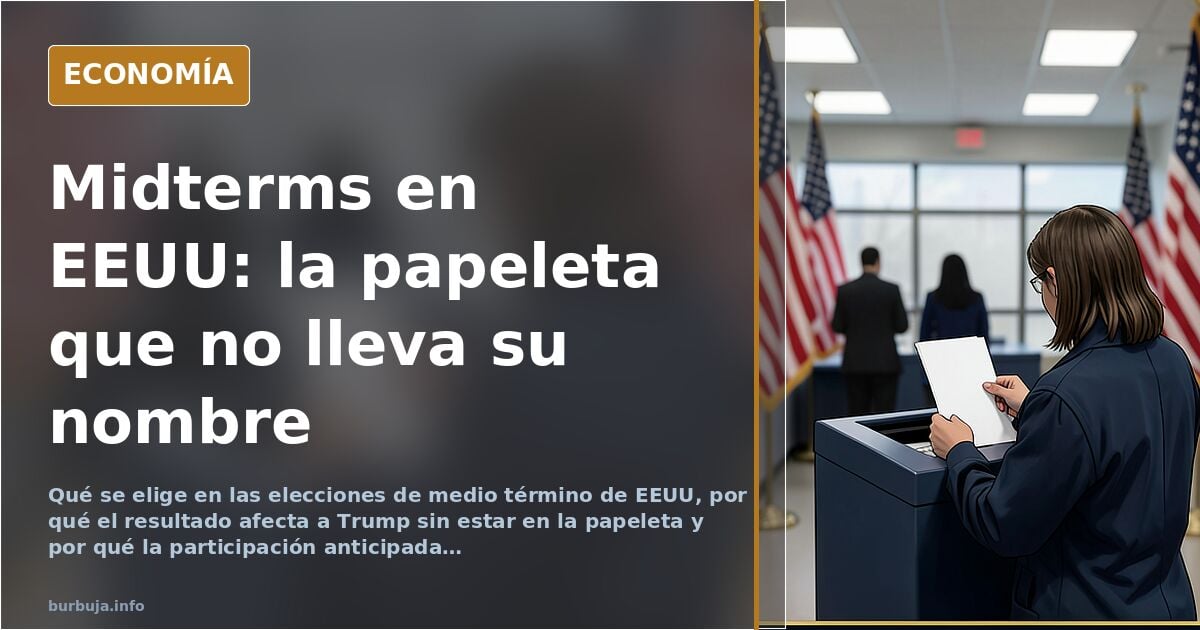
Indiana and Kentucky Kick Off US Midterm Vote Count
Can a Republican district with a 20-point lead flip overnight? That is the question as polls closed at midnight Spanish time in Indiana and Kentucky, marking the start of the US midterm election count. The tally began with over 33 million early votes cast—18% more than in 2022—and an alarming signal: Indiana's 5th district, a Republican stronghold by over 20 points in recent cycles, showed a Democratic lead exceeding 20 points with 30% counted, according to forum calculations.
What Is Being Elected
The entire House, all 435 seats up for renewal every two years. One-third of the Senate, roughly 33 or 34 Class 2 seats plus vacancies. Plus 36 governors, state assemblies, and local referendums. The President is not on the ballot, but it matters little: US media frame this as a referendum on Trump, and many voters see it that way. The institutional paradox is that the Executive does not legislate; Congress holds that power. If the House flips, budget approval without opposition consent ends, and committees shift control: subpoenas, hearings, and scandals move to prime time.
The Unexpected Indiana Flip
With 31.5% of the vote counted in Indiana's 3rd district, Democrat Thompson led Republican Stutzman by 14 points in a territory Trump won by 31, per thread data. In the 5th district, the Democratic lead exceeded 20 points with 30% counted. The most worrying technical detail: all electronic ballots pointed in the same direction, whereas Republicans held a three-point advantage there two years ago. At the time of writing, counting was still at 3% in several seats.
The Debate Over Terminology
Terminological discussions dominated the day: "midterm elections," "half-term elections," or "legislative midpoints." The literal translation of "midterm" has no exact equivalent in Spanish, and in most European countries these events do not exist because seats are voted once every four years. The nuance matters: in the US, Congress and the Senate renew every two years, and only half of those coincide with presidential elections.
Voter Registration Anomalies
Another flagged anomaly: the prior registration system where voters declare party affiliation. Voting is secret, but registration is not, which from a European perspective seems like a perverse incentive for polarization. Against this backdrop, the night looks long. Polls closed on time. Final results did not.
In the end, the irony remains constant: a country debating whether its president is a problem decides chamber colors based on voter irritation with the White House tenant. Districts appearing to sink today were untouchable strongholds just one cycle ago.
Also available in: Deutsch
Summary of a discussion on Burbuja.info - Foro de economía, actualidad y política., translated from Spanish and reviewed before publication. Read the full discussion (54 replies).
More summaries
-
Two Senate seats will decide it as Trump loses control of the narrative
Two seats separate Trump from losing the Senate: Texas, Alaska, Iowa and Michigan hold the key to the upper chamber, with Vance's tie-breaking vote as arbiter.
-
Trump promises $5,000 for every adult if Republicans win in November
Trump has promised $5,000 to every adult in the US if Republicans win on November 3: roughly $1.35 trillion with no budget line behind it.
-
Senate blocks Canada tariffs, exposing Republican rift
The Senate voted 51-48 to block Trump's Canada tariffs, with four Republicans joining Democrats. The measure now moves to the House.
-
Sol Campout: Elite Spokespeople and Suspicions of Manipulation
Spokespeople for the Sol campout against the housing crisis reportedly attended United World College and Comillas, according to disseminated data.
-
Chile's NotCo Uses AI to Reinvent Food, Becomes Unicorn
NotCo uses its AI Giuseppe to create plant-based foods mimicking animal products. Jeff Bezos invested, pushing the company past a $1 billion valuation.
-
AVE driver: Daily LZB failures risk catastrophic errors
An AVE train driver reports daily LZB transmission losses, warning that current regulations allow a single human error to cause tragedy.