
Iker Jiménez and the limits of questioning during the pandemic
Iker Jiménez returns to the center of the debate on the limits of questioning during the pandemic: free voice for some, part of the system for others.
English · Original discussion in Spanish · Published
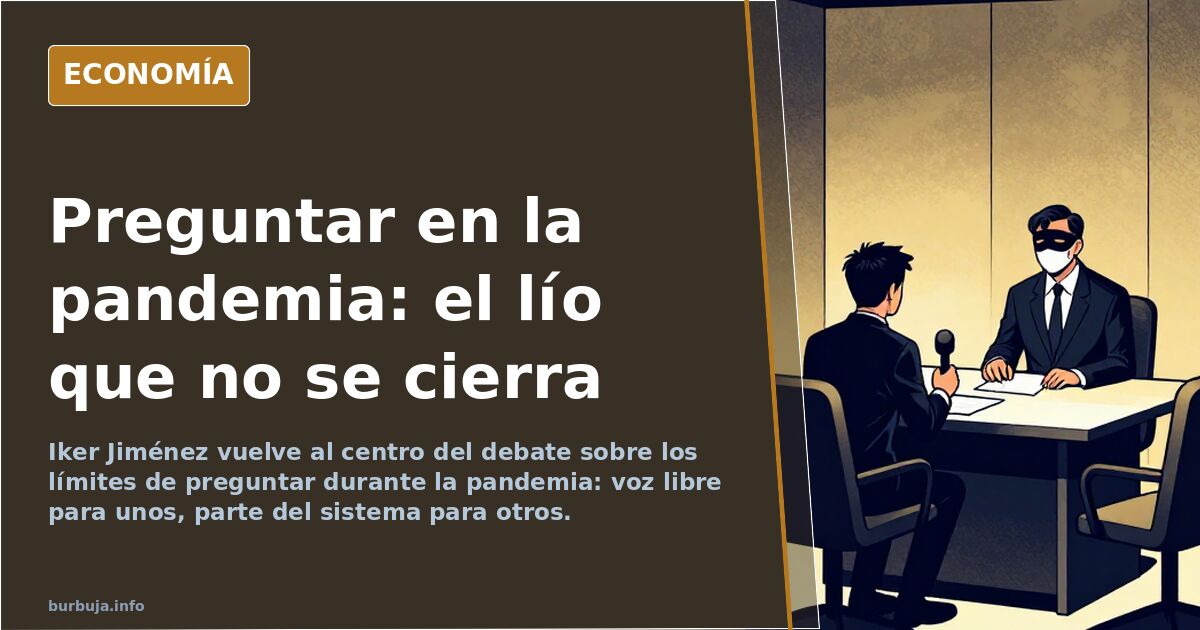
Iker Jiménez and the limits of questioning during the pandemic
Four years after lockdown, some argue that "you can't even ask questions anymore." The controversy surrounding Iker Jiménez does not debate a specific opinion, but the position from which it is expressed. The presenter turned his program into one of the few mainstream windows that questioned masks, diagnoses, protocols, and side effects during the health crisis. From this stems the division: for some, he is the last free voice on television; for others, another cog in the system.
The key, say both sides, is that asking questions should not be news. And yet it is.
What role did Iker Jiménez play during the pandemic?
When in January 2020 the focus was on China and much of the official discourse downplayed the outbreak, his program already warned that this could be serious. Before the lockdown, with authorities recommending no masks and the March 8 demonstration underway — Carmen Alopécico reportedly said "our lives were at stake" — the team maintained a thesis opposite to the official one. Then came March, the narrative shifted abruptly, and the entire country locked down.
There began the misunderstanding that no one has resolved. Some remember the presenter warning before anyone else; others, that he also insisted the disease was serious and that the vaccine was recommended. Both fit in the same program, and both are used as convenient to place him on one side or another.
Criticism: free voice or part of the system?
The most repeated accusation is having been part of the official chorus. It is argued that when scientific criteria changed, he stubbornly insisted on being right from the start and ended up aligned with the dominant version. Opposing this is the argument that he balanced things to keep his job: one who speaks clearly on mainstream television, it is said, goes to the streets and does not return.
Underlying this is a more uncomfortable suspicion: that questions were allowed only insofar as they did not touch the core issue. Part of the discussion even speculates with explanations that have no proof, yet they circulate. This is the idea summarizing the doubt with which the debate begins: why he can ask questions and with what margin.
Hospital protocols, the blind spot
Here the debate becomes opaque. Some recount, from within hospitals, that they refused to see patients with masks to avoid alarming the public, that autopsies were rejected to examine lungs, and that ventilation and sedation protocols were applied without room for discussion. It is also reported that stocks of unused antibiotics accumulated and that nursing homes were neglected.
These are testimonies, not verified records, and should be treated as such. But they point to a place the official version never comfortably explained: what was exactly done with the sick and why. Criticism of protocols, intubation, or sedative use has, in this debate, no answer that disproves it, and that is where the case stalls.
The European Parliament episode
In this realm circulates a proper name, that of Dr. David E. Martin, whose intervention in the European Parliament is used as endorsement of the discourse critical of the bicho's origin and patents. His opponents rebut that he is not a virologist or physician, but a financial analyst, former professor, and businessman, and that he trades in his own version. The discussion, again, ends less in data than in the credibility of who signs them.
Why it is said the public has forgotten
There is an argument that cuts through the entire discussion: memory. It is argued that a special on what peine would sound like ancient history, like one on the Roman Empire, and that the average viewer has already moved on. Against that, the response is always the same: those who lost someone in a nursing home cannot move on, and those responsible have not paid.
What remains unresolved
There is no verdict. No one has proven that Iker Jiménez was bought nor that he was completely free; nor that vaccines caused the health problems he has linked, without fully affirming it, to vaccination. The only certainty is that asking questions, in a mass medium, still has a price. And the underlying question, who decides what can be discussed, remains unanswered.
Four years after lockdown, some argue that "you can't even ask questions anymore." The controversy surrounding Iker Jiménez does not debate a specific opinion, but the position from which it is expressed. The presenter turned his program into one of the few mainstream windows that questioned masks, diagnoses, protocols, and side effects during the health crisis. From this stems the division: for some, he is the last free voice on television; for others, another cog in the system.
The key, say both sides, is that asking questions should not be news. And yet it is.
What role did Iker Jiménez play during the pandemic?
When in January 2020 the focus was on China and much of the official discourse downplayed the outbreak, his program already warned that this could be serious. Before the lockdown, with authorities recommending no masks and the March 8 demonstration underway — Carmen Alopécico reportedly said "our lives were at stake" — the team maintained a thesis opposite to the official one. Then came March, the narrative shifted abruptly, and the entire country locked down.
There began the misunderstanding that no one has resolved. Some remember the presenter warning before anyone else; others, that he also insisted the disease was serious and that the vaccine was recommended. Both fit in the same program, and both are used as convenient to place him on one side or another.
Criticism: free voice or part of the system?
The most repeated accusation is having been part of the official chorus. It is argued that when scientific criteria changed, he stubbornly insisted on being right from the start and ended up aligned with the dominant version. Opposing this is the argument that he balanced things to keep his job: one who speaks clearly on mainstream television, it is said, goes to the streets and does not return.
Underlying this is a more uncomfortable suspicion: that questions were allowed only insofar as they did not touch the core issue. Part of the discussion even speculates with explanations that have no proof, yet they circulate. This is the idea summarizing the doubt with which the debate begins: why he can ask questions and with what margin.
Hospital protocols, the blind spot
Here the debate becomes opaque. Some recount, from within hospitals, that they refused to see patients with masks to avoid alarming the public, that autopsies were rejected to examine lungs, and that ventilation and sedation protocols were applied without room for discussion. It is also reported that stocks of unused antibiotics accumulated and that nursing homes were neglected.
These are testimonies, not verified records, and should be treated as such. But they point to a place the official version never comfortably explained: what was exactly done with the sick and why. Criticism of protocols, intubation, or sedative use has, in this debate, no answer that disproves it, and that is where the case stalls.
The European Parliament episode
In this realm circulates a proper name, that of Dr. David E. Martin, whose intervention in the European Parliament is used as endorsement of the discourse critical of the bicho's origin and patents. His opponents rebut that he is not a virologist or physician, but a financial analyst, former professor, and businessman, and that he trades in his own version. The discussion, again, ends less in data than in the credibility of who signs them.
Why it is said the public has forgotten
There is an argument that cuts through the entire discussion: memory. It is argued that a special on what peine would sound like ancient history, like one on the Roman Empire, and that the average viewer has already moved on. Against that, the response is always the same: those who lost someone in a nursing home cannot move on, and those responsible have not paid.
What remains unresolved
There is no verdict. No one has proven that Iker Jiménez was bought nor that he was completely free; nor that vaccines caused the health problems he has linked, without fully affirming it, to vaccination. The only certainty is that asking questions, in a mass medium, still has a price. And the underlying question, who decides what can be discussed, remains unanswered.
Also available in: Deutsch
Summary of a discussion on Burbuja.info - Foro de economía, actualidad y política., translated from Spanish and reviewed before publication. Read the full discussion (341 replies).
More summaries
-
EU officials warn Spain: Amnesty law and judicial independence under scrutiny
A Portuguese voice in the EU questions Spain’s rule of law, CGPJ deadlock, and judicial independence, sparking debate on the amnesty law and separation of powers.
-
Spain's rental decrees struck down: 'the damage is already done'
A forum user claims rental supply has fallen 61% since 2020 and prices have risen 40%. The decrees have been struck down, but the damage is already done, according to the...
-
Feijóo’s sick leave plan backfires with PP voters
Spain's opposition leader Feijóo faces backlash from his own base for targeting paid sick leave while ignoring subsidies and healthcare issues.
-
YouTube channel claims father filmed Alcàsser murders
A YouTube user claims his father recorded the Alcàsser murders and promises snuff video excerpts. No evidence provided, only narrative and technical analysis.
-
Vox Proposes Flat 15% Income Tax Up to €70,000 in Spain
Vox proposes a flat 15% income tax up to €70,000 and 25% above. Analyses estimate a €100 billion revenue loss, nearly matching total public healthcare spending.
-
Ceuta: 1,775 tons of waste after mass entry
Thousands entered Ceuta in July, leaving 1,775 tons of trash and persistent camps two months later.