
Ibex 35: the 6,000 floor and the banks needing €70 billion
With the risk premium at 550 points and banks needing up to €70 billion, the Ibex gambled with 6,000 in June 2012 awaiting the Greek vote.
English · Original discussion in Spanish · Published
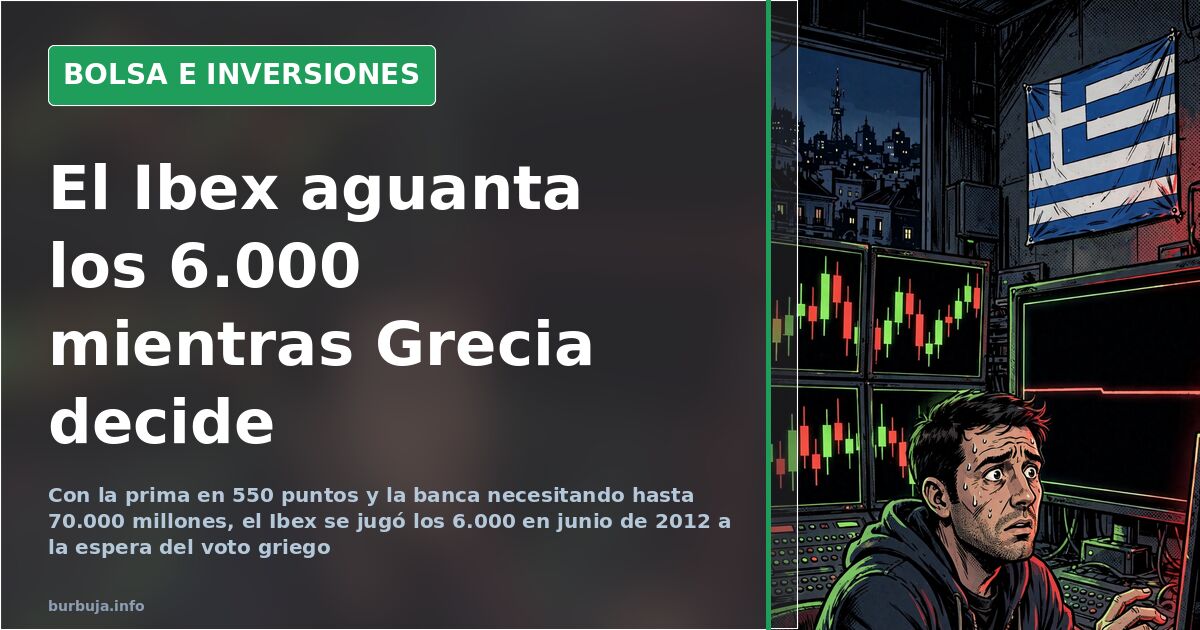
Ibex 35 gambles with 6,000 awaiting Greek verdict
June 2012. The Ibex 35 holds steady with the risk premium at 550 basis points, the DAX and CAC in the red, a crisis cabinet convened, and Greece called to the polls on Sunday. Any sensible investor would be hedged by now. Yet the selective index insists on rising, with a repeated explanation on trading terminals: pure short covering. The tug-of-war between the headline and the chart is what's being decided this month, and the important number isn't 7,000 but 6,000.
If anything became clear in this second act, it's that the market no longer prices in results; it prices in politics. And politics, in June 2012, had two scenarios: Greece in or Greece out.
How much capital do Spanish banks need?
Between 60 and 70 billion euros. That was the figure leaked one Monday, attributed to reports Oliver Wyman and Roland Berger were set to present, and it served to justify the next day's movement. Before anyone signed off on it publicly, it was already priced in.
The uncomfortable detail arrived via another channel. A widely circulated analysis those days argued that talking about 62 billion was an understatement: the real figure was closer to 169 billion. The difference isn't accounting; it's narrative. A 62 billion bailout sounds like an adjustment; 169 billion sounds like a disaster. The arithmetic doesn't change: who tells it and why does.
Merkel, the 'financial bubble', and the culpable bailed-out party
The German Chancellor let it slip without batting an eye: the Spanish bailout was due to a 'financial bubble' fueled by 'irresponsible' behavior. Translated into market language, the problem wasn't the euro's design, but the southern party. The mental framework was set for the rest of the month.
What trinc was a race between what Berlin approved and what Berlin held back. The Bundestag ratified the fiscal pact and the European Stability Mechanism with a large majority, and that same night the Constitutional Court asked the President of the Republic not to sign anything: six appeals required study before becoming law. Merkel won in parliament and lost on the calendar.
German data also didn't support the narrative of the locomotive. German PMIs registered the sharpest fall in its private sector in three years, with a record collapse in business expectations in services and the fastest pace of decline in export orders since April 2009. The problem was no longer traveling south alone.
Where is the Ibex 35 floor in June 2012?
Technical analyses circulating handled three references and a warning. The first, a probable floor between 6,400 and 6,000, with special attention to the break of a pattern tracked for weeks. The second, the bad scenario, starting right at 6,000. And the third, the upside: to talk of anything serious, 6,826 had to be surpassed, paving the way towards 7,000.
In between were the short-term levels: 6,686-6,712 as the main channel and 6,542 as a zone to defend. Above 7,000-7,115, a turning point had been signaled in advance, with a repeated warning: beware of false breakouts. The idea, plainly put, was that the relevant factor wasn't the level itself, but how the price reached it. The same number tells a different story depending on the candle that brings it.
Value-by-value targets: from Santander to Arcelor
Where some saw indices, others saw stocks. For Telefónica, surpassing 9.80 peine the door to stay long; falling below it brought the target to 8.78. In BBVA, the reading was short below 4.90 or out. Santander set an entry between 4.56 and 4.44 with a stop at 4.42, and increasing positions only above 4.74-4.75. FCC spoke of a near entry point with a clear path to 12. And in Arcelor, with the stock at 10.80, more than one recalled almost buying at 52.
Add Amadeus: it was described as an example of expansion in the second impulse, with the price holding up well against the 15.80 resistance and targets at 16.25 and 17.20. Each level, a bet.
The trench, disguised volume, and the risk of stop-hunting
In the short term, the diagnosis was a dirty fight. Institutional volume appeared to be selling all morning while the index hinted at rising, with surges designed to hunt stops, and the implicit recommendation was to stay out. The closing auction, with a positive balance, didn't change the tone.
Across the Atlantic, antiestéticar was conspicuously absent. The ProShares VIX Short Term fell 10% in a single session, and the S&P 500 marked its targets of 1,299 and then 1,331 without much fuss. The Fed extended its Operation Twist, and that ammunition was enough to sustain the rebound while Europe debated. If the American market wasn't afraid, it was hard for the Spanish market to find its floor on its own.
Commodities and emerging markets went another way. With oil and metals weak, the industrial leg of the rebound was hobbled, and several analyses pointed out that its incorporation was a necessary condition for the rise to stop being a mere rebound.
Who owns the assets of the bailed-out banks?
Some pointed out the loophole in the European formula: Europe would be the owner and guarantor of the intervened entities, but Europe is nothing, it has no legal personality of its own, so the real owner would end up being the ESM (European Stability Mechanism). And there lay the underlying problem: if debt isn't put on the balance sheet but assets are removed, Spain's ratios worsen just the same. With a substantial difference. Debt can be managed; an asset that is no longer there, cannot.
The 'pensionazo' and other basement matters
While attention flew to Greece, another matter circulated in the system's basement: the possible cut in pensions. It was discussed with code names, between adjusting benefits and a bailout mechanism no one dared name. The general consensus was that the political calendar pushed for its postponement.
In parallel, telcos became the pattern for another disappointment. The most repeated accusation was that of a model built on the relationship with the regulator, with captive customers paying over 60% of a bill as a fixed fee, competition hindered for years, and executives from politics comfortably seated on boards. With competition now unleashed and the Brazilian market as the next frontier, the question was how long the business would last without reinventing itself. In a specific stock, the conclusion of one analysis was that not even the executives themselves still believed in the business as it was structured.
From Danone's collapse to the post-work gin and tonic
Not everything was macro. An analysis that had defended Danone's strength with charts was forced to eat its collapse: a brutal gap that broke supports at 48 and left the stock searching for 45 without prior notice. The author admitted it without excuses, which, in an ecosystem of gurus, is almost a rarity.
And between the risk premium and the German bond, the conversation drifted to where any table drifts when the market gets stuck: to gin. They debated which tonic goes with a Tanqueray, advised against Nordic Mist as a disguised cola, and asked for advice on a third brand. Amidst the tasting, a relevant piece of data emerged: the FDA approved the first obesity drug in 13 years, an appetite suppressant with a 5% weight loss credited in one year. Someone recalled that the alternative is more uncomfortable than a pill: diet and exercise.
The exact point where analysis gets stuck
On the eve of the European summit, the dominant position was caution: Merkel was not going to yield, and the conditions would remain unachievable for the South. Against that, the chart suggested it was time to rise, with or without an agreement, and some openly spoke of the series' objectives being almost reached after a desperately slow run.
The only real consensus was the most uncomfortable one: until the German Constitutional Court ruled and Greece voted, everything else was noise. And neither verdict had arrived.
June 2012. The Ibex 35 holds steady with the risk premium at 550 basis points, the DAX and CAC in the red, a crisis cabinet convened, and Greece called to the polls on Sunday. Any sensible investor would be hedged by now. Yet the selective index insists on rising, with a repeated explanation on trading terminals: pure short covering. The tug-of-war between the headline and the chart is what's being decided this month, and the important number isn't 7,000 but 6,000.
If anything became clear in this second act, it's that the market no longer prices in results; it prices in politics. And politics, in June 2012, had two scenarios: Greece in or Greece out.
How much capital do Spanish banks need?
Between 60 and 70 billion euros. That was the figure leaked one Monday, attributed to reports Oliver Wyman and Roland Berger were set to present, and it served to justify the next day's movement. Before anyone signed off on it publicly, it was already priced in.
The uncomfortable detail arrived via another channel. A widely circulated analysis those days argued that talking about 62 billion was an understatement: the real figure was closer to 169 billion. The difference isn't accounting; it's narrative. A 62 billion bailout sounds like an adjustment; 169 billion sounds like a disaster. The arithmetic doesn't change: who tells it and why does.
Merkel, the 'financial bubble', and the culpable bailed-out party
The German Chancellor let it slip without batting an eye: the Spanish bailout was due to a 'financial bubble' fueled by 'irresponsible' behavior. Translated into market language, the problem wasn't the euro's design, but the southern party. The mental framework was set for the rest of the month.
What trinc was a race between what Berlin approved and what Berlin held back. The Bundestag ratified the fiscal pact and the European Stability Mechanism with a large majority, and that same night the Constitutional Court asked the President of the Republic not to sign anything: six appeals required study before becoming law. Merkel won in parliament and lost on the calendar.
German data also didn't support the narrative of the locomotive. German PMIs registered the sharpest fall in its private sector in three years, with a record collapse in business expectations in services and the fastest pace of decline in export orders since April 2009. The problem was no longer traveling south alone.
Where is the Ibex 35 floor in June 2012?
Technical analyses circulating handled three references and a warning. The first, a probable floor between 6,400 and 6,000, with special attention to the break of a pattern tracked for weeks. The second, the bad scenario, starting right at 6,000. And the third, the upside: to talk of anything serious, 6,826 had to be surpassed, paving the way towards 7,000.
In between were the short-term levels: 6,686-6,712 as the main channel and 6,542 as a zone to defend. Above 7,000-7,115, a turning point had been signaled in advance, with a repeated warning: beware of false breakouts. The idea, plainly put, was that the relevant factor wasn't the level itself, but how the price reached it. The same number tells a different story depending on the candle that brings it.
Value-by-value targets: from Santander to Arcelor
Where some saw indices, others saw stocks. For Telefónica, surpassing 9.80 peine the door to stay long; falling below it brought the target to 8.78. In BBVA, the reading was short below 4.90 or out. Santander set an entry between 4.56 and 4.44 with a stop at 4.42, and increasing positions only above 4.74-4.75. FCC spoke of a near entry point with a clear path to 12. And in Arcelor, with the stock at 10.80, more than one recalled almost buying at 52.
Add Amadeus: it was described as an example of expansion in the second impulse, with the price holding up well against the 15.80 resistance and targets at 16.25 and 17.20. Each level, a bet.
The trench, disguised volume, and the risk of stop-hunting
In the short term, the diagnosis was a dirty fight. Institutional volume appeared to be selling all morning while the index hinted at rising, with surges designed to hunt stops, and the implicit recommendation was to stay out. The closing auction, with a positive balance, didn't change the tone.
Across the Atlantic, antiestéticar was conspicuously absent. The ProShares VIX Short Term fell 10% in a single session, and the S&P 500 marked its targets of 1,299 and then 1,331 without much fuss. The Fed extended its Operation Twist, and that ammunition was enough to sustain the rebound while Europe debated. If the American market wasn't afraid, it was hard for the Spanish market to find its floor on its own.
Commodities and emerging markets went another way. With oil and metals weak, the industrial leg of the rebound was hobbled, and several analyses pointed out that its incorporation was a necessary condition for the rise to stop being a mere rebound.
Who owns the assets of the bailed-out banks?
Some pointed out the loophole in the European formula: Europe would be the owner and guarantor of the intervened entities, but Europe is nothing, it has no legal personality of its own, so the real owner would end up being the ESM (European Stability Mechanism). And there lay the underlying problem: if debt isn't put on the balance sheet but assets are removed, Spain's ratios worsen just the same. With a substantial difference. Debt can be managed; an asset that is no longer there, cannot.
The 'pensionazo' and other basement matters
While attention flew to Greece, another matter circulated in the system's basement: the possible cut in pensions. It was discussed with code names, between adjusting benefits and a bailout mechanism no one dared name. The general consensus was that the political calendar pushed for its postponement.
In parallel, telcos became the pattern for another disappointment. The most repeated accusation was that of a model built on the relationship with the regulator, with captive customers paying over 60% of a bill as a fixed fee, competition hindered for years, and executives from politics comfortably seated on boards. With competition now unleashed and the Brazilian market as the next frontier, the question was how long the business would last without reinventing itself. In a specific stock, the conclusion of one analysis was that not even the executives themselves still believed in the business as it was structured.
From Danone's collapse to the post-work gin and tonic
Not everything was macro. An analysis that had defended Danone's strength with charts was forced to eat its collapse: a brutal gap that broke supports at 48 and left the stock searching for 45 without prior notice. The author admitted it without excuses, which, in an ecosystem of gurus, is almost a rarity.
And between the risk premium and the German bond, the conversation drifted to where any table drifts when the market gets stuck: to gin. They debated which tonic goes with a Tanqueray, advised against Nordic Mist as a disguised cola, and asked for advice on a third brand. Amidst the tasting, a relevant piece of data emerged: the FDA approved the first obesity drug in 13 years, an appetite suppressant with a 5% weight loss credited in one year. Someone recalled that the alternative is more uncomfortable than a pill: diet and exercise.
The exact point where analysis gets stuck
On the eve of the European summit, the dominant position was caution: Merkel was not going to yield, and the conditions would remain unachievable for the South. Against that, the chart suggested it was time to rise, with or without an agreement, and some openly spoke of the series' objectives being almost reached after a desperately slow run.
The only real consensus was the most uncomfortable one: until the German Constitutional Court ruled and Greece voted, everything else was noise. And neither verdict had arrived.
Summary of a discussion on Burbuja.info - Foro de economía, actualidad y política., translated from Spanish and reviewed before publication. Read the full discussion (3279 replies).
More summaries
-
IBEX 35 Ends October 2012 at 7,831 Points with Risk Premium at 417
IBEX 35 closed October 2012 at 7,831 points (+1.74% monthly, -8.44% yearly) with the risk premium at 417.7 basis points and the ten-year bond at 5.64%.
-
Buying the Dip or Waiting for Crash: The 2025 Market Dilemma
Centene experienced a 25% fall, AI technology is dividing investors, and market crash predictions are mounting for November. The 2025 investment dilemma: buy now or wait?
-
Gold stuck at 0.382 as bitcoin takes the spotlight
Gold stuck at 0.382 and unable to recover while bitcoin hits 6.000 dollars; thresholds at 1.250 and 1.050 set the scene.
-
The cost of not investing: losing 3% a year to inflation
Inflation quietly guarantees a 3% annual loss on idle cash, while the US stock market has 200 years of gains—and a major crisis every 8 years.
-
Extra virgin olive oil falls to €6.35 a litre at Mercadona
Extra virgin olive oil is now €6.35/litre at Mercadona, down from €6.75 months ago, while the origin price of picual is €4.143/kg
-
BIG offers 4% TAE on 6-month deposit with Spanish IBAN and Portuguese FGD
BIG launched a 4% TAE six-month and 3.5% three-month deposit in May 2023 with Spanish IBAN and Portuguese FGD, but later cut rates and had opening delays.