
Ibex 35 Rises Alongside Japan's Crisis and 5.55% Bond Yield
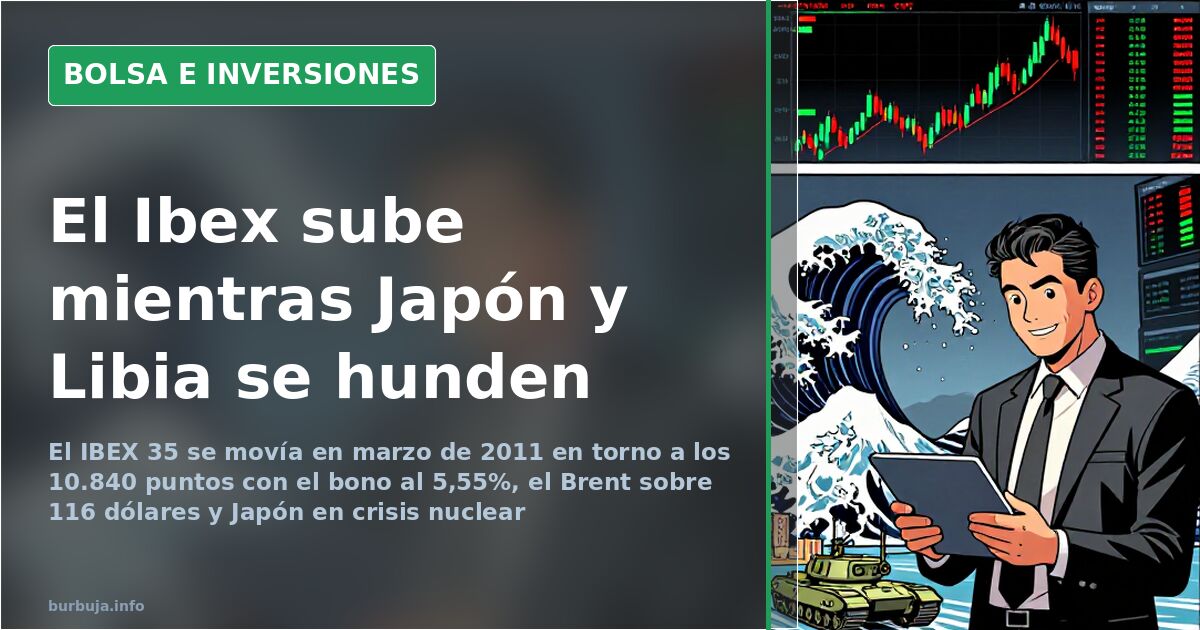
In March 2011, the IBEX 35 hovered around 10,840 points with a 5.55% bond yield, Brent crude at $116, and Japan facing a nuclear crisis.
English · Original discussion in Spanish · Published
Ibex Persists in Rising While Japan Burns and Portugal Defaults
In March 2011, the world was falling apart on all sides, and the IBEX 35 was climbing. Portugal was defaulting, CAM was transferred to Santander, Libya entered into war, crude oil prices soared, and Japan faced a sequence of earthquake, tsunami, and nuclear crisis. The selective index hovered around 10,840 points, with the ten-year bond yield at 5.55% and Brent crude surpassing $116. The contradiction is so stark that one wonders if the Spanish stock market lives on another planet.
Why the Ibex 35 Rises Amidst Japan's Crisis
Because the calendar weighs more than the news. With a quarterly expiry in play, veteran traders suggest, panic can easily wait until large positions are closed. The Japanese earthquake, the Libyan war, and the Portuguese default didn't move the market as much as the need to sustain prices until the appointed day. Another, more cynical interpretation: if the stock market fell with every disaster, one would have to explain why it has been withstanding dreadful news for months.
The most common argument in the lower echelons of the market is that of the 'big hands'. When blocks of buy orders appear in small packages and the price doesn't rise, the interpretation is that someone is accumulating. When 700 long orders appear and are closed in ten minutes, the interpretation changes: that's noise to confuse. The result is a crazy market, more out of control than the Japanese power plants, as summarized by those who watch the ticker professionally.
Japan: The Earthquake That Didn't Sink the Index
The Japanese disaster hit the markets primarily through an unexpected channel: liquidity. Japan, it was said, would inject vast sums of money to prevent its economy from collapsing, and this money sought returns in European indices. The IBEX, according to this view, became a natural destination for that cash. Simultaneously, WTI crude hit a new annual high at $107, and Brent surpassed $116, signals that would normally have crushed any rebound.
The Japanese paradox has a second layer. With half its infrastructure in ruins, some argued that this was the beginning of the end of its eternal deflation. A country that decides to rebuild itself entirely is, after all, a country that decides to spend.
Iberdrola Renovables: The Merger That Did Move the Market
There was one movement that didn't depend on Japan or Libya: the suspension of trading for Iberdrola and Iberdrola Renovables. The board had agreed to propose a merger by absorption, with the parent company as the absorbing entity and the subsidiary as the absorbed one.
Compared to this move, the rest was noise. Small-cap stocks like Quabit traded between €0.2 and €0.204. At Santander, a forum user wondered if its rise was related to the bank taking over CAM.
The Bond, Crude Oil, and Central Bank Liquidity
The most unsettling indicator was the bond yield. The Spanish ten-year bond touched 5.55% before easing to 5.25%, a move that didn't align with the index's calm. If debt yields weren't subsiding, why wasn't the IBEX reacting? The recurring answer pointed to the Federal Reserve. Some argued that Bernanke's cheap money had been propping up stock markets by decree for months, and when the banker disappeared from the scene, the indices resumed their natural path.
That's the crux of it: the stock market stopped reflecting the economy long ago. Yes and no, said those who could explain it. Markets are sovereign and are driven by the interests of those who invest money, not by the news. Fundamentals, by this logic, are more like an alibi than a cause.
What to Do with the Ibex Between 10,500 and 11,000
It depends on whether one believes in the floor. Those who saw the upward trendline since May 2009 pointed to 9,700-9,800 as a likely rebound zone if the structure collapsed. Those trading without a position recommended staying out: with such volatility, stop-losses would be triggered automatically, and any distant target was a gamble. The range between being brave and being prudent was measured in euros.
The technical layer offered no clarity either. The S&P 500 held within the expanding triangle that chartists had been drawing for days; the DAX couldn't break 6,800; and the Dow was oscillating between 12,000 and 13,000. Everyone was looking at levels, no one at certainties.
The drift remains unresolved: if the IBEX holds 10,500 with the bond at 5.55%, the rebound has fuel; if the quarterly expiry arrives and the big hands change sides, 9,700 reappears on the map. And all this, with Japan's reactors still not fully cooled.
In March 2011, the world was falling apart on all sides, and the IBEX 35 was climbing. Portugal was defaulting, CAM was transferred to Santander, Libya entered into war, crude oil prices soared, and Japan faced a sequence of earthquake, tsunami, and nuclear crisis. The selective index hovered around 10,840 points, with the ten-year bond yield at 5.55% and Brent crude surpassing $116. The contradiction is so stark that one wonders if the Spanish stock market lives on another planet.
Why the Ibex 35 Rises Amidst Japan's Crisis
Because the calendar weighs more than the news. With a quarterly expiry in play, veteran traders suggest, panic can easily wait until large positions are closed. The Japanese earthquake, the Libyan war, and the Portuguese default didn't move the market as much as the need to sustain prices until the appointed day. Another, more cynical interpretation: if the stock market fell with every disaster, one would have to explain why it has been withstanding dreadful news for months.
The most common argument in the lower echelons of the market is that of the 'big hands'. When blocks of buy orders appear in small packages and the price doesn't rise, the interpretation is that someone is accumulating. When 700 long orders appear and are closed in ten minutes, the interpretation changes: that's noise to confuse. The result is a crazy market, more out of control than the Japanese power plants, as summarized by those who watch the ticker professionally.
Japan: The Earthquake That Didn't Sink the Index
The Japanese disaster hit the markets primarily through an unexpected channel: liquidity. Japan, it was said, would inject vast sums of money to prevent its economy from collapsing, and this money sought returns in European indices. The IBEX, according to this view, became a natural destination for that cash. Simultaneously, WTI crude hit a new annual high at $107, and Brent surpassed $116, signals that would normally have crushed any rebound.
The Japanese paradox has a second layer. With half its infrastructure in ruins, some argued that this was the beginning of the end of its eternal deflation. A country that decides to rebuild itself entirely is, after all, a country that decides to spend.
Iberdrola Renovables: The Merger That Did Move the Market
There was one movement that didn't depend on Japan or Libya: the suspension of trading for Iberdrola and Iberdrola Renovables. The board had agreed to propose a merger by absorption, with the parent company as the absorbing entity and the subsidiary as the absorbed one.
Compared to this move, the rest was noise. Small-cap stocks like Quabit traded between €0.2 and €0.204. At Santander, a forum user wondered if its rise was related to the bank taking over CAM.
The Bond, Crude Oil, and Central Bank Liquidity
The most unsettling indicator was the bond yield. The Spanish ten-year bond touched 5.55% before easing to 5.25%, a move that didn't align with the index's calm. If debt yields weren't subsiding, why wasn't the IBEX reacting? The recurring answer pointed to the Federal Reserve. Some argued that Bernanke's cheap money had been propping up stock markets by decree for months, and when the banker disappeared from the scene, the indices resumed their natural path.
That's the crux of it: the stock market stopped reflecting the economy long ago. Yes and no, said those who could explain it. Markets are sovereign and are driven by the interests of those who invest money, not by the news. Fundamentals, by this logic, are more like an alibi than a cause.
What to Do with the Ibex Between 10,500 and 11,000
It depends on whether one believes in the floor. Those who saw the upward trendline since May 2009 pointed to 9,700-9,800 as a likely rebound zone if the structure collapsed. Those trading without a position recommended staying out: with such volatility, stop-losses would be triggered automatically, and any distant target was a gamble. The range between being brave and being prudent was measured in euros.
The technical layer offered no clarity either. The S&P 500 held within the expanding triangle that chartists had been drawing for days; the DAX couldn't break 6,800; and the Dow was oscillating between 12,000 and 13,000. Everyone was looking at levels, no one at certainties.
The drift remains unresolved: if the IBEX holds 10,500 with the bond at 5.55%, the rebound has fuel; if the quarterly expiry arrives and the big hands change sides, 9,700 reappears on the map. And all this, with Japan's reactors still not fully cooled.
Summary of a discussion on Burbuja.info - Foro de economía, actualidad y política., translated from Spanish and reviewed before publication. Read the full discussion (1606 replies).
More summaries
-
Ibex 35 in August 2012: The Stock Market Went Dark for Three Hours
On August 6, 2012, the Spanish stock market stopped trading for three hours amid crisis. The Ibex 35, short-selling bans, Bankia, and rescue rumors marked...
-
Ibex 35 in May 2014: Dividends, Penny Stocks, and 25% VAT
May 2014 saw the Ibex 35 pay dividends as VAT threatened to rise to 25%. Penny stocks, capital increases, and a stagnant Santander.
-
Gold stuck at 0.382 as bitcoin takes the spotlight
Gold stuck at 0.382 and unable to recover while bitcoin hits 6.000 dollars; thresholds at 1.250 and 1.050 set the scene.
-
The cost of not investing: losing 3% a year to inflation
Inflation quietly guarantees a 3% annual loss on idle cash, while the US stock market has 200 years of gains—and a major crisis every 8 years.
-
Extra virgin olive oil falls to €6.35 a litre at Mercadona
Extra virgin olive oil is now €6.35/litre at Mercadona, down from €6.75 months ago, while the origin price of picual is €4.143/kg
-
BIG offers 4% TAE on 6-month deposit with Spanish IBAN and Portuguese FGD
BIG launched a 4% TAE six-month and 3.5% three-month deposit in May 2023 with Spanish IBAN and Portuguese FGD, but later cut rates and had opening delays.