
IBEX 35 Plunges 6.64%, Euro Hits Four-Year Lows
The IBEX 35 closed down 6.64% and the euro fell to $1.237, a four-year low, amid high volatility in May.
English · Original discussion in Spanish · Published
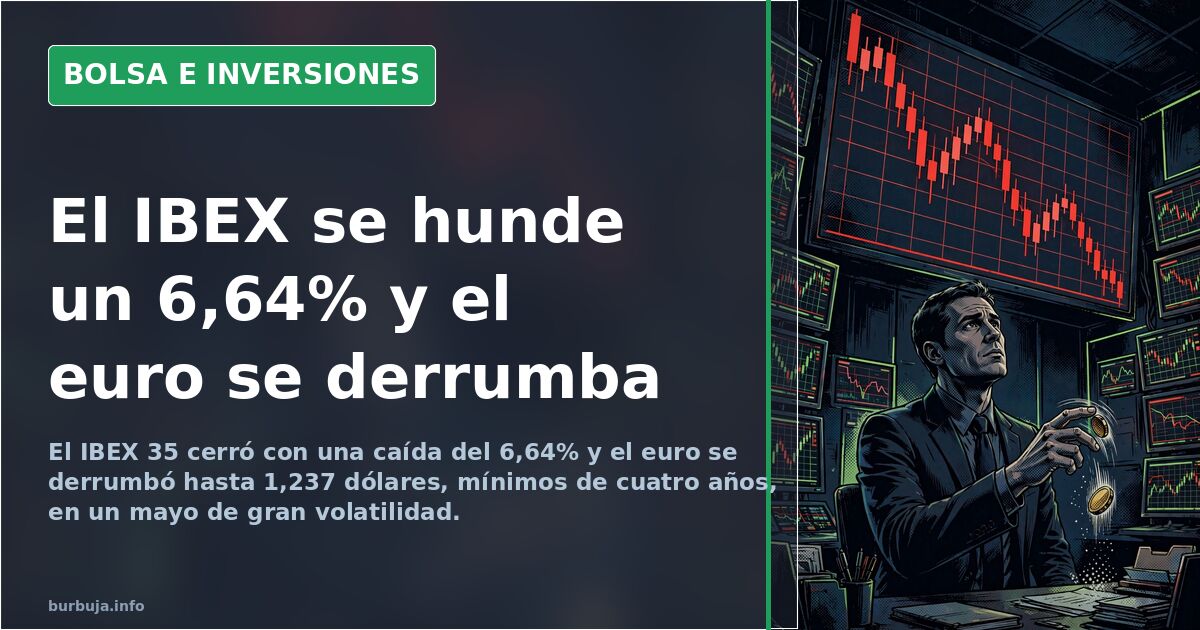
IBEX 35: From Optimism to Panic in May 2010
The month began with euphoria. It ended with the IBEX 35 closing at 9,314 points, down 6.64% in one of the final sessions, the euro plummeting to $1.237, its lowest level in four years, and much of the market assuming Greece was just the first domino. In a few days, what was read as a technical rebound turned into one of the year's most violent corrections on the Spanish stock market.
The trigger was not singular. Negotiations for the Greek bailout, austerity measures approved by a single-vote margin, and foreign investors' distrust of Spanish debt combined into a cocktail that blew up any bullish scenario. European indices moved to the tune of the S&P, and consensus broke: the market stopped behaving like an orderly place and turned into what several traders described as a casino.
The Fall No One Wanted to See Coming
The day of the crash did not come as a surprise. Warnings had been accumulating for days. Some in the market argued that the agreement with Greece would clear the air; others countered that the Greek rescue only postponed the problem and that the market was already pricing it in. The latter won, and how.
The IBEX reached a low of 9,243.50 points, a puntual drop of 7.36%. Santander, one of the most punished stocks, touched 9 euros, and some saw it fall 10% in a single session. The euro plummeted to $1.237, and European indices lost ground across the board: the Portuguese PSI at 7,007 points, the German DAX at 5,894.
Why did the IBEX collapse if the Greek rescue was already on the table? Precisely because of that. The market didn't buy the narrative that Greece was an isolated case. The approval of austerity in Spain by a single vote difference was read as a sign of political weakness, and distrust of peripheral debt was directly transferred to stocks. The problem ceased to be Greek and became a problem of European credibility.
The Euro at Lows and Debt as a Thermometer
The euro's plunge to $1.237 was the most eloquent indicator that the problem was not just equities. The common currency erased four years of gains, and investors sought refuge outside the euro.
In this context, indices began to correlate more strongly with each other. The IBEX no longer moved on its own: it trinc the S&P and the German and Portuguese indices. One trader observed that the IBEX 35 was ceasing to be that manageable index that moved on local news, with the exception of some impactful political statements. European indices rose and fell in unison, as if they were a single mass.
This high correlation eliminated the illusion that anyone could anticipate. Supports were questioned daily, and buy orders were left hanging. Technical consensus pointed to ever-lower theoretical floor levels: first 9,000, then 8,800, and some even spoke of extreme scenarios at 3,000 points.
Guarantees, Dividends, and the Detail That Ruined More Than One
One of the most documented episodes of the month had nothing to do with macroeconomics. Several traders incurred additional losses due to a technical aspect that many overlooked: the distribution of dividends on short positions with CFDs. According to forum participants, those who were short with CFDs on a stock that paid a dividend found a charge on their account they hadn't anticipated, and in some cases, the double blow of the dividend adjustment in the market and the corresponding payment.
The detail recurred with Criteria, OHL, and several others. Some found out the next day, upon seeing their account balance. The lesson was cheap for some, very expensive for others: announced dividends are known in advance, but in the midst of a correction, most traders weren't looking at the calendar.
Volatility as a Signal and the Margin Call Pulse
One of the most repeated patterns was falling volatility levels. When volatility disappears, two things happen simultaneously: movements become slow, and surprises, when they arrive, are brutal. Several traders warned that as volatility decreased, the risk of a sharp movement triggered by any news increased.
In this phase, trading desks use mechanisms that are unpleasant for the retail investor, such as upward adjustments to required guarantees. A sudden increase in guarantees forces the closure of leveraged positions and generates movements that don't respond to any news, only to the need to cover margins. One participant described it bluntly: when the market can't find direction, it resorts to the tools it has left to shake out small money.
One of the forum traders, Mulder, summarized the institutional flow of the day as trinc:
[CITA]The volume of the big players in the Ibex today was medium and the balance negative. They sold all morning until 2:30 PM. In the auction, they bought and sold; the difference between that purchase and sale is practically nil, so it's neutral for tomorrow[/CITA]
This reading of institutional order flow, by a trader who trinc large trading blocks, proved to be one of the few useful indicators in a month where technical analysis was overwhelmed by political news.
Yesterday's Rally, Today's Fall: Daily Volatility
The pattern of a one-session rally that unraveled the next day repeated itself in a reduced version several times during the month. The IBEX closed with moderate gains, and the next day it gave it all back. Movements occurred with more estimulante ilegal than depth, leaving traders with the constant feeling that the floor was always just below their feet.
Support levels trinc one another. 9,243 was the first. Then 8,919, which saw a puntual drop of 4.63%. Then 9,314, which seemed like a floor and lasted a few days. By the end of the month, consensus had shifted towards more somber horizons: first the reference of 8,800, then the 3,000 in the most extreme scenarios. None of those extreme levels were reached in the analyzed period. But the discussion was already considering them.
Bets for Monday
The question circulating every Friday afternoon had only one honest answer: nobody knew. But that didn't stop everyone from having their scenario. One participant openly asked how much the stock market would rise the Monday after an agreement on Greece: 2%, 3%?
By the end of the month, the only certainty was that volatility had completely disappeared for several consecutive days—a sign, according to the most seasoned traders, that something was building up—and that the calm wouldn't last. The next surprise could come from sovereign debt, central banks, or any other front nobody was looking at.
According to a forum participant, trillions of euros in bailouts, debt monetization by the ECB, and productive European companies facing rising financial costs on the horizon. That was the scenario some were beginning to draw. And in that scenario, savers had little reason to smile.
The month began with euphoria. It ended with the IBEX 35 closing at 9,314 points, down 6.64% in one of the final sessions, the euro plummeting to $1.237, its lowest level in four years, and much of the market assuming Greece was just the first domino. In a few days, what was read as a technical rebound turned into one of the year's most violent corrections on the Spanish stock market.
The trigger was not singular. Negotiations for the Greek bailout, austerity measures approved by a single-vote margin, and foreign investors' distrust of Spanish debt combined into a cocktail that blew up any bullish scenario. European indices moved to the tune of the S&P, and consensus broke: the market stopped behaving like an orderly place and turned into what several traders described as a casino.
The Fall No One Wanted to See Coming
The day of the crash did not come as a surprise. Warnings had been accumulating for days. Some in the market argued that the agreement with Greece would clear the air; others countered that the Greek rescue only postponed the problem and that the market was already pricing it in. The latter won, and how.
The IBEX reached a low of 9,243.50 points, a puntual drop of 7.36%. Santander, one of the most punished stocks, touched 9 euros, and some saw it fall 10% in a single session. The euro plummeted to $1.237, and European indices lost ground across the board: the Portuguese PSI at 7,007 points, the German DAX at 5,894.
Why did the IBEX collapse if the Greek rescue was already on the table? Precisely because of that. The market didn't buy the narrative that Greece was an isolated case. The approval of austerity in Spain by a single vote difference was read as a sign of political weakness, and distrust of peripheral debt was directly transferred to stocks. The problem ceased to be Greek and became a problem of European credibility.
The Euro at Lows and Debt as a Thermometer
The euro's plunge to $1.237 was the most eloquent indicator that the problem was not just equities. The common currency erased four years of gains, and investors sought refuge outside the euro.
In this context, indices began to correlate more strongly with each other. The IBEX no longer moved on its own: it trinc the S&P and the German and Portuguese indices. One trader observed that the IBEX 35 was ceasing to be that manageable index that moved on local news, with the exception of some impactful political statements. European indices rose and fell in unison, as if they were a single mass.
This high correlation eliminated the illusion that anyone could anticipate. Supports were questioned daily, and buy orders were left hanging. Technical consensus pointed to ever-lower theoretical floor levels: first 9,000, then 8,800, and some even spoke of extreme scenarios at 3,000 points.
Guarantees, Dividends, and the Detail That Ruined More Than One
One of the most documented episodes of the month had nothing to do with macroeconomics. Several traders incurred additional losses due to a technical aspect that many overlooked: the distribution of dividends on short positions with CFDs. According to forum participants, those who were short with CFDs on a stock that paid a dividend found a charge on their account they hadn't anticipated, and in some cases, the double blow of the dividend adjustment in the market and the corresponding payment.
The detail recurred with Criteria, OHL, and several others. Some found out the next day, upon seeing their account balance. The lesson was cheap for some, very expensive for others: announced dividends are known in advance, but in the midst of a correction, most traders weren't looking at the calendar.
Volatility as a Signal and the Margin Call Pulse
One of the most repeated patterns was falling volatility levels. When volatility disappears, two things happen simultaneously: movements become slow, and surprises, when they arrive, are brutal. Several traders warned that as volatility decreased, the risk of a sharp movement triggered by any news increased.
In this phase, trading desks use mechanisms that are unpleasant for the retail investor, such as upward adjustments to required guarantees. A sudden increase in guarantees forces the closure of leveraged positions and generates movements that don't respond to any news, only to the need to cover margins. One participant described it bluntly: when the market can't find direction, it resorts to the tools it has left to shake out small money.
One of the forum traders, Mulder, summarized the institutional flow of the day as trinc:
[CITA]The volume of the big players in the Ibex today was medium and the balance negative. They sold all morning until 2:30 PM. In the auction, they bought and sold; the difference between that purchase and sale is practically nil, so it's neutral for tomorrow[/CITA]
This reading of institutional order flow, by a trader who trinc large trading blocks, proved to be one of the few useful indicators in a month where technical analysis was overwhelmed by political news.
Yesterday's Rally, Today's Fall: Daily Volatility
The pattern of a one-session rally that unraveled the next day repeated itself in a reduced version several times during the month. The IBEX closed with moderate gains, and the next day it gave it all back. Movements occurred with more estimulante ilegal than depth, leaving traders with the constant feeling that the floor was always just below their feet.
Support levels trinc one another. 9,243 was the first. Then 8,919, which saw a puntual drop of 4.63%. Then 9,314, which seemed like a floor and lasted a few days. By the end of the month, consensus had shifted towards more somber horizons: first the reference of 8,800, then the 3,000 in the most extreme scenarios. None of those extreme levels were reached in the analyzed period. But the discussion was already considering them.
Bets for Monday
The question circulating every Friday afternoon had only one honest answer: nobody knew. But that didn't stop everyone from having their scenario. One participant openly asked how much the stock market would rise the Monday after an agreement on Greece: 2%, 3%?
By the end of the month, the only certainty was that volatility had completely disappeared for several consecutive days—a sign, according to the most seasoned traders, that something was building up—and that the calm wouldn't last. The next surprise could come from sovereign debt, central banks, or any other front nobody was looking at.
According to a forum participant, trillions of euros in bailouts, debt monetization by the ECB, and productive European companies facing rising financial costs on the horizon. That was the scenario some were beginning to draw. And in that scenario, savers had little reason to smile.
Summary of a discussion on Burbuja.info - Foro de economía, actualidad y política., translated from Spanish and reviewed before publication. Read the full discussion (6076 replies).
More summaries
-
The AI Bubble: How Circular Payments Keep the S&P 500 Afloat
OpenAI has $550B in commitments but no profit, Oracle issues 6.85% debt, and the billing loop keeps the S&P 500 rising.
-
Gold stuck at 0.382 as bitcoin takes the spotlight
Gold stuck at 0.382 and unable to recover while bitcoin hits 6.000 dollars; thresholds at 1.250 and 1.050 set the scene.
-
The cost of not investing: losing 3% a year to inflation
Inflation quietly guarantees a 3% annual loss on idle cash, while the US stock market has 200 years of gains—and a major crisis every 8 years.
-
Extra virgin olive oil falls to €6.35 a litre at Mercadona
Extra virgin olive oil is now €6.35/litre at Mercadona, down from €6.75 months ago, while the origin price of picual is €4.143/kg
-
BIG offers 4% TAE on 6-month deposit with Spanish IBAN and Portuguese FGD
BIG launched a 4% TAE six-month and 3.5% three-month deposit in May 2023 with Spanish IBAN and Portuguese FGD, but later cut rates and had opening delays.
-
Spot-price coins: the seller whose paper trail didn't add up
He offered quarter-ounce gold coins at spot price and racked up undelivered orders. Buyers cross-checked his details and several got their money back.