
Ibex 35 hovers at 8,800 as banks seek another trillion from ECB
The Ibex 35 traded sideways in February 2012 around 8,800 points while banks prepared for another ECB liquidity injection, and Gamesa plunged 12%.
English · Original discussion in Spanish · Published
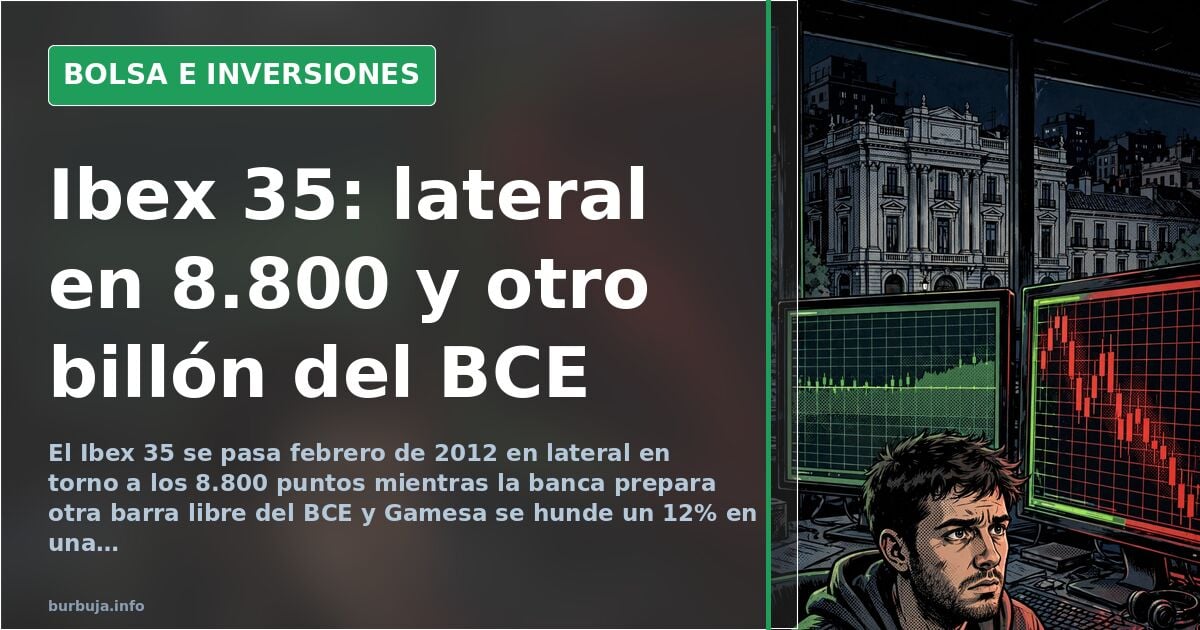
Ibex holds at 8,800 as banks secure another trillion from the ECB
The Ibex 35 isn't falling. And in February 2012, with half the world expecting the euro to collapse, simply holding ground is news. The Spanish index spent the entire month oscillating within a narrow band, between 8,850 and 8,900 points, in a wearying sideways trend that is making everyone nervous. The charts suggest indecision. Traders say something else.
The real news isn't on the screen. It's in Frankfurt. European banks are preparing to request another liquidity injection from the European Central Bank. Another trillion euros. The second liquidity binge in three months. A sharp analysis summarizes it with a smirk: banks are doing it "to prevent an even greater credit crunch." The problem is never the money. The problem is who pays for the party.
The ECB's 'liquidity binge': A trillion that comes at a high cost
The figures being discussed are simple and terrifying. If 1.5 trillion euros are requested every two months or so, "this is going to cost us dearly," warns an investor weary of the spiral. Official logic dictates that liquidity is a patch, a painkiller. Market logic points to something more uncomfortable: with borrowed money, peripheral debts are tackled without losing a single euro, and profits are doubled in the process.
Amidst the distribution, Greece. The Hellenic country faces a deadline set by the EU to close its bailout, and parties are negotiating against the clock. The market, meanwhile, is doing what it always does: looking at the S&P 500.
Gamesa plummets 12%, exposing novice traders
Gamesa's collapse is the story of the month. The wind turbine manufacturer loses 12% in a single session, shedding 3 euros. The fall drags Iberdrola down with it. And it leaves a trail of wounds among those who had placed their trust, and their stop-loss orders, in a rebound.
A novice trader recounts her ordeal with a tone mixing humor and tragedy. She bought at 2.96, set a stop at 2.89, and placed a sell order at 3.15. When she tried to react, the stop hadn't triggered: the order was "out of funds" because she had sent another sell order to the market. Result: sunk to the Mariana Trench, along with her shares. The lesson on risk, applied to one's own portfolio, hurts more than any manual.
Longs versus shorts: The technical battle at 8,800
Here, no one agrees, and that's what's interesting. One current holds that the index is "extremely weak" and won't exceed 9,150 points in the best-case scenario. Others see a mature floor, a genuine upward turn. Three months of sideways trading, repeating the same levels, have consolidated investor sentiment, and that, according to the most skeptical, is dangerous: an upward surge could be exhaustion, not hope.
The battle is also being fought outside Spain. The S&P 500 has risen 30% since October, and many see a "gigantic H-C-H" – a head-and-shoulders pattern – signaling a correction. A trader is building a bearish position in the DAX from 6,943 points and warns that 7,000 is "very relevant." The problem is that the German index has been rising non-stop from 5,400. And the reality, he warns, is that it doesn't always correct: in July 2010, it surged upwards, leaving short-sellers trapped.
Future 'lions': 700 contracts leaving no trace
There's a part of the market that moves outside the charts and headlines. It's the volume of Ibex futures, which someone scrutinizes in detail every afternoon. One day, 291 contracts are sold at 10:10 at 8,860, and another 704 contracts at 16:30 at 8,745. Another day, 375 contracts are bought in auction. The daily balance, positive or negative, anticipates movements that the price hasn't yet recognized.
Jargon calls it lions and camouflage. There are large, open trades, and others are distributed using algorithms on correlated indices to avoid leaving a trace. A trader describes it this way: when you have many contracts to place, there's the distributed trade, where "an execution algorithm randomly distributes the load." Behind every candlestick, there's a hand playing hide-and-seek. What the chart doesn't show is whose hand it is.
Index or single stock? The dilemma no one resolves
A debate is ongoing this month, and it's significant. Should one buy the index or focus on a single stock? The proponents of the index have a devastating argument: in 50 years, "95% of the stocks currently in the Ibex will have disappeared in one way or another." It's reckless to buy a stock and forget about it. The index itself selects for you, replacing laggards with performers, and survives. Aceralia, Agromán, Aguas de Barcelona: the list of illustrious casualties on the Spanish selective index is long.
The opposing view counters that indices eventually recover, yes, "depending on the country's business capacity," because companies merge or are replaced by others that take their place. A single company, on the other hand, only has a reason to exist if it's profitable. The discussion is the same old one: passive versus active management. And in the middle, stocks like BME, trading at 20.035 euros, which some consider a bargain for being "a liquidity-generating and dividend-paying machine."
Telefónica, Endesa, BME: The levels to watch
The resistance map is repeated by trader after trader. Telefónica closes at 13.34 euros after marking a low of 12.98, with clear resistance at 13. Endesa is struggling around 16 euros and shows selling weakness at 15.8-15.9. Iberdrola is stuck due to short-seller pressure. One of the most active traders places a short on the Ibex from 8,900 with a stop at 9,050 and doesn't hold back: the target is the big guano.
The most pessimistic current forecasts a sequence for the index: fall to 7,600, rebound to 8,100, fall to 6,700, pullback to 7,700, and from there, "a big guano." It's a prediction, not a certainty. And against it weighs the argument that the market has been in a bull run since March 9, 2009, and that by constantly predicting doom, one eventually gets it right.
The human factor: private equity and farewells
Between the charts, the month leaves behind stories that don't make the financial news. A trader confesses that his company is for sale and he's likely to be laid off. "If you can avoid private equity firms, do so," he advises, based on the experience of seeing a fund buy, cut staff, and show people the door. The crisis has names and surnames, even if they don't appear in the headlines.
Another participant enters the market for two reasons: an injury that left her immobilized and some BBVA shares her husband left her before he passed away. "Every time I make a trade, I dedicate it to him," she writes. A friend is surprised: "You understand the stock market?" Trading doesn't distinguish between millionaires and novices. The latter often learn faster.
De Guindos, Bernanke, and the uncontrollable dragon
The month closes with an transatlantic alucinación. The Minister of Economy, Luis de Guindos, meets with the Chairman of the Federal Reserve, Ben Bernanke. The official photo will say they discussed the European crisis. The market will read it as a discussion about implicit support for the euro. No one knows what was truly said, and that is probably the sarracena of the story.
Meanwhile, someone describes their position with a metaphor that explains it all: "The dragon is called Barclays, its first surname is SP, the second is DAX, and its nickname is VIX. Everything is short except the nickname, which is long." No stop-loss has been triggered. "I'm riding this dragon." The question is whether the dragon is tamed or just waiting.
The Ibex closes the month without breaking its sideways trend. No one knows what will come next. If the big guano is delayed, it will be a sign that the market has more resilience than the pessimists claim. If it happens, those who stayed long will have a lesson that no book teaches. But at 8,800, with this liquidity flowing, antiestéticar and greed remain exactly balanced.
The Ibex 35 isn't falling. And in February 2012, with half the world expecting the euro to collapse, simply holding ground is news. The Spanish index spent the entire month oscillating within a narrow band, between 8,850 and 8,900 points, in a wearying sideways trend that is making everyone nervous. The charts suggest indecision. Traders say something else.
The real news isn't on the screen. It's in Frankfurt. European banks are preparing to request another liquidity injection from the European Central Bank. Another trillion euros. The second liquidity binge in three months. A sharp analysis summarizes it with a smirk: banks are doing it "to prevent an even greater credit crunch." The problem is never the money. The problem is who pays for the party.
The ECB's 'liquidity binge': A trillion that comes at a high cost
The figures being discussed are simple and terrifying. If 1.5 trillion euros are requested every two months or so, "this is going to cost us dearly," warns an investor weary of the spiral. Official logic dictates that liquidity is a patch, a painkiller. Market logic points to something more uncomfortable: with borrowed money, peripheral debts are tackled without losing a single euro, and profits are doubled in the process.
Amidst the distribution, Greece. The Hellenic country faces a deadline set by the EU to close its bailout, and parties are negotiating against the clock. The market, meanwhile, is doing what it always does: looking at the S&P 500.
Gamesa plummets 12%, exposing novice traders
Gamesa's collapse is the story of the month. The wind turbine manufacturer loses 12% in a single session, shedding 3 euros. The fall drags Iberdrola down with it. And it leaves a trail of wounds among those who had placed their trust, and their stop-loss orders, in a rebound.
A novice trader recounts her ordeal with a tone mixing humor and tragedy. She bought at 2.96, set a stop at 2.89, and placed a sell order at 3.15. When she tried to react, the stop hadn't triggered: the order was "out of funds" because she had sent another sell order to the market. Result: sunk to the Mariana Trench, along with her shares. The lesson on risk, applied to one's own portfolio, hurts more than any manual.
Longs versus shorts: The technical battle at 8,800
Here, no one agrees, and that's what's interesting. One current holds that the index is "extremely weak" and won't exceed 9,150 points in the best-case scenario. Others see a mature floor, a genuine upward turn. Three months of sideways trading, repeating the same levels, have consolidated investor sentiment, and that, according to the most skeptical, is dangerous: an upward surge could be exhaustion, not hope.
The battle is also being fought outside Spain. The S&P 500 has risen 30% since October, and many see a "gigantic H-C-H" – a head-and-shoulders pattern – signaling a correction. A trader is building a bearish position in the DAX from 6,943 points and warns that 7,000 is "very relevant." The problem is that the German index has been rising non-stop from 5,400. And the reality, he warns, is that it doesn't always correct: in July 2010, it surged upwards, leaving short-sellers trapped.
Future 'lions': 700 contracts leaving no trace
There's a part of the market that moves outside the charts and headlines. It's the volume of Ibex futures, which someone scrutinizes in detail every afternoon. One day, 291 contracts are sold at 10:10 at 8,860, and another 704 contracts at 16:30 at 8,745. Another day, 375 contracts are bought in auction. The daily balance, positive or negative, anticipates movements that the price hasn't yet recognized.
Jargon calls it lions and camouflage. There are large, open trades, and others are distributed using algorithms on correlated indices to avoid leaving a trace. A trader describes it this way: when you have many contracts to place, there's the distributed trade, where "an execution algorithm randomly distributes the load." Behind every candlestick, there's a hand playing hide-and-seek. What the chart doesn't show is whose hand it is.
Index or single stock? The dilemma no one resolves
A debate is ongoing this month, and it's significant. Should one buy the index or focus on a single stock? The proponents of the index have a devastating argument: in 50 years, "95% of the stocks currently in the Ibex will have disappeared in one way or another." It's reckless to buy a stock and forget about it. The index itself selects for you, replacing laggards with performers, and survives. Aceralia, Agromán, Aguas de Barcelona: the list of illustrious casualties on the Spanish selective index is long.
The opposing view counters that indices eventually recover, yes, "depending on the country's business capacity," because companies merge or are replaced by others that take their place. A single company, on the other hand, only has a reason to exist if it's profitable. The discussion is the same old one: passive versus active management. And in the middle, stocks like BME, trading at 20.035 euros, which some consider a bargain for being "a liquidity-generating and dividend-paying machine."
Telefónica, Endesa, BME: The levels to watch
The resistance map is repeated by trader after trader. Telefónica closes at 13.34 euros after marking a low of 12.98, with clear resistance at 13. Endesa is struggling around 16 euros and shows selling weakness at 15.8-15.9. Iberdrola is stuck due to short-seller pressure. One of the most active traders places a short on the Ibex from 8,900 with a stop at 9,050 and doesn't hold back: the target is the big guano.
The most pessimistic current forecasts a sequence for the index: fall to 7,600, rebound to 8,100, fall to 6,700, pullback to 7,700, and from there, "a big guano." It's a prediction, not a certainty. And against it weighs the argument that the market has been in a bull run since March 9, 2009, and that by constantly predicting doom, one eventually gets it right.
The human factor: private equity and farewells
Between the charts, the month leaves behind stories that don't make the financial news. A trader confesses that his company is for sale and he's likely to be laid off. "If you can avoid private equity firms, do so," he advises, based on the experience of seeing a fund buy, cut staff, and show people the door. The crisis has names and surnames, even if they don't appear in the headlines.
Another participant enters the market for two reasons: an injury that left her immobilized and some BBVA shares her husband left her before he passed away. "Every time I make a trade, I dedicate it to him," she writes. A friend is surprised: "You understand the stock market?" Trading doesn't distinguish between millionaires and novices. The latter often learn faster.
De Guindos, Bernanke, and the uncontrollable dragon
The month closes with an transatlantic alucinación. The Minister of Economy, Luis de Guindos, meets with the Chairman of the Federal Reserve, Ben Bernanke. The official photo will say they discussed the European crisis. The market will read it as a discussion about implicit support for the euro. No one knows what was truly said, and that is probably the sarracena of the story.
Meanwhile, someone describes their position with a metaphor that explains it all: "The dragon is called Barclays, its first surname is SP, the second is DAX, and its nickname is VIX. Everything is short except the nickname, which is long." No stop-loss has been triggered. "I'm riding this dragon." The question is whether the dragon is tamed or just waiting.
The Ibex closes the month without breaking its sideways trend. No one knows what will come next. If the big guano is delayed, it will be a sign that the market has more resilience than the pessimists claim. If it happens, those who stayed long will have a lesson that no book teaches. But at 8,800, with this liquidity flowing, antiestéticar and greed remain exactly balanced.
Summary of a discussion on Burbuja.info - Foro de economía, actualidad y política., translated from Spanish and reviewed before publication. Read the full discussion (4975 replies).
More summaries
-
Ibex 35 in June 2013: A 12% Drop and an Uncertain Bottom
The Ibex 35 traded between 8,200 and 8,600 points in June 2013, then fell 12% from its highs, with a bearish target of 6,800 and Gamesa rising.
-
The AI Bubble: How Circular Payments Keep the S&P 500 Afloat
OpenAI has $550B in commitments but no profit, Oracle issues 6.85% debt, and the billing loop keeps the S&P 500 rising.
-
Gold stuck at 0.382 as bitcoin takes the spotlight
Gold stuck at 0.382 and unable to recover while bitcoin hits 6.000 dollars; thresholds at 1.250 and 1.050 set the scene.
-
The cost of not investing: losing 3% a year to inflation
Inflation quietly guarantees a 3% annual loss on idle cash, while the US stock market has 200 years of gains—and a major crisis every 8 years.
-
Extra virgin olive oil falls to €6.35 a litre at Mercadona
Extra virgin olive oil is now €6.35/litre at Mercadona, down from €6.75 months ago, while the origin price of picual is €4.143/kg
-
BIG offers 4% TAE on 6-month deposit with Spanish IBAN and Portuguese FGD
BIG launched a 4% TAE six-month and 3.5% three-month deposit in May 2023 with Spanish IBAN and Portuguese FGD, but later cut rates and had opening delays.