
Ibex 35: Greece and PMIs Close Q3 2011 Below 8,000
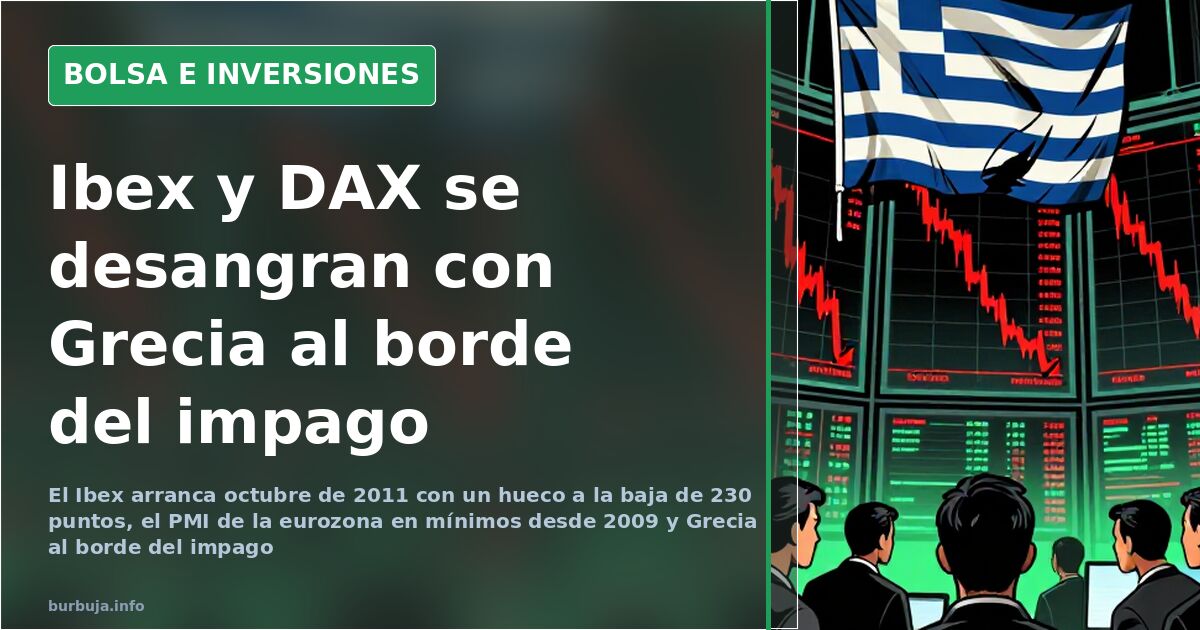
The Ibex starts October 2011 with a 230-point gap down, Eurozone PMI at 2009 lows, and Greece on the verge of default.
English · Original discussion in Spanish · Published
Ibex Ends Third Quarter of 2011 with Greece Hovering Around 8,000
Early October 2011. The Ibex 35 begins the year's final quarter with a gap down of around 230 points, and the word 'bankruptcy' circling Athens without anyone in Brussels daring to utter it. The German Chancellor of SMEs, Michael Fuchs, stated it bluntly: Greek debt default will reach 50%. With this starting point, European indices spent the week searching for solid ground and finding cliffs.
This is no ordinary correction. It's the third quarter of 2011, the year the Eurozone stopped pretending everything was under control.
The PMI That Confirms Europe is Cooling
Tuesday's key data arrived at ten in the morning: the Eurozone manufacturing PMI falls from 49 to 48.5, the worst reading since August 2009. It's still above the consensus expectation of 48.4, but that's like boasting that the fever is half a degree lower than predicted. Germany, the engine everyone cites as a lifesaver, isn't escaping either: its PMI drops from 50.9 to 50.3. Below 50, activity contracts, and several are already starting to look at double-digit recession.
The optimistic reading says the deterioration is mild. The pessimistic response is that we've come from two years of stimulus, and this is the best the machinery can produce. American futures didn't help at the open: Dow -0.55% to 10,639, S&P 500 -0.44% to 1,124, and Nasdaq -0.65% to 2,187. Wall Street wasn't buying the truce either.
The Levels the Ibex and DAX Are Playing With
The Ibex had the pending task of closing the gap left on September 26th, between 8,201 and 8,333 points. At Santander, the equivalent gap was between 5.91 and 6.01 euros. The most seasoned trinc had two clear references: 8,800 points as the first upward target — as published by Ecotrader — and the DAX floor at 5,490, which had become the session's red line.
That German level didn't hold. Midway through the session, the closest point from above was a convergence between 5,406 and 5,412, which was light-years away. Theory fulfills itself when liquidity tightens: first liquidation, then price drops, then margin calls, and cascading deleveraging. More than 1 billion in intraday negative balance in just a short while, with money fleeing the stock market.
Silver Plummets and Gold Ceases to Be a Safe Haven
Amidst all this Greek drama, the commodities crash went almost unnoticed. Silver quoted in euros dropped 14% during the session, with gold also falling. For those who had been using the metal as a shield against disaster, the blow was instructive: safe havens also have exit prices and don't warn before falling. Some in the market saw downside potential down to 15 euros, and it didn't seem like bar-stool exaggeration.
Latin American stocks entered the suspect list due to the dollar's strength. The presence of Spanish companies in the region, that catch-all that contributes so much cosmetic improvement to the accounts, was beginning to be scrutinized closely for the first time in months.
FCC, the Stock No One Wants to Let Go
FCC joined the party, a stock trading on the selective index that an amateur analyst described bluntly as unserious for where it stood. The question of whether FCC was 'being eaten by lions' was asked with irony, but the chart wasn't laughing. The distance to the next relevant low was so wide it explained the technical severity of the pattern on its own.
The case of AGEN was the personal dark note: down 16% in a single session due to a reverse stock split that caught people off guard. When a corporate adjustment eats into investor capital, the lesson is not forgotten.
Short Selling Ban, Up in the Air
The question circulated without an official answer: would the ban on short positions be extended, or would everything remain as it was? No one had leaked any information, and uncertainty added to the rest. In parallel, a thesis emerged that still resonates: launching haircuts on American mortgage debt, negotiated bank by bank, to reactivate growth. Viable? Fair? Did anyone care? That thread wasn't fully unraveled.
The countdown to the end of September left the board where it always is: a stock market clinging to its technical channels while the official narrative insists that Greece will be fixed with another bailout. Money, meanwhile, continues to leave the way it entered: without making noise and with hands in pockets.
Early October 2011. The Ibex 35 begins the year's final quarter with a gap down of around 230 points, and the word 'bankruptcy' circling Athens without anyone in Brussels daring to utter it. The German Chancellor of SMEs, Michael Fuchs, stated it bluntly: Greek debt default will reach 50%. With this starting point, European indices spent the week searching for solid ground and finding cliffs.
This is no ordinary correction. It's the third quarter of 2011, the year the Eurozone stopped pretending everything was under control.
The PMI That Confirms Europe is Cooling
Tuesday's key data arrived at ten in the morning: the Eurozone manufacturing PMI falls from 49 to 48.5, the worst reading since August 2009. It's still above the consensus expectation of 48.4, but that's like boasting that the fever is half a degree lower than predicted. Germany, the engine everyone cites as a lifesaver, isn't escaping either: its PMI drops from 50.9 to 50.3. Below 50, activity contracts, and several are already starting to look at double-digit recession.
The optimistic reading says the deterioration is mild. The pessimistic response is that we've come from two years of stimulus, and this is the best the machinery can produce. American futures didn't help at the open: Dow -0.55% to 10,639, S&P 500 -0.44% to 1,124, and Nasdaq -0.65% to 2,187. Wall Street wasn't buying the truce either.
The Levels the Ibex and DAX Are Playing With
The Ibex had the pending task of closing the gap left on September 26th, between 8,201 and 8,333 points. At Santander, the equivalent gap was between 5.91 and 6.01 euros. The most seasoned trinc had two clear references: 8,800 points as the first upward target — as published by Ecotrader — and the DAX floor at 5,490, which had become the session's red line.
That German level didn't hold. Midway through the session, the closest point from above was a convergence between 5,406 and 5,412, which was light-years away. Theory fulfills itself when liquidity tightens: first liquidation, then price drops, then margin calls, and cascading deleveraging. More than 1 billion in intraday negative balance in just a short while, with money fleeing the stock market.
Silver Plummets and Gold Ceases to Be a Safe Haven
Amidst all this Greek drama, the commodities crash went almost unnoticed. Silver quoted in euros dropped 14% during the session, with gold also falling. For those who had been using the metal as a shield against disaster, the blow was instructive: safe havens also have exit prices and don't warn before falling. Some in the market saw downside potential down to 15 euros, and it didn't seem like bar-stool exaggeration.
Latin American stocks entered the suspect list due to the dollar's strength. The presence of Spanish companies in the region, that catch-all that contributes so much cosmetic improvement to the accounts, was beginning to be scrutinized closely for the first time in months.
FCC, the Stock No One Wants to Let Go
FCC joined the party, a stock trading on the selective index that an amateur analyst described bluntly as unserious for where it stood. The question of whether FCC was 'being eaten by lions' was asked with irony, but the chart wasn't laughing. The distance to the next relevant low was so wide it explained the technical severity of the pattern on its own.
The case of AGEN was the personal dark note: down 16% in a single session due to a reverse stock split that caught people off guard. When a corporate adjustment eats into investor capital, the lesson is not forgotten.
Short Selling Ban, Up in the Air
The question circulated without an official answer: would the ban on short positions be extended, or would everything remain as it was? No one had leaked any information, and uncertainty added to the rest. In parallel, a thesis emerged that still resonates: launching haircuts on American mortgage debt, negotiated bank by bank, to reactivate growth. Viable? Fair? Did anyone care? That thread wasn't fully unraveled.
The countdown to the end of September left the board where it always is: a stock market clinging to its technical channels while the official narrative insists that Greece will be fixed with another bailout. Money, meanwhile, continues to leave the way it entered: without making noise and with hands in pockets.
Summary of a discussion on Burbuja.info - Foro de economía, actualidad y política., translated from Spanish and reviewed before publication. Read the full discussion (1287 replies).
More summaries
-
IBEX 35 in April 2010: Greek Crisis Plunges Index to 10,077
In April 2010, the IBEX 35 fell to 10,077 points, with futures at 9,932, driven by the Greek debt crisis and the punishment of Spanish banks.
-
IBEX 35 October 2011: Greek haircut and a floor no one signed
In October 2011, the IBEX 35 rose while Greece faced a haircut of up to 60% and Fitch downgraded six banks. No one signed the index's floor.
-
Ibex 35 in March 2010: Heading for 11,000 with Greece in the Background
The Ibex rose from 10,400 to attack 11,000 in March 2010, as unemployment hit 4.13 million and Greece and Portugal strained debt markets.
-
Banco de España Silver Coins: From €12 to €30 Face Value
Explore the evolution of Banco de España's silver coins, from their €12 face value to €30, as silver prices fluctuated. Discover why these collectibles are now scarce.
-
Gold stuck at 0.382 as bitcoin takes the spotlight
Gold stuck at 0.382 and unable to recover while bitcoin hits 6.000 dollars; thresholds at 1.250 and 1.050 set the scene.
-
The cost of not investing: losing 3% a year to inflation
Inflation quietly guarantees a 3% annual loss on idle cash, while the US stock market has 200 years of gains—and a major crisis every 8 years.