
IBEX 35 in April 2010: Greek Crisis Plunges Index to 10,077
In April 2010, the IBEX 35 fell to 10,077 points, with futures at 9,932, driven by the Greek debt crisis and the punishment of Spanish banks.
English · Original discussion in Spanish · Published
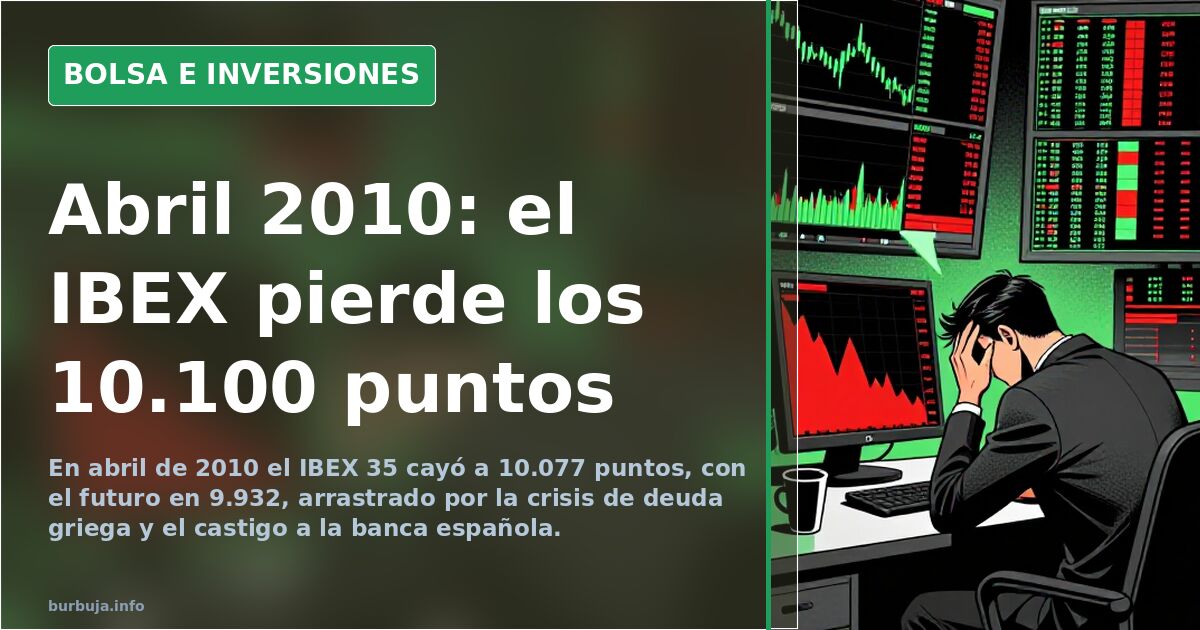
April 2010: IBEX 35 Drops Below 10,100, and No One Knows Where the Bottom Is
Midway through a day in late April 2010, the IBEX 35 screen showed 10,077 points. It wasn't a clean close or a respected support level; it was a low scraped during a session where almost the entire Spanish market was falling simultaneously. Futures, always a step ahead of the narrative, had already touched 9,932. The drop wasn't originating from Madrid. It came from Athens, from rating agencies, and from a dull panic about sovereign debt that, that month, shattered the calm some had taken for granted.
During those days, two things were repeatedly stated: that institutions weren't selling, and that the Spanish index was holding up worse than its European neighbors. Both claims eventually collided with the reality of the trading tape.
The Greek Crisis That Dragged Down the IBEX 35
The trigger had a specific name, and it wasn't Spanish. Morgan Stanley warned that the Greek debt crisis was unleashing a chain of events that could push Germany to leave the euro, with harsh consequences for unwary investors. The note circulated, was translated, and cited endlessly. The market's response wasn't reasonable doubt; it was selling.
Sovereign debt weighed more than corporate earnings. The figures coming from Wall Street were reasonably good, but it didn't matter. Something else ruled in Europe: the Greek bond and suspicion about Spain. Indices moved in sync with any headline about bailouts, haircuts, or exits from the euro. In that environment, technical analysis served to put a number on antiestéticar, not to dissipate it.
The German index clung to a pivot at 6,222 points, while the Spanish one couldn't hold. This seemingly technical difference described something more uncomfortable: when distrust points to Southern Europe, Madrid suffers more than Frankfurt.
Daily Reports on Institutional Trading Volume
One of the most closely trinc contributions that month was a daily report dissecting institutional volume activity on the IBEX. It didn't look at charts or draw lines. It examined who was buying, who was selling, and at what time, attempting to separate big money from retail noise. Each session was summarized with the day's volume (low, normal, high), the final balance (positive or negative), and a reading of intentions.
The method had its charm. It noted if large blocks had bought before 9:30 AM and sold later, if they had disappeared by midday, or if they had made a move during the closing auction. One day, the balance was slightly positive with low volume; the next, significantly negative after a strong sale at 3:00 PM of about 1,400 contracts, which the analyst himself suspected might be a computer error. The usual conclusion was a bet on the next day's opening gap.
And that was precisely the most fragile part of the entire structure. There were days when the reading of intentions anticipated an upward gap, and the market peine lower. Other times, the report warned of a support level in futures, and the futures touched it, bounced briefly, and continued to fall. The manual work was serious. The certainties, considerably less so.
The Day the IBEX Lost 10,100
The collapse unfolded without epic drama. A session with a bearish engulfing pattern wiped out the index and almost all stocks, after a previous close that seemed to signal upward continuation. Targets at the time pointed to 11,000 and then 10,750. The first stop was met in reverse.
The drip turned into a collapse. Santander fell 5.41%. BBVA, 5.74%. Bankinter, another 5.74%. Banco Popular, 6.09%. Ferrovial, 6.57%. Sacyr, 7.19%. FCC, Abertis, Banesto, and Mapfre completed a list of losses rarely seen with such uniformity. It wasn't a cursed penny stock or a company with problems; it was the entire Spanish financial system going through the shredder.
One of the most discussed episodes involved a small stock that dropped 8.4% in a single session. The owner of the shares vowed to copy a sentence a hundred times as penance: he would never buy that stock again. Someone replied that copying it a hundred more times would absolve him. Trench humor for a portfolio in the red.
Wall Street wasn't helping either. The Dow Jones closed down 1.42%, the Nasdaq down 2.02%, and the S&P 500 down 1.67%. With that picture across the Atlantic, the Monday European session was considered lost before it even began.
Why Was the IBEX Falling More Than the DAX or STOXX?
The question loomed over every trading day. Several analyses pointed to a distribution pattern: the index shed shares on rallies and held at lows, repeating almost point by point the behavior shown since 11,350. Those trinc this script warned that if the pattern continued for a few more weeks, the outcome was already written.
And against this, the repeated observation was that institutions were still not becoming sellers, which theoretically limited the damage. The trap: big money wasn't selling in blocks, but the price was falling anyway.
Meanwhile, rating agencies continued to play their role. The downgrade of Spain's AAA rating was met with bitter sarcasm by those who had been warning for months. It wasn't a surprise. It was confirmation that the country was no longer among the untouchables.
The Gap Pool: Predictions That Don't Add Up
During that month, a game with a specific name became popular: guessing the opening gap. Two amateur analysts became references, one betting on upward gaps and the other on downward gaps, and every Friday people voted for their favorite. The problem was the statistics. One of them, according to the circulating count, missed gaps more often than a faulty shotgun, though he nailed support levels. The other almost always covered himself with the formula of contradictory signals.
The exercise had a ritualistic quality. There was talk of a whispering indicator with two sub-indices that sometimes pointed in the same direction and sometimes diverged. When they agreed, everyone was on the same page; when they argued, the debate began. And on Monday, the market resolved it without asking anyone's opinion.
What was revealing was that previous successes had generated excessive confidence. One of the most loyal trinc admitted it after the crash: since February, the hit rate had surpassed that of any professional analyst, and that wasn't normal. No system can sustain that pace forever. When the failure came, it came in a big way.
Brokers, CFDs, and the Fine Print of Leverage
Between one collapse and the next, much of the conversation revolved around practicalities: with whom to trade and at what cost. The recurring names were Interdin, R4, and ING Direct for long-term positions. The underlying complaint was always the same: bank commissions multiplied by four what it cost to trade elsewhere, and on top of that, the bank didn't even allow setting a stop-loss.
CFDs (Contracts for Difference) entered the conversation strongly. The warning was clear: they are leveraged, requiring only 30% to 10% of the margin, so they don't function like normal stocks at all. You win big, and you lose big. And beware of parallel markets, where a spike unrelated to the underlying asset can trigger your stop and take you out of the game without the actual value having moved.
Learning through hard knocks, one person summarized. Whoever wants to use stops learns to use them by losing money first. No one disputed that.
Taxation, Offshore Companies, and the Ghost of Barings
There was also time for tax planning. Discussions arose about whether it's better to donate during life or leave an inheritance, where to establish residency, and why a good tax advisor often comes from a legal rather than an economic background. Someone considered setting up something in Andorra. Another replied that a non-resident company in the UK or Jersey would be better, with the drawback that recovering the money later isn't always easy.
In parallel, someone recalled the story of Nick Leeson and the collapse of Barings in 1994, London's oldest bank, brought down by a single trader. A warning more than fifteen years old that, in April 2010, still sounded quite relevant.
In the end, the figure that is unsettling isn't Greek or German. It's that of an IBEX 35 at 10,181.80 points after weeks of forecasts, volume reports, gap predictions, and institutional analysis. Someone summarized it with the oldest irony in the world: the stock market never goes down; besides, you can always rent or refinance. No one laughed. Or perhaps everyone did, which amounts to the same thing.
Midway through a day in late April 2010, the IBEX 35 screen showed 10,077 points. It wasn't a clean close or a respected support level; it was a low scraped during a session where almost the entire Spanish market was falling simultaneously. Futures, always a step ahead of the narrative, had already touched 9,932. The drop wasn't originating from Madrid. It came from Athens, from rating agencies, and from a dull panic about sovereign debt that, that month, shattered the calm some had taken for granted.
During those days, two things were repeatedly stated: that institutions weren't selling, and that the Spanish index was holding up worse than its European neighbors. Both claims eventually collided with the reality of the trading tape.
The Greek Crisis That Dragged Down the IBEX 35
The trigger had a specific name, and it wasn't Spanish. Morgan Stanley warned that the Greek debt crisis was unleashing a chain of events that could push Germany to leave the euro, with harsh consequences for unwary investors. The note circulated, was translated, and cited endlessly. The market's response wasn't reasonable doubt; it was selling.
Sovereign debt weighed more than corporate earnings. The figures coming from Wall Street were reasonably good, but it didn't matter. Something else ruled in Europe: the Greek bond and suspicion about Spain. Indices moved in sync with any headline about bailouts, haircuts, or exits from the euro. In that environment, technical analysis served to put a number on antiestéticar, not to dissipate it.
The German index clung to a pivot at 6,222 points, while the Spanish one couldn't hold. This seemingly technical difference described something more uncomfortable: when distrust points to Southern Europe, Madrid suffers more than Frankfurt.
Daily Reports on Institutional Trading Volume
One of the most closely trinc contributions that month was a daily report dissecting institutional volume activity on the IBEX. It didn't look at charts or draw lines. It examined who was buying, who was selling, and at what time, attempting to separate big money from retail noise. Each session was summarized with the day's volume (low, normal, high), the final balance (positive or negative), and a reading of intentions.
The method had its charm. It noted if large blocks had bought before 9:30 AM and sold later, if they had disappeared by midday, or if they had made a move during the closing auction. One day, the balance was slightly positive with low volume; the next, significantly negative after a strong sale at 3:00 PM of about 1,400 contracts, which the analyst himself suspected might be a computer error. The usual conclusion was a bet on the next day's opening gap.
And that was precisely the most fragile part of the entire structure. There were days when the reading of intentions anticipated an upward gap, and the market peine lower. Other times, the report warned of a support level in futures, and the futures touched it, bounced briefly, and continued to fall. The manual work was serious. The certainties, considerably less so.
The Day the IBEX Lost 10,100
The collapse unfolded without epic drama. A session with a bearish engulfing pattern wiped out the index and almost all stocks, after a previous close that seemed to signal upward continuation. Targets at the time pointed to 11,000 and then 10,750. The first stop was met in reverse.
The drip turned into a collapse. Santander fell 5.41%. BBVA, 5.74%. Bankinter, another 5.74%. Banco Popular, 6.09%. Ferrovial, 6.57%. Sacyr, 7.19%. FCC, Abertis, Banesto, and Mapfre completed a list of losses rarely seen with such uniformity. It wasn't a cursed penny stock or a company with problems; it was the entire Spanish financial system going through the shredder.
One of the most discussed episodes involved a small stock that dropped 8.4% in a single session. The owner of the shares vowed to copy a sentence a hundred times as penance: he would never buy that stock again. Someone replied that copying it a hundred more times would absolve him. Trench humor for a portfolio in the red.
Wall Street wasn't helping either. The Dow Jones closed down 1.42%, the Nasdaq down 2.02%, and the S&P 500 down 1.67%. With that picture across the Atlantic, the Monday European session was considered lost before it even began.
Why Was the IBEX Falling More Than the DAX or STOXX?
The question loomed over every trading day. Several analyses pointed to a distribution pattern: the index shed shares on rallies and held at lows, repeating almost point by point the behavior shown since 11,350. Those trinc this script warned that if the pattern continued for a few more weeks, the outcome was already written.
And against this, the repeated observation was that institutions were still not becoming sellers, which theoretically limited the damage. The trap: big money wasn't selling in blocks, but the price was falling anyway.
Meanwhile, rating agencies continued to play their role. The downgrade of Spain's AAA rating was met with bitter sarcasm by those who had been warning for months. It wasn't a surprise. It was confirmation that the country was no longer among the untouchables.
The Gap Pool: Predictions That Don't Add Up
During that month, a game with a specific name became popular: guessing the opening gap. Two amateur analysts became references, one betting on upward gaps and the other on downward gaps, and every Friday people voted for their favorite. The problem was the statistics. One of them, according to the circulating count, missed gaps more often than a faulty shotgun, though he nailed support levels. The other almost always covered himself with the formula of contradictory signals.
The exercise had a ritualistic quality. There was talk of a whispering indicator with two sub-indices that sometimes pointed in the same direction and sometimes diverged. When they agreed, everyone was on the same page; when they argued, the debate began. And on Monday, the market resolved it without asking anyone's opinion.
What was revealing was that previous successes had generated excessive confidence. One of the most loyal trinc admitted it after the crash: since February, the hit rate had surpassed that of any professional analyst, and that wasn't normal. No system can sustain that pace forever. When the failure came, it came in a big way.
Brokers, CFDs, and the Fine Print of Leverage
Between one collapse and the next, much of the conversation revolved around practicalities: with whom to trade and at what cost. The recurring names were Interdin, R4, and ING Direct for long-term positions. The underlying complaint was always the same: bank commissions multiplied by four what it cost to trade elsewhere, and on top of that, the bank didn't even allow setting a stop-loss.
CFDs (Contracts for Difference) entered the conversation strongly. The warning was clear: they are leveraged, requiring only 30% to 10% of the margin, so they don't function like normal stocks at all. You win big, and you lose big. And beware of parallel markets, where a spike unrelated to the underlying asset can trigger your stop and take you out of the game without the actual value having moved.
Learning through hard knocks, one person summarized. Whoever wants to use stops learns to use them by losing money first. No one disputed that.
Taxation, Offshore Companies, and the Ghost of Barings
There was also time for tax planning. Discussions arose about whether it's better to donate during life or leave an inheritance, where to establish residency, and why a good tax advisor often comes from a legal rather than an economic background. Someone considered setting up something in Andorra. Another replied that a non-resident company in the UK or Jersey would be better, with the drawback that recovering the money later isn't always easy.
In parallel, someone recalled the story of Nick Leeson and the collapse of Barings in 1994, London's oldest bank, brought down by a single trader. A warning more than fifteen years old that, in April 2010, still sounded quite relevant.
In the end, the figure that is unsettling isn't Greek or German. It's that of an IBEX 35 at 10,181.80 points after weeks of forecasts, volume reports, gap predictions, and institutional analysis. Someone summarized it with the oldest irony in the world: the stock market never goes down; besides, you can always rent or refinance. No one laughed. Or perhaps everyone did, which amounts to the same thing.
Summary of a discussion on Burbuja.info - Foro de economía, actualidad y política., translated from Spanish and reviewed before publication. Read the full discussion (2823 replies).
More summaries
-
April 2012 Ibex: Sacyr at €0.66 and Capital Flight
The Ibex 35 traded between 7,205 and 6,950 points in April 2012, with Sacyr at €0.66 and the worst capital flight of the cycle. Was this the bottom?
-
Ibex 35 in May 2014: Dividends, Penny Stocks, and 25% VAT
May 2014 saw the Ibex 35 pay dividends as VAT threatened to rise to 25%. Penny stocks, capital increases, and a stagnant Santander.
-
Ibex 35 January 2014: Banking Surges as Technical Analysis Targets 9,950
The Ibex 35 rose in January 2014 with banking stocks soaring, while Santander's non-performing loans in Spain reached 7.49% and technical analysis eyed the 9,950 level.
-
Ibex 35 March 2012: The Expected Crash That Never Came
Iberdrola, Gamesa, Sacyr, and the unfulfilled HCH pattern: in March 2012, the Ibex 35 closed near 8,400 points as half the market bet on a crash...
-
Gold stuck at 0.382 as bitcoin takes the spotlight
Gold stuck at 0.382 and unable to recover while bitcoin hits 6.000 dollars; thresholds at 1.250 and 1.050 set the scene.
-
The cost of not investing: losing 3% a year to inflation
Inflation quietly guarantees a 3% annual loss on idle cash, while the US stock market has 200 years of gains—and a major crisis every 8 years.