
IBEX 35: From 11,200 points to battling 8,600 amid Greek crisis
The IBEX hovered around 11,200 points in June 2015 with Greece in uncertainty. Months later, it traded between 8,600 and 8,669 points.
English · Original discussion in Spanish · Published
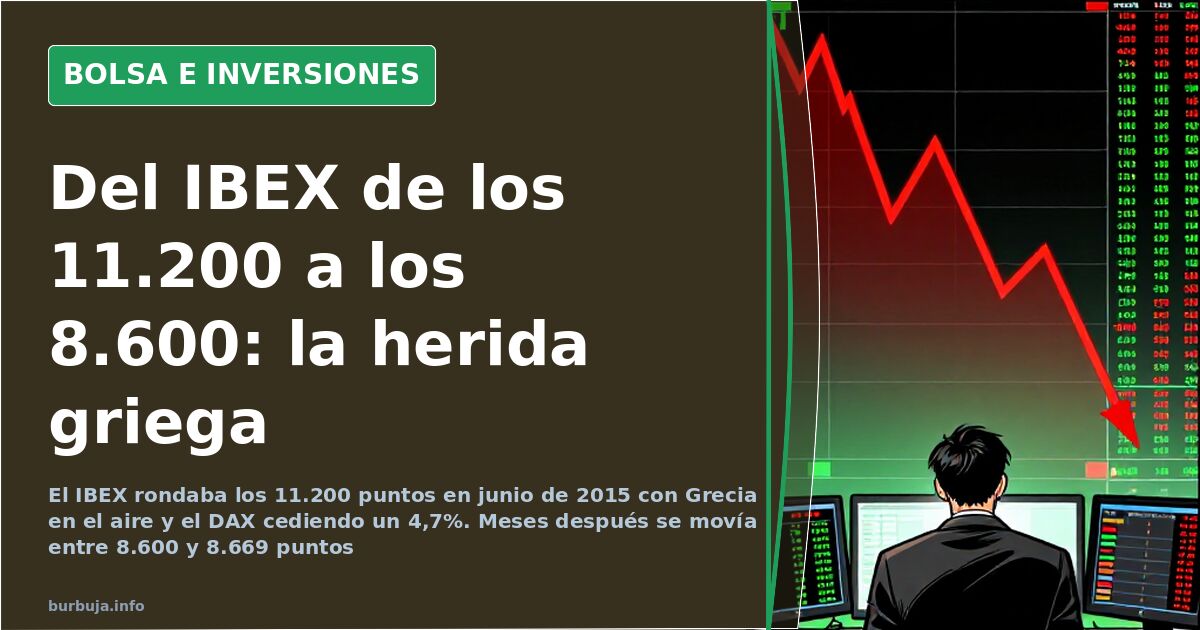
The IBEX fell from over 11,200 to battling 8,600 points
The Greek crisis did not destroy the IBEX; it left it bleeding. In June 2015, the Spanish index was hovering around 11,200 points after a Friday of sharp declines, the German DAX lost 4.7% in a single session, and the Athens stock exchange threatened not to open on Monday. Eighteen months later, the same index was trading in a narrow range between the support of 8,600 points and its 200-day moving average at 8,669. No one declared it dead. It simply stopped rising.
From 11,200 to 8,600: the path Greece peine
The starting point made sense: some expected further drops to buy lower, and that quality fall occurred, though not when anticipated. The Friday before the summer of 2015 began was a disaster to remember, yet the index held on for a few days. Confidence was short-lived. When the IBEX flirted with 11,500 points, entering the market was, in the words of those who did, "a bit Roto-ish". They were right: the index never reached that level again.
The discussion then wasn't about whether a correction would happen, but when. There was talk of a strong support zone at 10,200 points and a pending breakout that never fully materialized. The result is known: the range broke downwards, and the rest of the year was spent testing how deep the hole went.
Why was there antiestéticar the Athens stock market wouldn't open on Monday?
Because Greek officials themselves warned that the market might not function the trinc Monday. That's the crucial detail: the risk was no longer that the IBEX would drop 4%, but that an entire stock exchange would cease trading. With that scenario, the argument that "this could never happen to the IBEX" was based more on emotion than technical analysis, and time proved it wrong.
The drop ultimately remained around 4% for the Spanish index and 4.7% for the DAX, with intraday peaks of 550 points. European stock markets recovered an average of 1% once the results of the Italian referendum were known, confirming a thesis repeated for months: the worst-case scenario was already priced in, and investors had adjusted portfolios according to the polls.
Greece, 30% of the program, and the negotiation bluff
The prevailing conclusion was that Brussels would not demand full compliance with the adjustment program. The circulating figure was specific: they would allow Greece to default on 30%. The euro, meanwhile, remained unfazed. If the threat of exit had been real, the currency would have fallen below the dollar, which it didn't. This contradiction between stock market panic and currency calm was the most honest thermometer of the entire episode.
Another front was open across the Atlantic. The Federal Reserve had been announcing the withdrawal of stimulus for months, and an interest rate hike was expected, but it was repeatedly postponed, first due to weak GDP and then due to a lack of confidence. The dominant cynical calculation was: when the time came, the US would be months away from elections, and there would be no political value in tightening policy.
The IBEX doesn't decide: the DAX and S&P 500 lead
This was one of the few points on which very different voices agreed: the Spanish index trinc others. The German and US indices set the pace, making analyses of IBEX supports and trends largely irrelevant, as decisions were made in Frankfurt and New York. The practical consequence is uncomfortable: Spanish investors were analyzing the wrong chart.
Another, more pessimistic, view held that the problem was structural and that the market moved to benefit intermediaries, with stop-loss raids exploiting any situation. The accusation might be exaggerated. What is undeniable is that throughout the cycle, there was distribution: sales of shares by fund managers and large shareholders. Someone was offloading stock at 2015 prices.
2016: Italian banks, referendum, and new lows
The second act arrived with another referendum, the Italian one, and the banking sector in the spotlight. The IBEX spent nine consecutive sessions confined between 8,600 and 8,669 points, waiting for a breakout to provide direction. When it broke, it was downwards: the index approached a 10% annual drop, and BBVA hit a low of 8.3 euros. The DOW fell by up to 6% in one day, and the S&P 500, which had not tested its 200-day moving average since 2011, came close to doing so.
The damage reached ordinary portfolios. An IBEX-indexed fund lost over 10% in a single week, according to testimony from its holder. Fuel prices, however, continued to fall. Some ironies write themselves.
With the index in the 8,600 range and the Italian referendum resolved, the prevailing bet is that Greece was never the real problem, but rather debt, growth, and a monetary policy that came too late. Those who maintained that the floor was at 8,000 points still haven't explained why the market took a year to stop fluctuating wildly. The range broke, yes. Which way it breaks next remains, as of today, an unknown.
The Greek crisis did not destroy the IBEX; it left it bleeding. In June 2015, the Spanish index was hovering around 11,200 points after a Friday of sharp declines, the German DAX lost 4.7% in a single session, and the Athens stock exchange threatened not to open on Monday. Eighteen months later, the same index was trading in a narrow range between the support of 8,600 points and its 200-day moving average at 8,669. No one declared it dead. It simply stopped rising.
From 11,200 to 8,600: the path Greece peine
The starting point made sense: some expected further drops to buy lower, and that quality fall occurred, though not when anticipated. The Friday before the summer of 2015 began was a disaster to remember, yet the index held on for a few days. Confidence was short-lived. When the IBEX flirted with 11,500 points, entering the market was, in the words of those who did, "a bit Roto-ish". They were right: the index never reached that level again.
The discussion then wasn't about whether a correction would happen, but when. There was talk of a strong support zone at 10,200 points and a pending breakout that never fully materialized. The result is known: the range broke downwards, and the rest of the year was spent testing how deep the hole went.
Why was there antiestéticar the Athens stock market wouldn't open on Monday?
Because Greek officials themselves warned that the market might not function the trinc Monday. That's the crucial detail: the risk was no longer that the IBEX would drop 4%, but that an entire stock exchange would cease trading. With that scenario, the argument that "this could never happen to the IBEX" was based more on emotion than technical analysis, and time proved it wrong.
The drop ultimately remained around 4% for the Spanish index and 4.7% for the DAX, with intraday peaks of 550 points. European stock markets recovered an average of 1% once the results of the Italian referendum were known, confirming a thesis repeated for months: the worst-case scenario was already priced in, and investors had adjusted portfolios according to the polls.
Greece, 30% of the program, and the negotiation bluff
The prevailing conclusion was that Brussels would not demand full compliance with the adjustment program. The circulating figure was specific: they would allow Greece to default on 30%. The euro, meanwhile, remained unfazed. If the threat of exit had been real, the currency would have fallen below the dollar, which it didn't. This contradiction between stock market panic and currency calm was the most honest thermometer of the entire episode.
Another front was open across the Atlantic. The Federal Reserve had been announcing the withdrawal of stimulus for months, and an interest rate hike was expected, but it was repeatedly postponed, first due to weak GDP and then due to a lack of confidence. The dominant cynical calculation was: when the time came, the US would be months away from elections, and there would be no political value in tightening policy.
The IBEX doesn't decide: the DAX and S&P 500 lead
This was one of the few points on which very different voices agreed: the Spanish index trinc others. The German and US indices set the pace, making analyses of IBEX supports and trends largely irrelevant, as decisions were made in Frankfurt and New York. The practical consequence is uncomfortable: Spanish investors were analyzing the wrong chart.
Another, more pessimistic, view held that the problem was structural and that the market moved to benefit intermediaries, with stop-loss raids exploiting any situation. The accusation might be exaggerated. What is undeniable is that throughout the cycle, there was distribution: sales of shares by fund managers and large shareholders. Someone was offloading stock at 2015 prices.
2016: Italian banks, referendum, and new lows
The second act arrived with another referendum, the Italian one, and the banking sector in the spotlight. The IBEX spent nine consecutive sessions confined between 8,600 and 8,669 points, waiting for a breakout to provide direction. When it broke, it was downwards: the index approached a 10% annual drop, and BBVA hit a low of 8.3 euros. The DOW fell by up to 6% in one day, and the S&P 500, which had not tested its 200-day moving average since 2011, came close to doing so.
The damage reached ordinary portfolios. An IBEX-indexed fund lost over 10% in a single week, according to testimony from its holder. Fuel prices, however, continued to fall. Some ironies write themselves.
With the index in the 8,600 range and the Italian referendum resolved, the prevailing bet is that Greece was never the real problem, but rather debt, growth, and a monetary policy that came too late. Those who maintained that the floor was at 8,000 points still haven't explained why the market took a year to stop fluctuating wildly. The range broke, yes. Which way it breaks next remains, as of today, an unknown.
Summary of a discussion on Burbuja.info - Foro de economía, actualidad y política., translated from Spanish and reviewed before publication. Read the full discussion (737 replies).
More summaries
-
IBEX 35 in April 2010: Greek Crisis Plunges Index to 10,077
In April 2010, the IBEX 35 fell to 10,077 points, with futures at 9,932, driven by the Greek debt crisis and the punishment of Spanish banks.
-
IBEX 35 October 2011: Greek haircut and a floor no one signed
In October 2011, the IBEX 35 rose while Greece faced a haircut of up to 60% and Fitch downgraded six banks. No one signed the index's floor.
-
Ibex Falls to 9,918 Amidst Greece and Bankia's Exit
The Ibex closed at 9,918 points in June 2011 with BBVA down 5.46%, while Greece negotiated its bailout and Bankia placed shares with clients...
-
Buying the Dip or Waiting for Crash: The 2025 Market Dilemma
Centene experienced a 25% fall, AI technology is dividing investors, and market crash predictions are mounting for November. The 2025 investment dilemma: buy now or wait?
-
Gold stuck at 0.382 as bitcoin takes the spotlight
Gold stuck at 0.382 and unable to recover while bitcoin hits 6.000 dollars; thresholds at 1.250 and 1.050 set the scene.
-
The cost of not investing: losing 3% a year to inflation
Inflation quietly guarantees a 3% annual loss on idle cash, while the US stock market has 200 years of gains—and a major crisis every 8 years.