
Rome and Spain: Two Empires, One Debate on Legacy
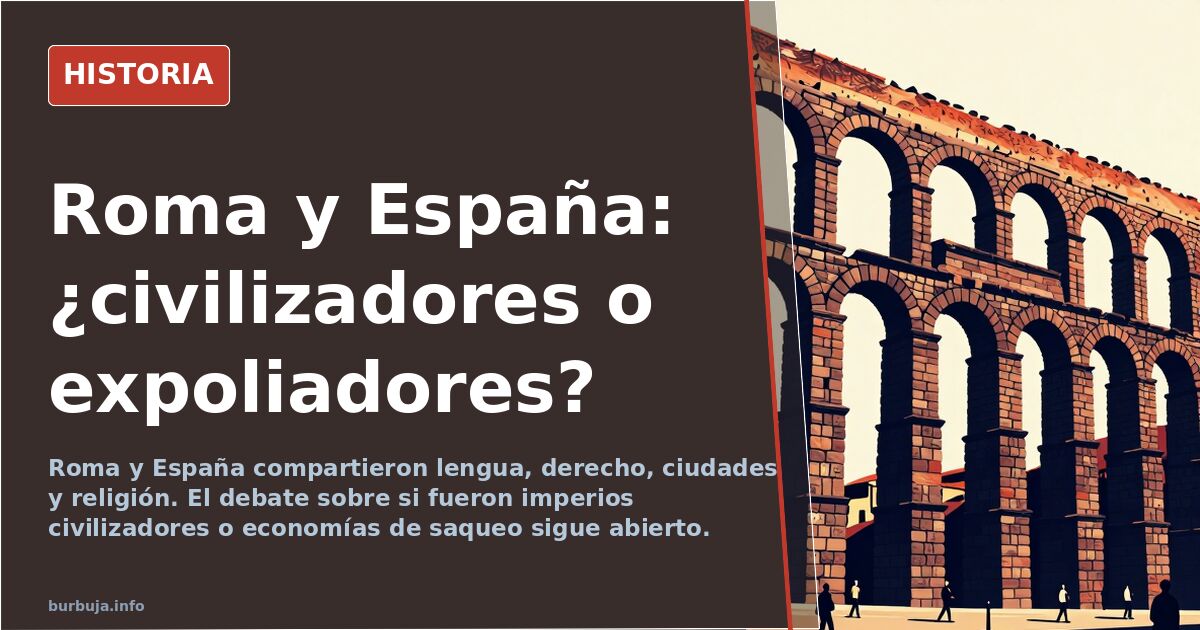
Rome and Spain shared language, law, cities, and religion. The debate over whether they were civilizing empires or extraction economies remains open.
English · Original discussion in Spanish · Published
Rome and Spain: The Parallel That Divides Historians
Two empires separated by fourteen centuries share a common pattern: they founded cities, laid roads, imposed a common language, and spread a religion. The comparison between the Roman Empire and the Spanish Empire in the Americas is not new, but it still sparks controversy. Some see in both a civilizing project that lifted half the world out of tribal fragmentation; others, an extraction economy disguised as a providential mission. Far from being settled, the debate reopens every time someone mentions the word "legacy."
What Rome Left Behind and What Spain Left Behind
The Roman Empire civilized almost all of Europe, extended written language, left a common cultured tongue, and, in its later period, spread Christianity. Its heritage includes Latin, Greco-Roman culture, Roman law, and early Christianity. The Spanish Empire in the Americas, fourteen centuries later, replicated that model: it founded cities, universities, and hospitals, imposed Castilian as the administrative language, and spread Catholicism.
The comparison has enthusiastic defenders. It is argued that both empires were generators, not predators: they incorporated conquered territories into their political and economic structure, created infrastructure, and promoted cultural mixing. In contrast, the British Empire operated differently: coastal trading posts, raw material extraction, and, in many cases, replacement of the native population.
But the parallel has cracks. Rome built amphitheaters, roads, and aqueducts; Spain, churches and bell towers. One participant summarizes with sarcasm: some filled their territory with viaducts, others with universities where they debated whether Purgatory was solid, liquid, or gaseous.
Slave Economy as a Technological Brake
One of the arguments appearing in the discussion is economic. Rome had a slave-based economy sustained by the plundering of provinces and client states. That base, far from being a detail, explains why there was no Industrial Revolution in the 5th century. Machines do not get tired, do not eat every day, and do not rebel. If the argument that slavery hindered mechanization were true, machines would never have been created, since they were replaceable by slaves.
Greco-Roman science was much more advanced than we usually believe. They had measured the Earth's circumference, knew the Archimedes' screw, and handled Greek fire. Roads and the Pax Romana facilitated communications. Why didn't they take the leap? The most repeated hypothesis: they had no rival power threatening them. The Parthians were never a real threat. Without a military technological race, without the need to innovate to survive, the incentive faded.
Spain's Legacy in the Americas: Civilization or Plunder?
The controversy over Spain's legacy is more virulent. Some claim that Spain left in 1820 the most developed and prosperous territory on the planet, with cities, roads, bridges, forts, complete cartography of the known world, and systematic studies of all the languages encountered. The Spanish Empire ensured that millions of people learned that two plus two are not fifteen, one participant summarizes ironically.
The reply comes from the other side: the economy was corrupt, based on plunder and taxes, and basically agricultural. Slaves gave prestige; machines did not. Technical artifacts were made, but only as a means to demonstrate power and glory, without practical application.
The most uncomfortable point: what peine after independence? Defenders of Spain's legacy argue that former British colonies improved upon freeing themselves from the yoke, while Spanish ones, without peninsular direction, devoted themselves to organizing OTI festivals. The Roman heritage was good because most subjects were white, the genetic base was good, it is even said. The British Empire does not leave the same mark in the United States as in India. Nor does the French in Quebec and Senegal.
The Church's Ingratitude and the Myth of the Inquisition
A recurring point is the ingratitude of the Catholic Church towards the two empires to which it owes everything. The Inquisition, it is recalled, was founded in France in the 12th century, not in Spain. The Crusades were declared in the 11th century and participated in mainly by French, Flemish, and Germans. Provincial xenophobic narcissistic hatred feeds on ignorance, one participant concludes.
Against this, Spain's role in the creation of international law, human rights (School of Salamanca and Valladolid controversy), the scientific study of languages (Elio Antonio de Nebrija), and modern capitalist economy, starting with mercantilism, is claimed. The defense of science against Protestant barbarism contrasts with witch burnings and the destruction of libraries.
King Felipe VI and the Title of Roman Emperor
One of the curiosities arising in the discussion is that King Felipe VI is, in fact, the legitimate heir to the title of Roman Emperor. The statement, launched without further context, connects with the idea of historical continuity between Rome and Spain that runs through the entire debate.
The Economic Model: Generator or Predator?
The key distinction that emerges is between generator and predator empires. The generator replicates itself in provinces by incorporating the subjugated society without setting glass ceilings that prevent reaching equality with the natives of the empire. Its economic foundation is symmetrical or tends toward symmetry. The predator creates coastal trading posts from which raw materials and taxes leave and manufacturing and colonial control arrive. Its degree of success, seen today, lies in the exact replacement of the native population by the colonial one.
Rome and Spain, according to this thesis, were generators. The British Empire, a predator. The discussion about which of the two models is superior remains open.
Why Was There No Industrial Revolution in Rome?
The question hangs over the entire debate. The most repeated answer is the absence of real competition. Without rivals threatening its survival, Rome had no need to innovate. Technology existed, but it was not applied. Slaves were cheaper than machines, and machines did not give prestige. The result: centuries of potential advances that never materialized.
And Spain? If the Spanish Empire had defeated its historical rivals (France, England, Holland) and carried out the Industrial Revolution, it would be superior to the Roman one. Since that did not happen, the Roman Empire remains the greatest in history and the Spanish one, the second.
With these elements, the question is not which was better, but whether the legacy justifies the method. And there, everyone chooses their side.
Two empires separated by fourteen centuries share a common pattern: they founded cities, laid roads, imposed a common language, and spread a religion. The comparison between the Roman Empire and the Spanish Empire in the Americas is not new, but it still sparks controversy. Some see in both a civilizing project that lifted half the world out of tribal fragmentation; others, an extraction economy disguised as a providential mission. Far from being settled, the debate reopens every time someone mentions the word "legacy."
What Rome Left Behind and What Spain Left Behind
The Roman Empire civilized almost all of Europe, extended written language, left a common cultured tongue, and, in its later period, spread Christianity. Its heritage includes Latin, Greco-Roman culture, Roman law, and early Christianity. The Spanish Empire in the Americas, fourteen centuries later, replicated that model: it founded cities, universities, and hospitals, imposed Castilian as the administrative language, and spread Catholicism.
The comparison has enthusiastic defenders. It is argued that both empires were generators, not predators: they incorporated conquered territories into their political and economic structure, created infrastructure, and promoted cultural mixing. In contrast, the British Empire operated differently: coastal trading posts, raw material extraction, and, in many cases, replacement of the native population.
But the parallel has cracks. Rome built amphitheaters, roads, and aqueducts; Spain, churches and bell towers. One participant summarizes with sarcasm: some filled their territory with viaducts, others with universities where they debated whether Purgatory was solid, liquid, or gaseous.
Slave Economy as a Technological Brake
One of the arguments appearing in the discussion is economic. Rome had a slave-based economy sustained by the plundering of provinces and client states. That base, far from being a detail, explains why there was no Industrial Revolution in the 5th century. Machines do not get tired, do not eat every day, and do not rebel. If the argument that slavery hindered mechanization were true, machines would never have been created, since they were replaceable by slaves.
Greco-Roman science was much more advanced than we usually believe. They had measured the Earth's circumference, knew the Archimedes' screw, and handled Greek fire. Roads and the Pax Romana facilitated communications. Why didn't they take the leap? The most repeated hypothesis: they had no rival power threatening them. The Parthians were never a real threat. Without a military technological race, without the need to innovate to survive, the incentive faded.
Spain's Legacy in the Americas: Civilization or Plunder?
The controversy over Spain's legacy is more virulent. Some claim that Spain left in 1820 the most developed and prosperous territory on the planet, with cities, roads, bridges, forts, complete cartography of the known world, and systematic studies of all the languages encountered. The Spanish Empire ensured that millions of people learned that two plus two are not fifteen, one participant summarizes ironically.
The reply comes from the other side: the economy was corrupt, based on plunder and taxes, and basically agricultural. Slaves gave prestige; machines did not. Technical artifacts were made, but only as a means to demonstrate power and glory, without practical application.
The most uncomfortable point: what peine after independence? Defenders of Spain's legacy argue that former British colonies improved upon freeing themselves from the yoke, while Spanish ones, without peninsular direction, devoted themselves to organizing OTI festivals. The Roman heritage was good because most subjects were white, the genetic base was good, it is even said. The British Empire does not leave the same mark in the United States as in India. Nor does the French in Quebec and Senegal.
The Church's Ingratitude and the Myth of the Inquisition
A recurring point is the ingratitude of the Catholic Church towards the two empires to which it owes everything. The Inquisition, it is recalled, was founded in France in the 12th century, not in Spain. The Crusades were declared in the 11th century and participated in mainly by French, Flemish, and Germans. Provincial xenophobic narcissistic hatred feeds on ignorance, one participant concludes.
Against this, Spain's role in the creation of international law, human rights (School of Salamanca and Valladolid controversy), the scientific study of languages (Elio Antonio de Nebrija), and modern capitalist economy, starting with mercantilism, is claimed. The defense of science against Protestant barbarism contrasts with witch burnings and the destruction of libraries.
King Felipe VI and the Title of Roman Emperor
One of the curiosities arising in the discussion is that King Felipe VI is, in fact, the legitimate heir to the title of Roman Emperor. The statement, launched without further context, connects with the idea of historical continuity between Rome and Spain that runs through the entire debate.
The Economic Model: Generator or Predator?
The key distinction that emerges is between generator and predator empires. The generator replicates itself in provinces by incorporating the subjugated society without setting glass ceilings that prevent reaching equality with the natives of the empire. Its economic foundation is symmetrical or tends toward symmetry. The predator creates coastal trading posts from which raw materials and taxes leave and manufacturing and colonial control arrive. Its degree of success, seen today, lies in the exact replacement of the native population by the colonial one.
Rome and Spain, according to this thesis, were generators. The British Empire, a predator. The discussion about which of the two models is superior remains open.
Why Was There No Industrial Revolution in Rome?
The question hangs over the entire debate. The most repeated answer is the absence of real competition. Without rivals threatening its survival, Rome had no need to innovate. Technology existed, but it was not applied. Slaves were cheaper than machines, and machines did not give prestige. The result: centuries of potential advances that never materialized.
And Spain? If the Spanish Empire had defeated its historical rivals (France, England, Holland) and carried out the Industrial Revolution, it would be superior to the Roman one. Since that did not happen, the Roman Empire remains the greatest in history and the Spanish one, the second.
With these elements, the question is not which was better, but whether the legacy justifies the method. And there, everyone chooses their side.
Also available in: Deutsch
Summary of a discussion on Burbuja.info - Foro de economía, actualidad y política., translated from Spanish and reviewed before publication. Read the full discussion (133 replies).
More summaries
-
Why the Spanish Empire Collapsed: Neither Traition nor Freemasonry
18 million in the Indies vs 11 million in Spain, compared to 29 million in Japan, reveal why the Spanish Empire could not sustain itself.
-
Did the Spanish Empire Exist? Dynastic Myth vs. Cultural Reality
We analyze the thesis that the Spanish Empire never existed, contrasting dynastic arguments with the enduring strength of the Hispanic cultural substrate.
-
ETA and GAL: two arms of the same Gladio network in Spain
Investigation linking ETA and GAL as arms of the same NATO Gladio network, with drug trafficking funding and CIA control.
-
Spanish uses 'comida' for food, lunch, and eating
In Spain, the word 'comida' covers food, lunch, and meals. The definition of almuerzo as midday meal only entered the RAE dictionary in 1992.
-
Dragut's Skull Tower: Built from 5,000 Spanish Victims
The Tower of Skulls in Djerba, built by Dragut with 5,000 Spanish remains, symbolizes the brutality of 16th-century Mediterranean warfare.
-
Rio de Janeiro in 1932: A European City That Later Declined
In 1932, Rio de Janeiro was clean and orderly. Its GDP per capita doubled Spain's. Sixty years later, the reality changed drastically.