
Huerta de Soto, Milei’s anarcho-capitalist mentor on public payroll
Jesús Huerta de Soto, a Spanish economist and key influence on Javier Milei, advocates abolishing the state while holding a tenured position at a public university.
English · Original discussion in Spanish · Published
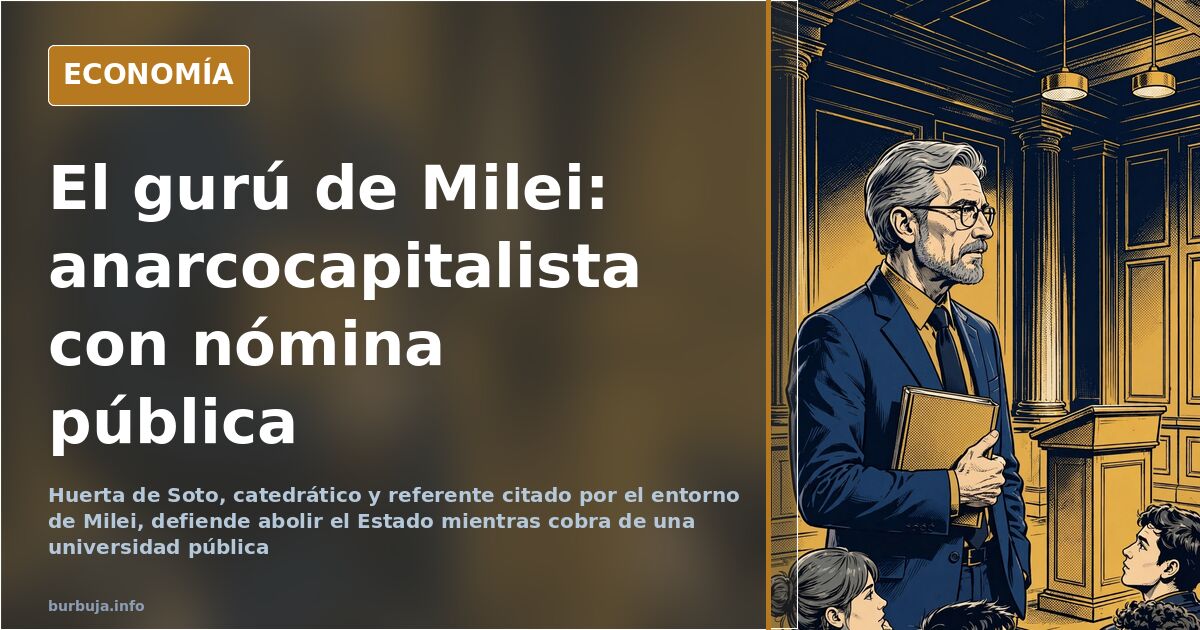
Huerta de Soto: The anarcho-capitalist guru of Milei who draws a state salary
There is a scene that sums up the issue: a Professor of Political Economy at Universidad Rey Juan Carlos, with a net worth critics estimate at €160 million and ten children, teaches at a public university while arguing the state is unnecessary. He is Jesús Huerta of Soto, the intellectual reference that, according to debate narratives, Javier Milei’s circle cites as the inspiration for the Argentine president’s libertarian turn. His figure has sparked a discussion far beyond academia. The paradox is not minor: the man theorizing about abolishing the state gets paid by it. And not just a little, although his professorial salary is trivial compared to his personal fortune, according to those who claim this wealth predates his academic career.
Who is Huerta de Soto and why is he called Milei’s guru?
Huerta de Soto is a Professor of Political Economy at Universidad Rey Juan Carlos in Madrid and one of the leading exponents of the Austrian School of Economics in Spain. His name entered public discourse when he was directly linked to the ideological formation of Javier Milei, President of Argentina. According to the narrative circulating in debates, he taught "everything" to the Argentine leader, a claim some qualify and others openly ridicule. What is true is that the label "anarcho-capitalist" attached to Milei is not an invention of his critics: he has repeatedly identified himself as such, and the doctrine underpinning it has specific names and origins.
Anarcho-capitalism, for those unfamiliar with economics faculties, proposes the complete disappearance of the state and the provision of all its services—security, justice, infrastructure—by private actors. It is a current rooted in authors like Murray Rothbard, and in Spain, Huerta de Soto is its main academic ambassador. That a professor at a public university defends this is no small contradiction, and that is where the debate heats up.
The paradox of the civil servant who wants to abolish the state
The most repeated argument is inconsistency: if the state is so bad, why accept its paycheck? Huerta de Soto is a civil servant, paid by a public university, and according to data used by his critics, has a personal fortune hovering around €160 million. The defense made of him is twofold. First, that his wealth predates his academic career and comes from family businesses, not public salary. Second, that his vocation is teaching and he could earn much more managing his assets than giving classes.
"He has 10 CHILDREN AND A BENTLEY," reads one message that best captures the astonishment. This figure is not trivial: supporting ten children and a luxury car requires wealth that a professor’s salary does not come close to covering. Those defending the professor argue he is donating his time for a fraction of what he would earn in the market. Critics see in him another example of a common figure: the liberal who hates the state but leeches off it.
Anarchist, anarcho-capitalist, or simply liberal: the mess of labels
The discussion over labels is likely the most heated. Calling Milei or Huerta de Soto "anarchists" provokes reactions ranging from laughter to insults. "If Milei is an anarchist, I am from Burundi," summarizes one message. The underlying argument is that classical anarchism, associated with Bakunin and Kropotkin, is a left-wing doctrine aiming to abolish all forms of hierarchy, including market hierarchies. Anarcho-capitalism, conversely, advocates for the disappearance of the state but not for the abolition of private property or economic hierarchies. In fact, some view it as an extreme form of liberalism that would ultimately hand power to large corporations.
"An anarcho-capitalist resembles an anarchist just as a socialist resembles a national socialist," asserts another message. The comparison is exaggerated but illustrates the degree of terminological confusion surrounding the issue. What seems clear is that applying the term "anarchist" to Milei functions more as provocation than rigorous description. And that the confusion is not innocent: it serves to discredit political opponents by attaching a label that sounds like chaos.
The connection to God and the unexpected theological argument
One of the most curious twists in the debate involves religion. It is argued that Huerta de Soto’s philosophical basis is not only economic but also theological: the state cannot replace God. The idea, linking to Bakunin’s critique of divine authority, holds that both God and the state function as supreme bosses dictating how to live. Removing God to install the state does not solve the problem of freedom; it merely changes masters.
This argument confuses friend and foe alike. "So, for an anarchist, God is irreplaceable?" asks one message sarcastically. The paradox is real: an anarcho-capitalist defending divine authority while rejecting state authority. For some, this proves anarcho-capitalism is not anarchism at all, but conservatism with libertarian language. For others, it simply reflects the significant influence of Christian thought within the Austrian School.
The insurance business and the model nobody believes
A criticism goes beyond personal consistency into the economic model. According to debate messages, Huerta de Soto owns an insurance company, and anarcho-capitalism precisely proposes that insurers replace the state in service provision. The suspicion is evident: is he defending a model that directly benefits him? "The real critique is not that he is a civil servant, but that he owns an insurer and defends a model where insurers replace the state," notes that message.
The problem, skeptics say, is that such a model is unworkable in practice. States legally mandate insurance in many circumstances, creating a symbiosis between insurers and regulation that contradicts supposed market freedom. In a scenario without a state, who would guarantee contract compliance? Who would protect the vulnerable? The answers offered by anarcho-capitalism sound, to many, like science fiction.
Milei, Argentina, and the experiment whose outcome remains unknown
Milei’s case adds complexity. A president who identifies as anarcho-capitalist while governing a state he claims to want to destroy. The contradiction is so vast that some see it as strategy: destroying the state from within. Others see simple imposture. "Milei works for Israel," is even said in the debate, mixing economic analysis with conspiracy theories that do little to clarify matters.
What seems fruta is that the Argentine experiment is underway and its results, good or bad, will have global consequences. If it succeeds, anarcho-capitalism will cease to be a seminar utopia and become a real alternative. If it fails, critics will have an unanswerable argument. Meanwhile, the debate over whether Milei is an anarchist, liberal, or mere provocateur will continue to feed pundits and academics.
In the end, the lingering question is not whether Huerta de Soto is a hypocrite for drawing a state salary while criticizing it. That debate is old and likely sterile. The interesting question is why a model proposing the abolition of the state gains traction among those who, precisely, live off it. And the answer, as almost always, has less to do with ideology than with incentives.
There is a scene that sums up the issue: a Professor of Political Economy at Universidad Rey Juan Carlos, with a net worth critics estimate at €160 million and ten children, teaches at a public university while arguing the state is unnecessary. He is Jesús Huerta of Soto, the intellectual reference that, according to debate narratives, Javier Milei’s circle cites as the inspiration for the Argentine president’s libertarian turn. His figure has sparked a discussion far beyond academia. The paradox is not minor: the man theorizing about abolishing the state gets paid by it. And not just a little, although his professorial salary is trivial compared to his personal fortune, according to those who claim this wealth predates his academic career.
Who is Huerta de Soto and why is he called Milei’s guru?
Huerta de Soto is a Professor of Political Economy at Universidad Rey Juan Carlos in Madrid and one of the leading exponents of the Austrian School of Economics in Spain. His name entered public discourse when he was directly linked to the ideological formation of Javier Milei, President of Argentina. According to the narrative circulating in debates, he taught "everything" to the Argentine leader, a claim some qualify and others openly ridicule. What is true is that the label "anarcho-capitalist" attached to Milei is not an invention of his critics: he has repeatedly identified himself as such, and the doctrine underpinning it has specific names and origins.
Anarcho-capitalism, for those unfamiliar with economics faculties, proposes the complete disappearance of the state and the provision of all its services—security, justice, infrastructure—by private actors. It is a current rooted in authors like Murray Rothbard, and in Spain, Huerta de Soto is its main academic ambassador. That a professor at a public university defends this is no small contradiction, and that is where the debate heats up.
The paradox of the civil servant who wants to abolish the state
The most repeated argument is inconsistency: if the state is so bad, why accept its paycheck? Huerta de Soto is a civil servant, paid by a public university, and according to data used by his critics, has a personal fortune hovering around €160 million. The defense made of him is twofold. First, that his wealth predates his academic career and comes from family businesses, not public salary. Second, that his vocation is teaching and he could earn much more managing his assets than giving classes.
"He has 10 CHILDREN AND A BENTLEY," reads one message that best captures the astonishment. This figure is not trivial: supporting ten children and a luxury car requires wealth that a professor’s salary does not come close to covering. Those defending the professor argue he is donating his time for a fraction of what he would earn in the market. Critics see in him another example of a common figure: the liberal who hates the state but leeches off it.
Anarchist, anarcho-capitalist, or simply liberal: the mess of labels
The discussion over labels is likely the most heated. Calling Milei or Huerta de Soto "anarchists" provokes reactions ranging from laughter to insults. "If Milei is an anarchist, I am from Burundi," summarizes one message. The underlying argument is that classical anarchism, associated with Bakunin and Kropotkin, is a left-wing doctrine aiming to abolish all forms of hierarchy, including market hierarchies. Anarcho-capitalism, conversely, advocates for the disappearance of the state but not for the abolition of private property or economic hierarchies. In fact, some view it as an extreme form of liberalism that would ultimately hand power to large corporations.
"An anarcho-capitalist resembles an anarchist just as a socialist resembles a national socialist," asserts another message. The comparison is exaggerated but illustrates the degree of terminological confusion surrounding the issue. What seems clear is that applying the term "anarchist" to Milei functions more as provocation than rigorous description. And that the confusion is not innocent: it serves to discredit political opponents by attaching a label that sounds like chaos.
The connection to God and the unexpected theological argument
One of the most curious twists in the debate involves religion. It is argued that Huerta de Soto’s philosophical basis is not only economic but also theological: the state cannot replace God. The idea, linking to Bakunin’s critique of divine authority, holds that both God and the state function as supreme bosses dictating how to live. Removing God to install the state does not solve the problem of freedom; it merely changes masters.
This argument confuses friend and foe alike. "So, for an anarchist, God is irreplaceable?" asks one message sarcastically. The paradox is real: an anarcho-capitalist defending divine authority while rejecting state authority. For some, this proves anarcho-capitalism is not anarchism at all, but conservatism with libertarian language. For others, it simply reflects the significant influence of Christian thought within the Austrian School.
The insurance business and the model nobody believes
A criticism goes beyond personal consistency into the economic model. According to debate messages, Huerta de Soto owns an insurance company, and anarcho-capitalism precisely proposes that insurers replace the state in service provision. The suspicion is evident: is he defending a model that directly benefits him? "The real critique is not that he is a civil servant, but that he owns an insurer and defends a model where insurers replace the state," notes that message.
The problem, skeptics say, is that such a model is unworkable in practice. States legally mandate insurance in many circumstances, creating a symbiosis between insurers and regulation that contradicts supposed market freedom. In a scenario without a state, who would guarantee contract compliance? Who would protect the vulnerable? The answers offered by anarcho-capitalism sound, to many, like science fiction.
Milei, Argentina, and the experiment whose outcome remains unknown
Milei’s case adds complexity. A president who identifies as anarcho-capitalist while governing a state he claims to want to destroy. The contradiction is so vast that some see it as strategy: destroying the state from within. Others see simple imposture. "Milei works for Israel," is even said in the debate, mixing economic analysis with conspiracy theories that do little to clarify matters.
What seems fruta is that the Argentine experiment is underway and its results, good or bad, will have global consequences. If it succeeds, anarcho-capitalism will cease to be a seminar utopia and become a real alternative. If it fails, critics will have an unanswerable argument. Meanwhile, the debate over whether Milei is an anarchist, liberal, or mere provocateur will continue to feed pundits and academics.
In the end, the lingering question is not whether Huerta de Soto is a hypocrite for drawing a state salary while criticizing it. That debate is old and likely sterile. The interesting question is why a model proposing the abolition of the state gains traction among those who, precisely, live off it. And the answer, as almost always, has less to do with ideology than with incentives.
Summary of a discussion on Burbuja.info - Foro de economía, actualidad y política., translated from Spanish and reviewed before publication. Read the full discussion (151 replies).
More summaries
-
Huerta de Soto breaks down Milei's ten points from Davos in class
Analysis of Milei's Davos speech: from Adam Smith as a lukewarm social democrat to 58% of income seized by the state, with Argentina footing the bill
-
Bizum donations on the street: uncontrolled and unverified
Collecting donations via Bizum on the street leaves donors without receipts or verification of where the money goes. Unproven accusations tarnish the case.
-
Ceuta crisis boosts Vox to second place
Vox gains two points in voting intention amid the Ceuta border crisis, challenging its potential as Spain's second political force despite electoral system hurdles.
-
German twins Kessler die together at 89 in Bavaria
Alice and Ellen Kessler, the German Eurovision 1959 duo, died together at 89 in Bavaria; police suspect legal assisted suicide.
-
ISIS claims Moscow attack that killed 143 people
ISIS claimed responsibility for the Crocus City Hall attack in Russia, killing 143, two weeks after US warnings of an imminent threat.
-
Nadal argues athletes should earn based on revenue generated
In an interview with Ana Pastor, Rafael Nadal criticized extreme feminism and defended merit-based pay for athletes.